Reading passage · Geography
Why Papua New Guinea has so many languages · Grades 10–11
An original passage about languages, religions and cultures with 7 questions that check details, inference and vocabulary.
- Grades 10–11 · ages 15 to 17
- Medium
- 45 to 55 minutes
- 3 pages
- Free
The answer key is a separate page for grown-ups. Sign in to download it.
The passage and its 7 questions
Directions: Read the passage carefully. Then answer the questions in full sentences.
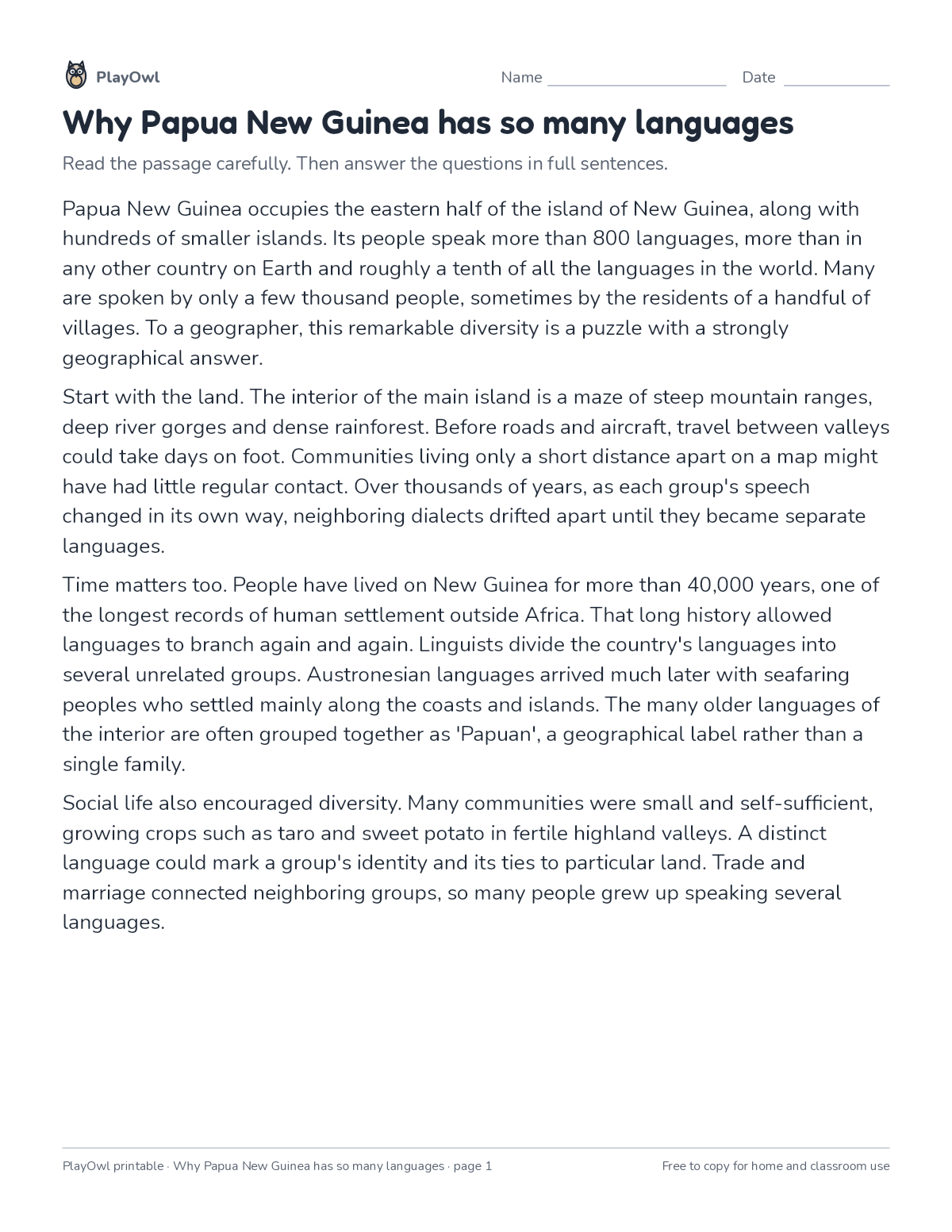
- Papua New Guinea occupies the eastern half of the island of New Guinea, along with hundreds of smaller islands. Its people speak more than 800 languages, more than in any other country on Earth and roughly a tenth of all the languages in the world. Many are spoken by only a few thousand people, sometimes by the residents of a handful of villages. To a geographer, this remarkable diversity is a puzzle with a strongly geographical answer.
- Start with the land. The interior of the main island is a maze of steep mountain ranges, deep river gorges and dense rainforest. Before roads and aircraft, travel between valleys could take days on foot. Communities living only a short distance apart on a map might have had little regular contact. Over thousands of years, as each group's speech changed in its own way, neighboring dialects drifted apart until they became separate languages.
- Time matters too. People have lived on New Guinea for more than 40,000 years, one of the longest records of human settlement outside Africa. That long history allowed languages to branch again and again. Linguists divide the country's languages into several unrelated groups. Austronesian languages arrived much later with seafaring peoples who settled mainly along the coasts and islands. The many older languages of the interior are often grouped together as 'Papuan', a geographical label rather than a single family.
- Social life also encouraged diversity. Many communities were small and self-sufficient, growing crops such as taro and sweet potato in fertile highland valleys. A distinct language could mark a group's identity and its ties to particular land. Trade and marriage connected neighboring groups, so many people grew up speaking several languages.
- Today the country has four official languages: English, Tok Pisin, Hiri Motu and Papua
- New Guinea Sign Language. Tok Pisin, a creole that grew out of contact between local people, traders and plantation workers, now serves as a lingua franca across much of the nation. Some linguists worry that as young people move to towns and adopt Tok
- Pisin or English, many smaller languages could fade within a few generations.
- Communities and researchers are recording stories, songs and word lists so that this extraordinary heritage is not lost.
- 1. Roughly how many languages are spoken in Papua New Guinea, and what share of the world's languages is that?
- 2. Explain how the physical landscape helped create so many separate languages.
- 3. What does the word 'self-sufficient' mean in paragraph 4?
- 4. Why is 'Papuan' described as a geographical label rather than a single language family?
- 5. Why might moving to towns threaten smaller languages?
- 6. Copy the sentence that describes efforts to protect the country's languages.
- 7. Explain how the passage connects to a current issue or another text you know.
What your child practices
Your child practices geography for Grades 10–11 with this reading passage.
- Grades and ages
- Grades 10–11, ages 15 to 17
- Time
- About 45 to 55 minutes
- Subject
- Geography
- Level
- Medium for Grades 10–11
- Answer key
- Yes, for grown-ups who sign in
- Printing
- 3 pages, US Letter or A4, low-ink option
- Updated
How to use it
Read the passage once just for the story or the facts, then again with the questions in mind. Encourage underlining the words in the text that back up each answer. It is pitched at the expected level for Grades 10–11, for practice after the topic has been taught. Its 3 pages split well across two sittings.
An answer key comes with it as a separate page that grown-ups download after signing in.
Tip for grown-ups: Ask your child to point to the sentence that answers each question before writing it.
Done on paper? A grown-up can record it on the child's page in PlayOwl; downloading alone doesn't count as finished.
Geography · Grades 10–11
More like this
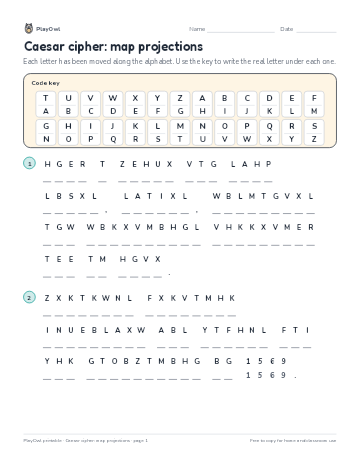 Caesar cipher: map projections
Geography · Grade 10 · Puzzle · 1 page
Caesar cipher: map projections
Geography · Grade 10 · Puzzle · 1 page
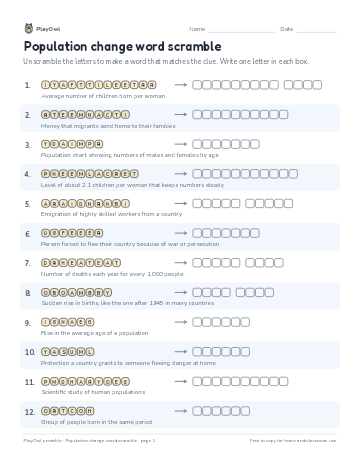 Population change word scramble
Geography · Grade 10 · Puzzle · 1 page
Population change word scramble
Geography · Grade 10 · Puzzle · 1 page
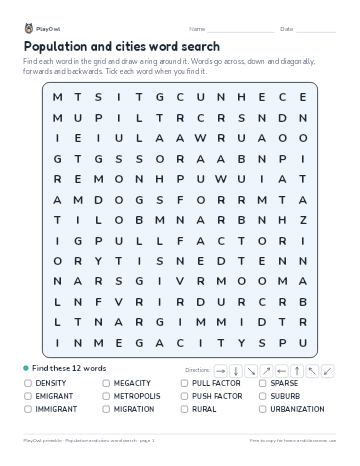 Population and cities word search
Geography · Grade 10 · Puzzle · 1 page
Population and cities word search
Geography · Grade 10 · Puzzle · 1 page
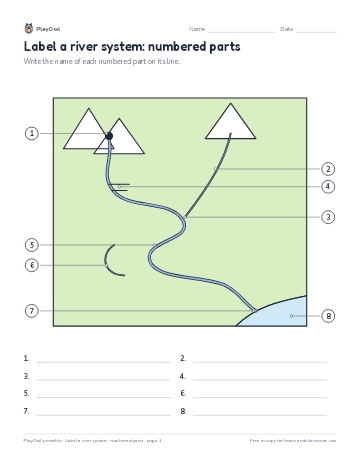 Label a river system: numbered parts
Geography · 8–10 · Worksheet · 1 page
Label a river system: numbered parts
Geography · 8–10 · Worksheet · 1 page
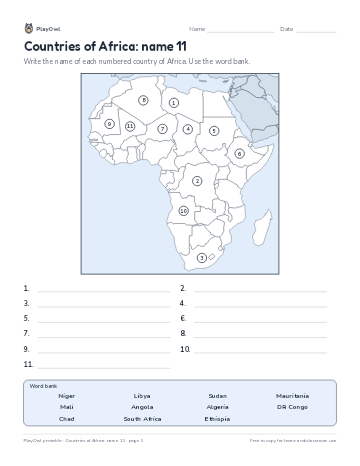 Countries of Africa: name 11
Geography · Grade 10 · Map · 1 page
Countries of Africa: name 11
Geography · Grade 10 · Map · 1 page
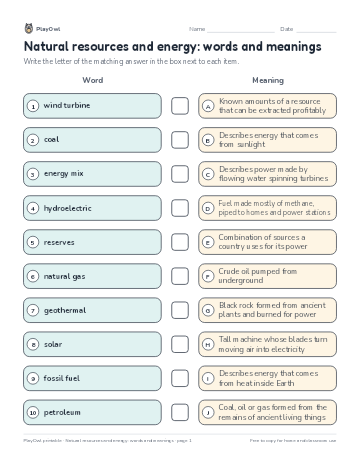 Natural resources and energy: words and meanings
Geography · Grade 11 · Worksheet · 1 page
Natural resources and energy: words and meanings
Geography · Grade 11 · Worksheet · 1 page
Printable generator
Make your own printables
Make brand-new sheets like this one, with answer keys, using the printable generator that comes with a PlayOwl plan. This sheet stays free.