Reading passage · History, Civics & Social Studies
The Montgomery bus boycott · Grade 11
An original passage about the civil rights movement with 7 questions that check details, inference and vocabulary.
- Grade 11 · ages 16 to 17
- Medium
- 45 to 55 minutes
- 3 pages
- Free
The answer key is a separate page for grown-ups. Sign in to download it.
The passage and its 7 questions
Directions: Read the passage carefully. Then answer the questions in full sentences.
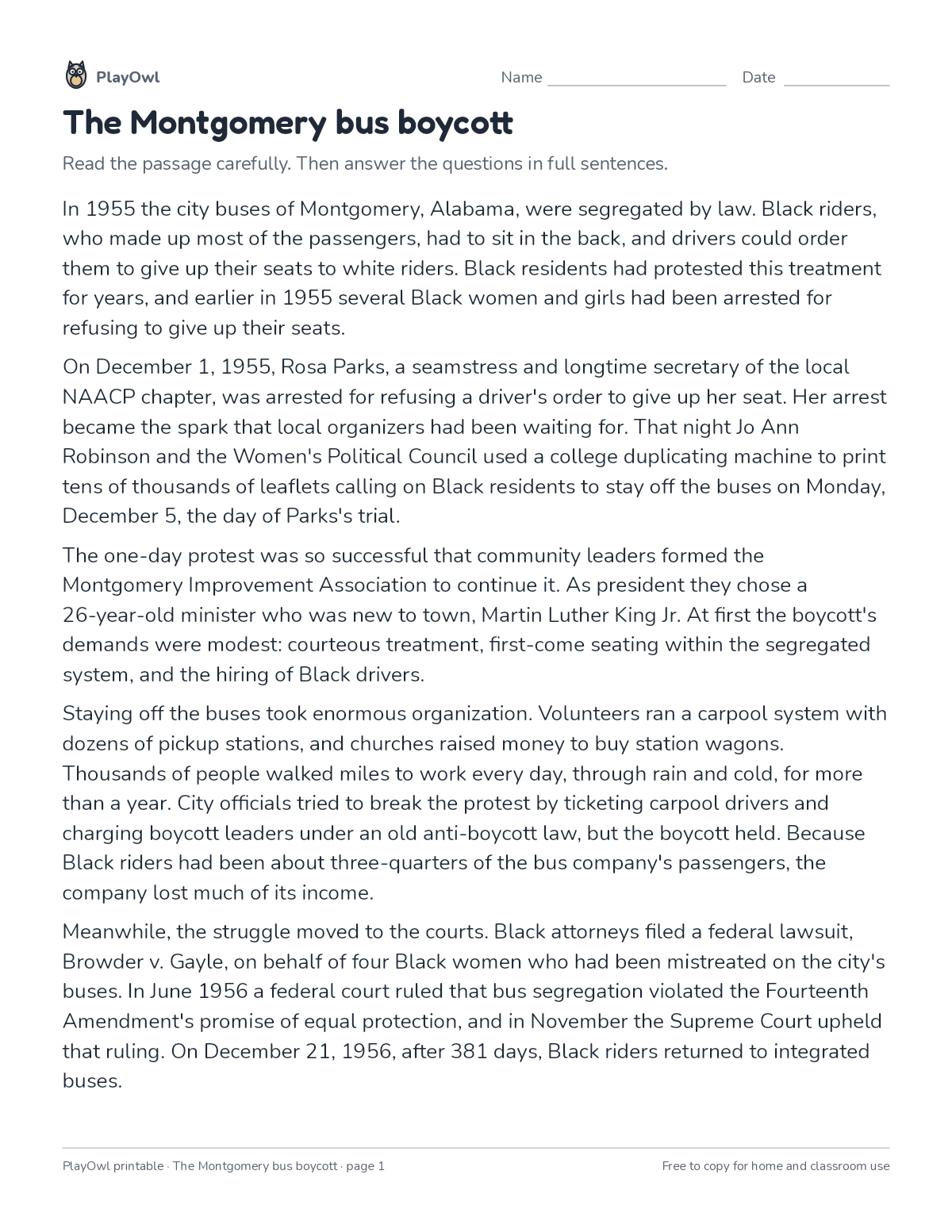
- In 1955 the city buses of Montgomery, Alabama, were segregated by law. Black riders, who made up most of the passengers, had to sit in the back, and drivers could order them to give up their seats to white riders. Black residents had protested this treatment for years, and earlier in 1955 several Black women and girls had been arrested for refusing to give up their seats.
- On December 1, 1955, Rosa Parks, a seamstress and longtime secretary of the local
- NAACP chapter, was arrested for refusing a driver's order to give up her seat. Her arrest became the spark that local organizers had been waiting for. That night Jo Ann
- Robinson and the Women's Political Council used a college duplicating machine to print tens of thousands of leaflets calling on Black residents to stay off the buses on Monday,
- December 5, the day of Parks's trial.
- The one-day protest was so successful that community leaders formed the
- Montgomery Improvement Association to continue it. As president they chose a
- 26-year-old minister who was new to town, Martin Luther King Jr. At first the boycott's demands were modest: courteous treatment, first-come seating within the segregated system, and the hiring of Black drivers.
- Staying off the buses took enormous organization. Volunteers ran a carpool system with dozens of pickup stations, and churches raised money to buy station wagons.
- Thousands of people walked miles to work every day, through rain and cold, for more than a year. City officials tried to break the protest by ticketing carpool drivers and charging boycott leaders under an old anti-boycott law, but the boycott held. Because
- Black riders had been about three-quarters of the bus company's passengers, the company lost much of its income.
- Meanwhile, the struggle moved to the courts. Black attorneys filed a federal lawsuit,
- Browder v. Gayle, on behalf of four Black women who had been mistreated on the city's buses. In June 1956 a federal court ruled that bus segregation violated the Fourteenth
- Amendment's promise of equal protection, and in November the Supreme Court upheld that ruling. On December 21, 1956, after 381 days, Black riders returned to integrated buses.
- The boycott showed that ordinary people, acting together and without violence, could apply both economic and legal pressure for change. It also introduced the nation to new leaders and inspired protests across the South in the years that followed.
- 1. What was the immediate cause of the boycott?
- 2. Why did the boycott hurt the bus company financially?
- 3. Explain how the movement combined economic pressure with legal action.
- 4. In paragraph 3, what does 'modest' mean as used to describe the first demands?
- 5. Why does the author call Parks's arrest 'the spark that local organizers had been waiting for'?
- 6. If you wanted to verify how people got to work during the boycott, what primary sources might you look for?
- 7. Rewrite the opening sentence for a different audience and explain your choices.
What your child practices
Your child practices the history and social studies skill “Change, continuity and causation”: describe how and why things changed over time and compare perspectives.
- Grades and ages
- Grade 11, ages 16 to 17
- Time
- About 45 to 55 minutes
- Subject
- History, Civics & Social Studies
- Level
- Medium for Grade 11
- Answer key
- Yes, for grown-ups who sign in
- Printing
- 3 pages, US Letter or A4, low-ink option
- Updated
How to use it
Read the passage once just for the story or the facts, then again with the questions in mind. Encourage underlining the words in the text that back up each answer. It is pitched at the expected level for Grade 11, for practice after the skill has been taught. Its 3 pages split well across two sittings.
An answer key comes with it as a separate page that grown-ups download after signing in.
Tip for grown-ups: Ask your child to point to the sentence that answers each question before writing it.
Done on paper? A grown-up can record it on the child's page in PlayOwl; downloading alone doesn't count as finished.
History, Civics & Social Studies · Grade 11
More like this
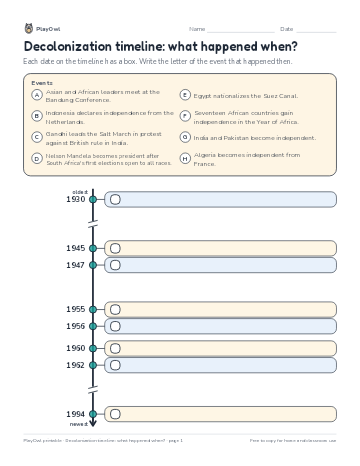 Decolonization timeline: what happened when?
History, Civics & Social Studies · Grade 11 · Worksheet · 1 page
Decolonization timeline: what happened when?
History, Civics & Social Studies · Grade 11 · Worksheet · 1 page
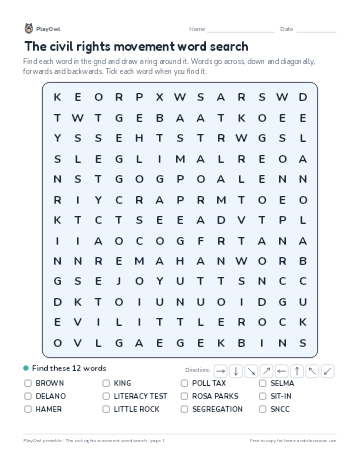 The civil rights movement word search
History, Civics & Social Studies · Grade 10 · Puzzle · 1 page
The civil rights movement word search
History, Civics & Social Studies · Grade 10 · Puzzle · 1 page
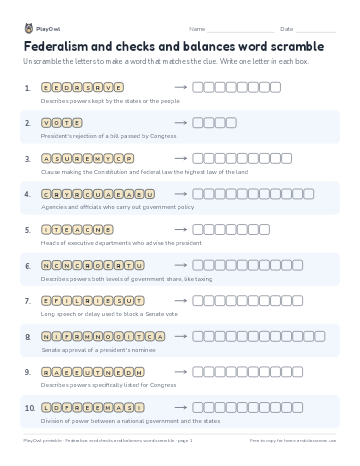 Federalism and checks and balances word scramble
History, Civics & Social Studies · Grade 11 · Puzzle · 1 page
Federalism and checks and balances word scramble
History, Civics & Social Studies · Grade 11 · Puzzle · 1 page
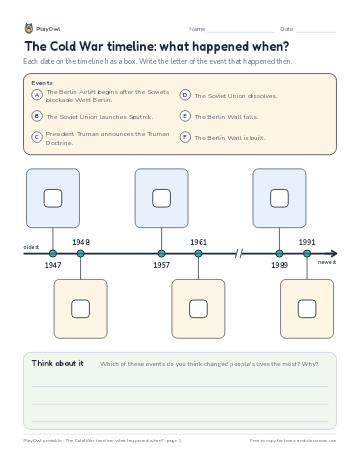 The Cold War timeline: what happened when?
History, Civics & Social Studies · Grade 11 · Worksheet · 1 page
The Cold War timeline: what happened when?
History, Civics & Social Studies · Grade 11 · Worksheet · 1 page
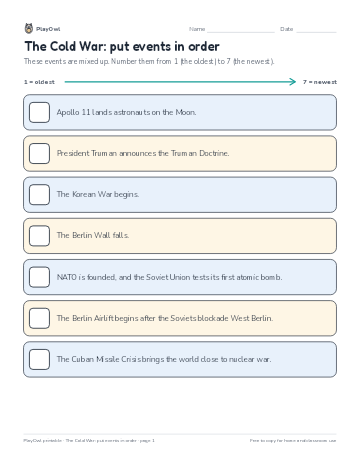 The Cold War: put events in order
History, Civics & Social Studies · Grade 12 · Worksheet · 1 page
The Cold War: put events in order
History, Civics & Social Studies · Grade 12 · Worksheet · 1 page
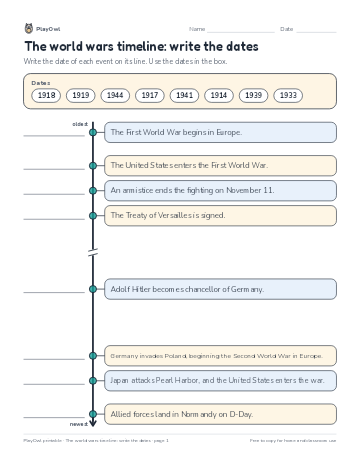 The world wars timeline: write the dates
History, Civics & Social Studies · Grade 11 · Worksheet · 1 page
The world wars timeline: write the dates
History, Civics & Social Studies · Grade 11 · Worksheet · 1 page
Printable generator
Make your own printables
Make brand-new sheets like this one, with answer keys, using the printable generator that comes with a PlayOwl plan. This sheet stays free.