Reading passage · History, Civics & Social Studies
How the Marshall Plan worked · Grade 12
An original passage about the Cold War with 7 questions that check details, inference and vocabulary.
- Grade 12 · ages 17 to 18
- Medium
- 45 to 55 minutes
- 3 pages
- Free
The answer key is a separate page for grown-ups. Sign in to download it.
The passage and its 7 questions
Directions: Read the passage carefully. Then answer the questions in full sentences.
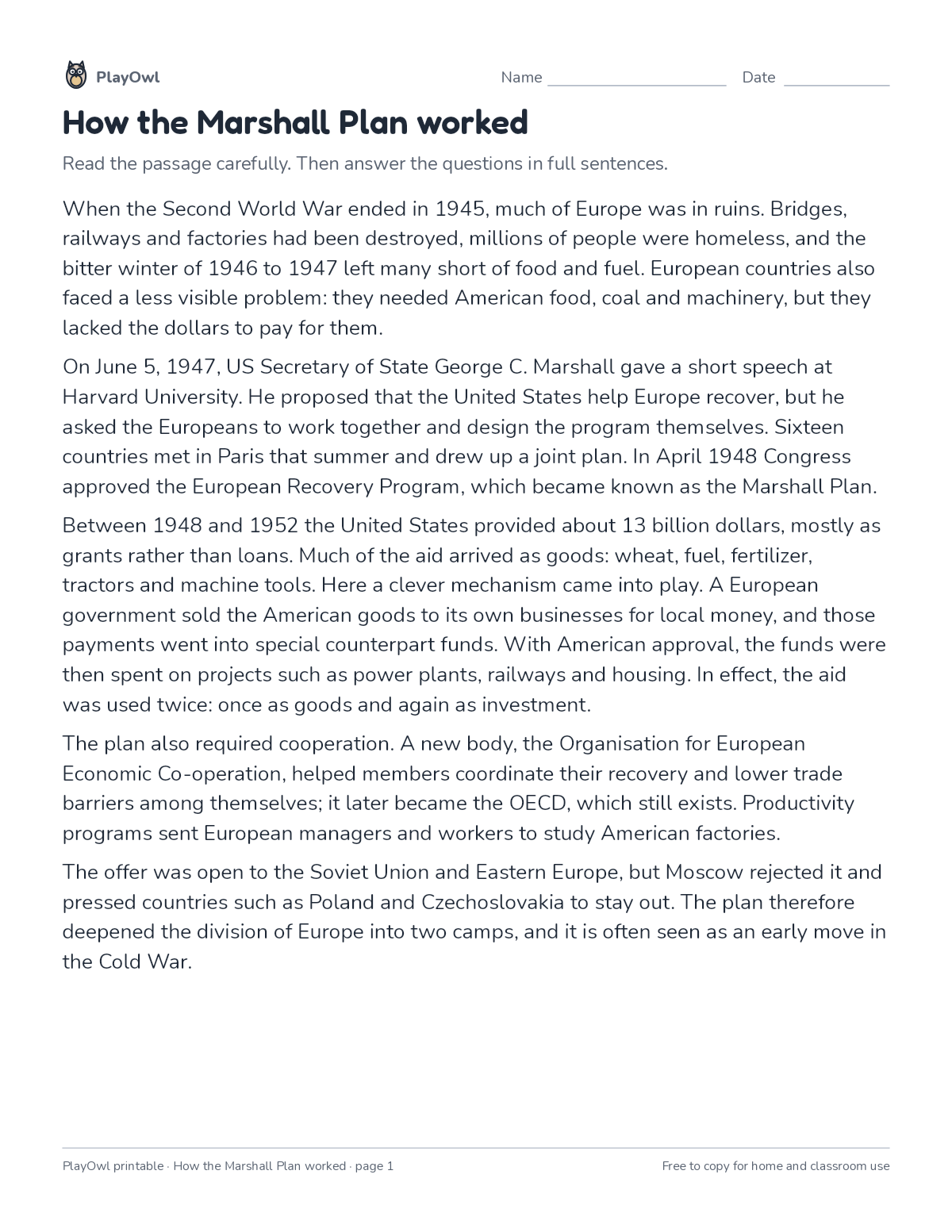
- When the Second World War ended in 1945, much of Europe was in ruins. Bridges, railways and factories had been destroyed, millions of people were homeless, and the bitter winter of 1946 to 1947 left many short of food and fuel. European countries also faced a less visible problem: they needed American food, coal and machinery, but they lacked the dollars to pay for them.
- On June 5, 1947, US Secretary of State George C. Marshall gave a short speech at
- Harvard University. He proposed that the United States help Europe recover, but he asked the Europeans to work together and design the program themselves. Sixteen countries met in Paris that summer and drew up a joint plan. In April 1948 Congress approved the European Recovery Program, which became known as the Marshall Plan.
- Between 1948 and 1952 the United States provided about 13 billion dollars, mostly as grants rather than loans. Much of the aid arrived as goods: wheat, fuel, fertilizer, tractors and machine tools. Here a clever mechanism came into play. A European government sold the American goods to its own businesses for local money, and those payments went into special counterpart funds. With American approval, the funds were then spent on projects such as power plants, railways and housing. In effect, the aid was used twice: once as goods and again as investment.
- The plan also required cooperation. A new body, the Organisation for European
- Economic Co-operation, helped members coordinate their recovery and lower trade barriers among themselves; it later became the OECD, which still exists. Productivity programs sent European managers and workers to study American factories.
- The offer was open to the Soviet Union and Eastern Europe, but Moscow rejected it and pressed countries such as Poland and Czechoslovakia to stay out. The plan therefore deepened the division of Europe into two camps, and it is often seen as an early move in the Cold War.
- How much did the plan matter? Historians disagree. Some argue that Western
- European recovery was already under way and that the aid, equal to only a few percent of the receiving countries' total output, could not have caused it alone. Others stress that the dollars arrived at a critical moment, easing shortages, encouraging cooperation and building confidence. Most agree that the plan's political effects, binding Western
- Europe and the United States closely together, were as important as its economic ones.
- 1. Besides physical destruction, what economic problem did Europe face after the war?
- 2. Explain how counterpart funds let the aid be used twice.
- 3. Why do you think Marshall asked European countries to design the program themselves?
- 4. In paragraph 3, what does 'mechanism' mean?
- 5. How did the Marshall Plan contribute to the division of Europe?
- 6. Summarize the two views historians hold about the plan's importance and the evidence each side uses.
- 7. Analyze how the author structures the passage to build an argument or explanation.
What your child practices
Your child practices the history and social studies skill “Change, continuity and causation”: describe how and why things changed over time and compare perspectives.
- Grades and ages
- Grade 12, ages 17 to 18
- Time
- About 45 to 55 minutes
- Subject
- History, Civics & Social Studies
- Level
- Medium for Grade 12
- Answer key
- Yes, for grown-ups who sign in
- Printing
- 3 pages, US Letter or A4, low-ink option
- Updated
How to use it
Read the passage once just for the story or the facts, then again with the questions in mind. Encourage underlining the words in the text that back up each answer. It is pitched at the expected level for Grade 12, for practice after the skill has been taught. Its 3 pages split well across two sittings.
An answer key comes with it as a separate page that grown-ups download after signing in.
Tip for grown-ups: Ask your child to point to the sentence that answers each question before writing it.
Done on paper? A grown-up can record it on the child's page in PlayOwl; downloading alone doesn't count as finished.
History, Civics & Social Studies · Grade 12
More like this
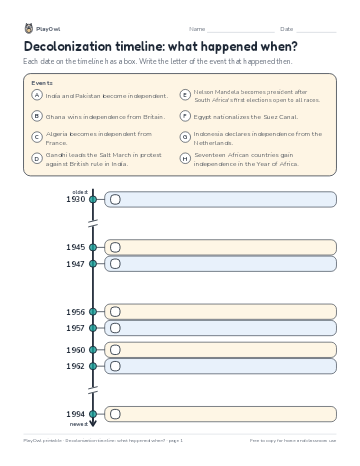 Decolonization timeline: what happened when?
History, Civics & Social Studies · Grade 12 · Worksheet · 1 page
Decolonization timeline: what happened when?
History, Civics & Social Studies · Grade 12 · Worksheet · 1 page
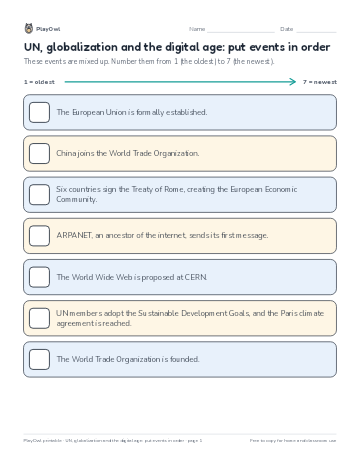 UN, globalization and the digital age: put events in order
History, Civics & Social Studies · Grade 11 · Worksheet · 1 page
UN, globalization and the digital age: put events in order
History, Civics & Social Studies · Grade 11 · Worksheet · 1 page
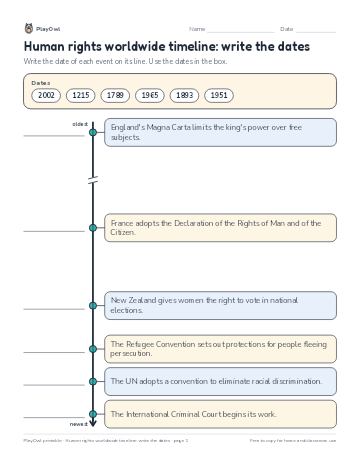 Human rights worldwide timeline: write the dates
History, Civics & Social Studies · Grade 12 · Worksheet · 1 page
Human rights worldwide timeline: write the dates
History, Civics & Social Studies · Grade 12 · Worksheet · 1 page
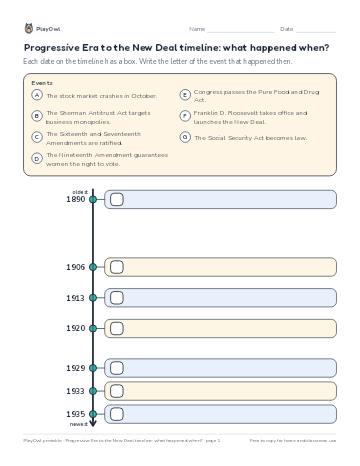 Progressive Era to the New Deal timeline: what happened when?
History, Civics & Social Studies · Grade 10 · Worksheet · 1 page
Progressive Era to the New Deal timeline: what happened when?
History, Civics & Social Studies · Grade 10 · Worksheet · 1 page
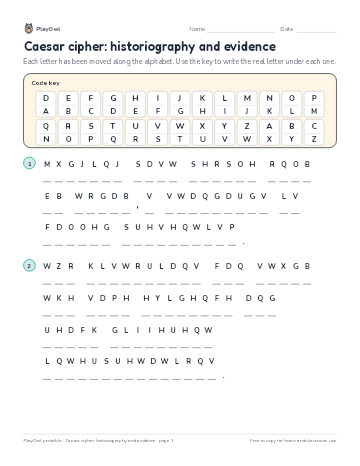 Caesar cipher: historiography and evidence
History, Civics & Social Studies · Grade 12 · Puzzle · 1 page
Caesar cipher: historiography and evidence
History, Civics & Social Studies · Grade 12 · Puzzle · 1 page
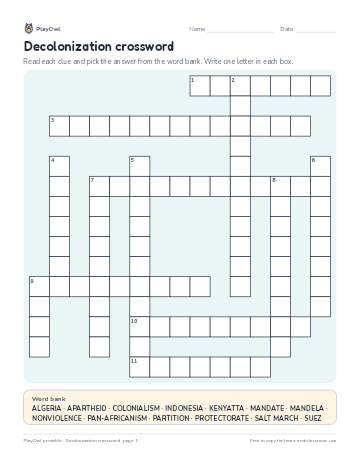 Decolonization crossword
History, Civics & Social Studies · Grade 10 · Puzzle · 2 pages
Decolonization crossword
History, Civics & Social Studies · Grade 10 · Puzzle · 2 pages
Printable generator
Make your own printables
Make brand-new sheets like this one, with answer keys, using the printable generator that comes with a PlayOwl plan. This sheet stays free.