Reading passage · History, Civics & Social Studies
How a bill becomes a law: warm-up · Grade 3
An original passage about three branches of government with 4 questions that check details, inference and vocabulary.
- Grade 3 · ages 8 to 9
- Easy
- 20 to 30 minutes
- 2 pages
- Free
The answer key is a separate page for grown-ups. Sign in to download it.
The passage and its 4 questions
Directions: Read the passage carefully. Then answer the questions in full sentences.
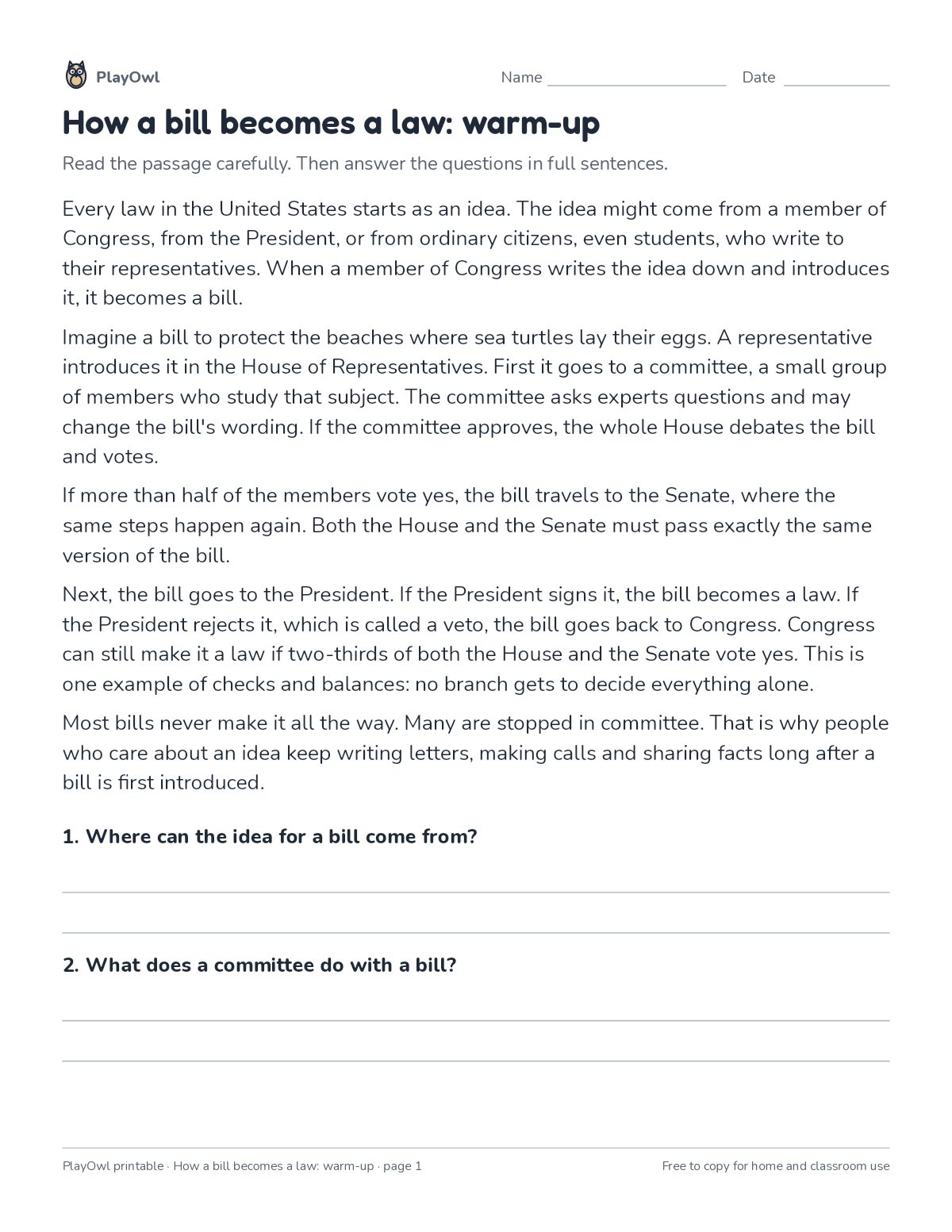
- Every law in the United States starts as an idea. The idea might come from a member of
- Congress, from the President, or from ordinary citizens, even students, who write to their representatives. When a member of Congress writes the idea down and introduces it, it becomes a bill.
- Imagine a bill to protect the beaches where sea turtles lay their eggs. A representative introduces it in the House of Representatives. First it goes to a committee, a small group of members who study that subject. The committee asks experts questions and may change the bill's wording. If the committee approves, the whole House debates the bill and votes.
- If more than half of the members vote yes, the bill travels to the Senate, where the same steps happen again. Both the House and the Senate must pass exactly the same version of the bill.
- Next, the bill goes to the President. If the President signs it, the bill becomes a law. If the President rejects it, which is called a veto, the bill goes back to Congress. Congress can still make it a law if two-thirds of both the House and the Senate vote yes. This is one example of checks and balances: no branch gets to decide everything alone.
- Most bills never make it all the way. Many are stopped in committee. That is why people who care about an idea keep writing letters, making calls and sharing facts long after a bill is first introduced.
- 1. Where can the idea for a bill come from?
- 2. What does a committee do with a bill?
- 3. What does the word 'veto' mean in paragraph 4?
- 4. What is the author's purpose: to inform, to entertain or to persuade? Explain.
What your child practices
Your child practices the history and social studies skill “Rules, government and participation”: explain how rules, institutions and civic participation work at different levels.
- Grades and ages
- Grade 3, ages 8 to 9
- Time
- About 20 to 30 minutes
- Subject
- History, Civics & Social Studies
- Level
- Easy for Grade 3
- Answer key
- Yes, for grown-ups who sign in
- Printing
- 2 pages, US Letter or A4, low-ink option
- Updated
How to use it
Read the passage once just for the story or the facts, then again with the questions in mind. Encourage underlining the words in the text that back up each answer. It is one of the easier sheets for Grade 3, good as a warm-up or a first look at the skill. Its 2 pages split well across two sittings.
An answer key comes with it as a separate page that grown-ups download after signing in.
Tip for grown-ups: Ask your child to point to the sentence that answers each question before writing it.
Done on paper? A grown-up can record it on the child's page in PlayOwl; downloading alone doesn't count as finished.
History, Civics & Social Studies · Grade 3
More like this
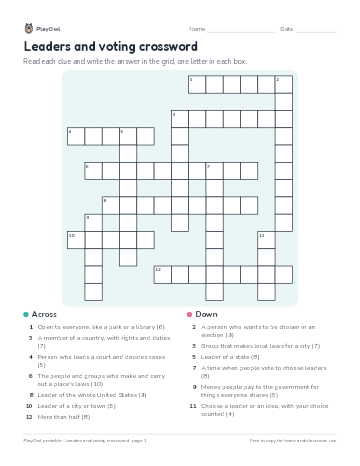 Leaders and voting crossword
History, Civics & Social Studies · Grade 3 · Puzzle · 1 page
Leaders and voting crossword
History, Civics & Social Studies · Grade 3 · Puzzle · 1 page
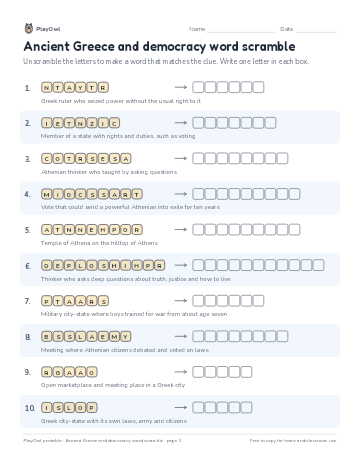 Ancient Greece and democracy word scramble
History, Civics & Social Studies · Grade 7 · Puzzle · 1 page
Ancient Greece and democracy word scramble
History, Civics & Social Studies · Grade 7 · Puzzle · 1 page
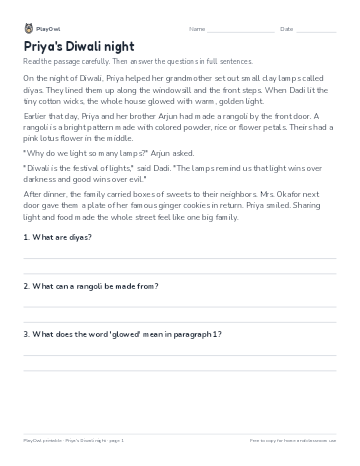 Priya's Diwali night
History, Civics & Social Studies · 1–3 · Reading · 2 pages
Priya's Diwali night
History, Civics & Social Studies · 1–3 · Reading · 2 pages
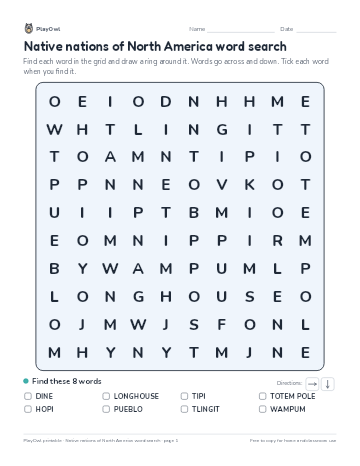 Native nations of North America word search
History, Civics & Social Studies · Grade 3 · Puzzle · 1 page
Native nations of North America word search
History, Civics & Social Studies · Grade 3 · Puzzle · 1 page
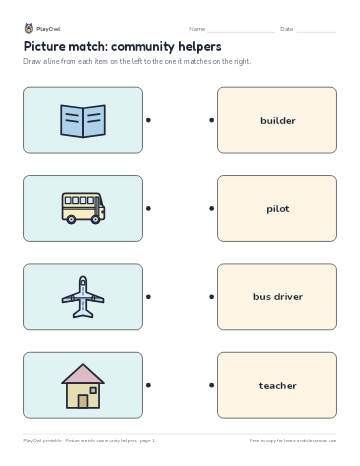 Picture match: community helpers
History, Civics & Social Studies · Kindergarten · Worksheet · 1 page
Picture match: community helpers
History, Civics & Social Studies · Kindergarten · Worksheet · 1 page
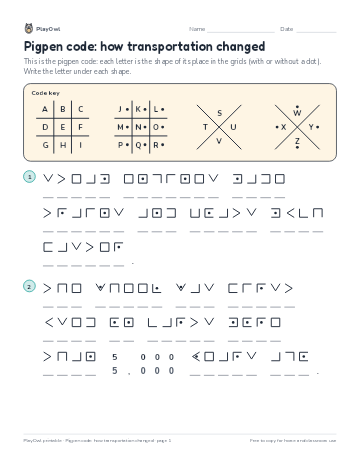 Pigpen code: how transportation changed
History, Civics & Social Studies · Grade 3 · Puzzle · 1 page
Pigpen code: how transportation changed
History, Civics & Social Studies · Grade 3 · Puzzle · 1 page
Printable generator
Make your own printables
Make brand-new sheets like this one, with answer keys, using the printable generator that comes with a PlayOwl plan. This sheet stays free.