Reading passage · English
The water bear: tiny but tough: stretch · Grade 5
An original passage about context clues: Grade 5 words with 8 questions that check details, inference and vocabulary.
- Grade 5 · ages 10 to 11
- Hard
- 30 to 40 minutes
- 2 pages
- Free
Goes with the game Vocabulary Quest.
The answer key is a separate page for grown-ups. Sign in to download it.
The passage and its 8 questions
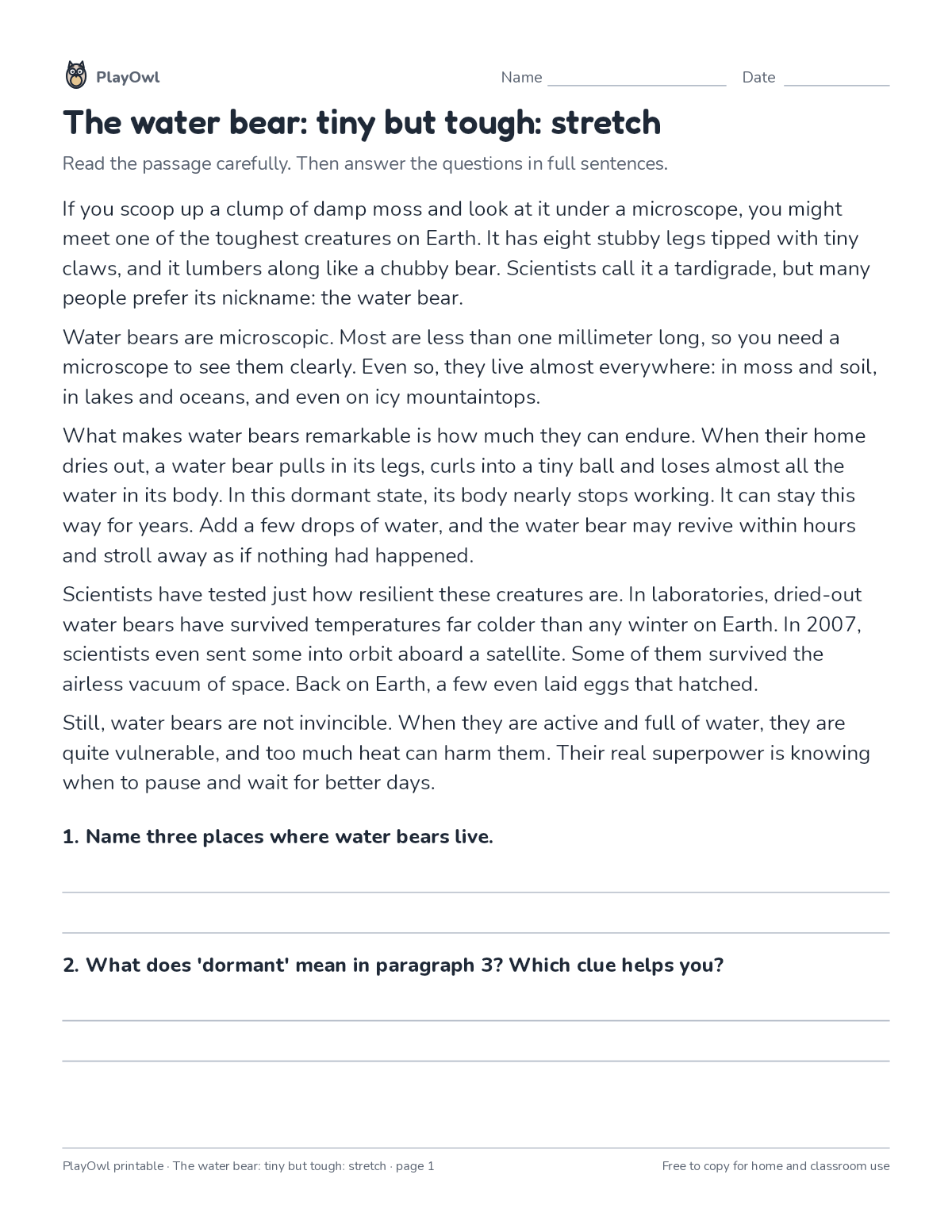
Directions: Read the passage carefully. Then answer the questions in full sentences.
- If you scoop up a clump of damp moss and look at it under a microscope, you might meet one of the toughest creatures on Earth. It has eight stubby legs tipped with tiny claws, and it lumbers along like a chubby bear. Scientists call it a tardigrade, but many people prefer its nickname: the water bear.
- Water bears are microscopic. Most are less than one millimeter long, so you need a microscope to see them clearly. Even so, they live almost everywhere: in moss and soil, in lakes and oceans, and even on icy mountaintops.
- What makes water bears remarkable is how much they can endure. When their home dries out, a water bear pulls in its legs, curls into a tiny ball and loses almost all the water in its body. In this dormant state, its body nearly stops working. It can stay this way for years. Add a few drops of water, and the water bear may revive within hours and stroll away as if nothing had happened.
- Scientists have tested just how resilient these creatures are. In laboratories, dried-out water bears have survived temperatures far colder than any winter on Earth. In 2007, scientists even sent some into orbit aboard a satellite. Some of them survived the airless vacuum of space. Back on Earth, a few even laid eggs that hatched.
- Still, water bears are not invincible. When they are active and full of water, they are quite vulnerable, and too much heat can harm them. Their real superpower is knowing when to pause and wait for better days.
- 1. Name three places where water bears live.
- 2. What does 'dormant' mean in paragraph 3? Which clue helps you?
- 3. Why do you think drying out helps a water bear survive?
- 4. The author says water bears are 'not invincible.' Use paragraph 5 to explain what invincible means.
- 5. Copy the sentence that gives evidence that water bears can survive in space.
- 6. What is the main idea of the whole passage?
- 7. Find a word in the passage that was new or tricky for you. What do you think it means? Which words around it helped you?
- 8. Write a question you would ask the author.
What your child practices
Your child practices the reading and English skill “Vocabulary in context”: use context to determine word meaning.
- Grades and ages
- Grade 5, ages 10 to 11
- Time
- About 30 to 40 minutes
- Subject
- English
- Level
- Hard for Grade 5
- Answer key
- Yes, for grown-ups who sign in
- Printing
- 2 pages, US Letter or A4, low-ink option
- Updated
How to use it
Read the passage once just for the story or the facts, then again with the questions in mind. Encourage underlining the words in the text that back up each answer. It is one of the harder sheets for Grade 5, best once the basics of the skill are secure. Its 2 pages split well across two sittings.
An answer key comes with it as a separate page that grown-ups download after signing in.
Tip for grown-ups: Ask your child to point to the sentence that answers each question before writing it.
Done on paper? A grown-up can record it on the child's page in PlayOwl; downloading alone doesn't count as finished.
English · Grade 5
More like this
 Context clues comic strip: 6 panels
English · Grade 5 · Worksheet · 1 page
Context clues comic strip: 6 panels
English · Grade 5 · Worksheet · 1 page
 The lighthouse keeper's map
English · 3–5 · Reading · 1 page
The lighthouse keeper's map
English · 3–5 · Reading · 1 page
 Prefixes that change meaning comic strip: 6 panels
English · Grade 4 · Worksheet · 1 page
Prefixes that change meaning comic strip: 6 panels
English · Grade 4 · Worksheet · 1 page
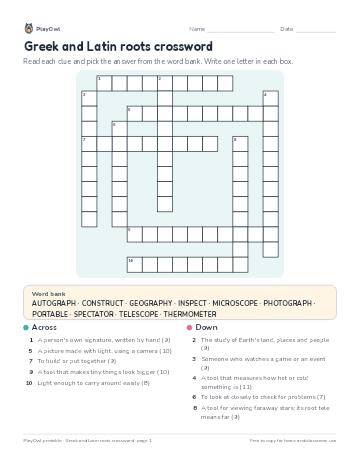 Greek and Latin roots crossword
English · Grade 5 · Puzzle · 1 page
Greek and Latin roots crossword
English · Grade 5 · Puzzle · 1 page
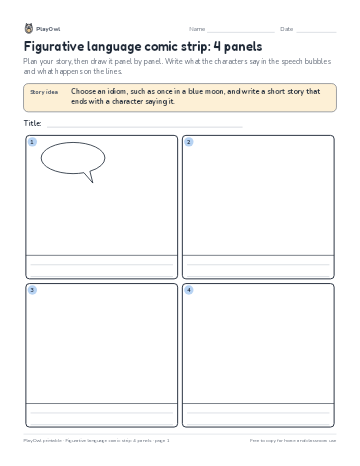 Figurative language comic strip: 4 panels
English · Grade 5 · Worksheet · 1 page
Figurative language comic strip: 4 panels
English · Grade 5 · Worksheet · 1 page
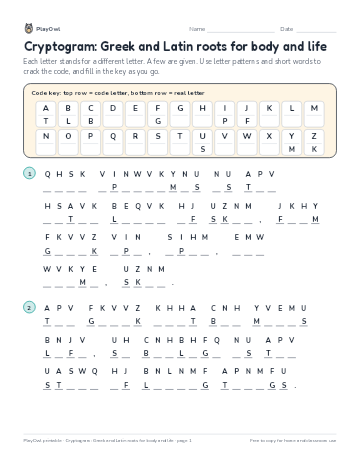 Cryptogram: Greek and Latin roots for body and life
English · Grade 6 · Puzzle · 1 page
Cryptogram: Greek and Latin roots for body and life
English · Grade 6 · Puzzle · 1 page
Printable generator
Make your own printables
Make brand-new sheets like this one, with answer keys, using the printable generator that comes with a PlayOwl plan. This sheet stays free.