Reading passage · English
The centipede's broken promise: stretch · Grade 6
An original passage about greek and Latin number roots with 7 questions that check details, inference and vocabulary.
- Grade 6 · ages 11 to 12
- Hard
- 30 to 40 minutes
- 2 pages
- Free
Goes with the game Vocabulary Quest.
The answer key is a separate page for grown-ups. Sign in to download it.
The passage and its 7 questions
Directions: Read the passage carefully. Then answer the questions in full sentences.
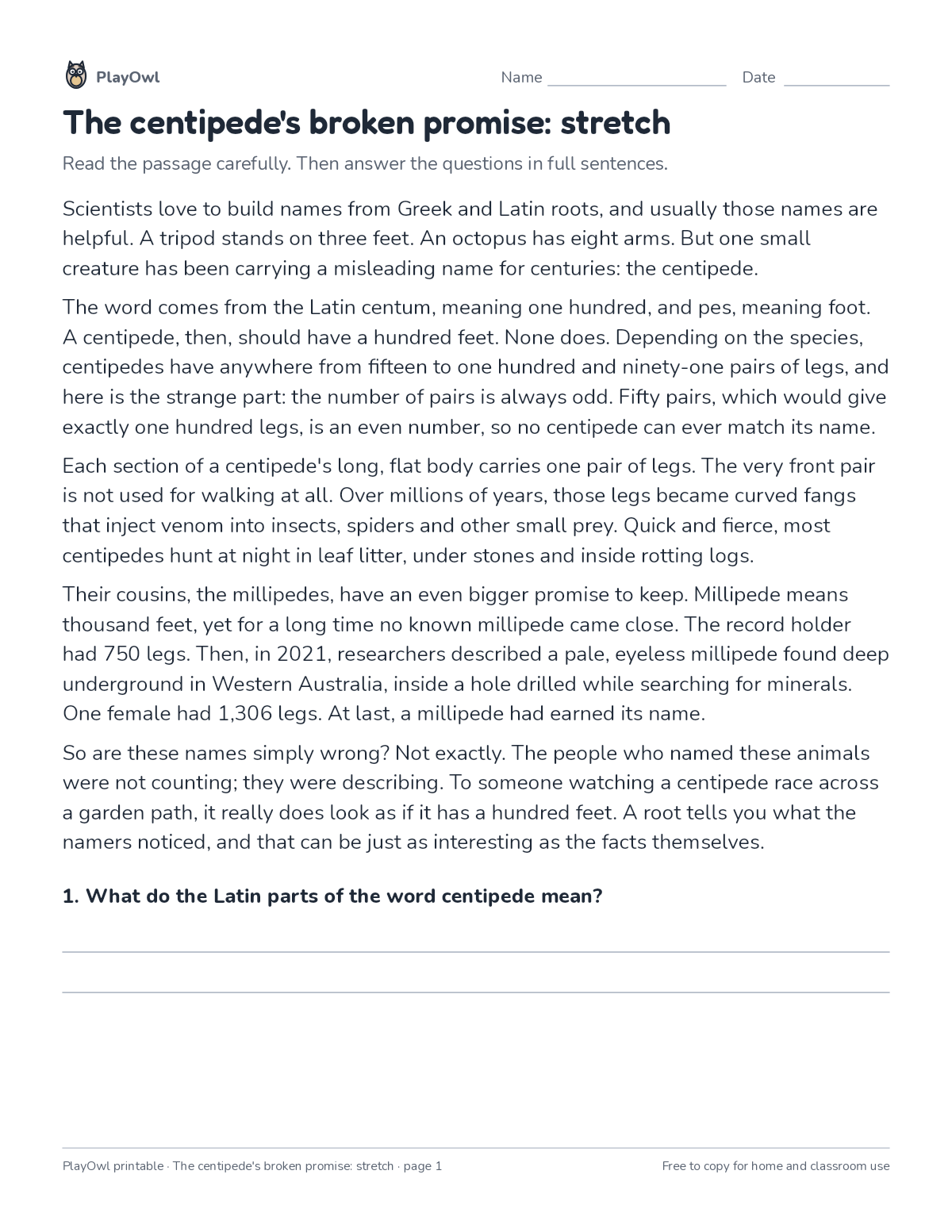
- Scientists love to build names from Greek and Latin roots, and usually those names are helpful. A tripod stands on three feet. An octopus has eight arms. But one small creature has been carrying a misleading name for centuries: the centipede.
- The word comes from the Latin centum, meaning one hundred, and pes, meaning foot.
- A centipede, then, should have a hundred feet. None does. Depending on the species, centipedes have anywhere from fifteen to one hundred and ninety-one pairs of legs, and here is the strange part: the number of pairs is always odd. Fifty pairs, which would give exactly one hundred legs, is an even number, so no centipede can ever match its name.
- Each section of a centipede's long, flat body carries one pair of legs. The very front pair is not used for walking at all. Over millions of years, those legs became curved fangs that inject venom into insects, spiders and other small prey. Quick and fierce, most centipedes hunt at night in leaf litter, under stones and inside rotting logs.
- Their cousins, the millipedes, have an even bigger promise to keep. Millipede means thousand feet, yet for a long time no known millipede came close. The record holder had 750 legs. Then, in 2021, researchers described a pale, eyeless millipede found deep underground in Western Australia, inside a hole drilled while searching for minerals.
- One female had 1,306 legs. At last, a millipede had earned its name.
- So are these names simply wrong? Not exactly. The people who named these animals were not counting; they were describing. To someone watching a centipede race across a garden path, it really does look as if it has a hundred feet. A root tells you what the namers noticed, and that can be just as interesting as the facts themselves.
- 1. What do the Latin parts of the word centipede mean?
- 2. Explain in your own words why no centipede can have exactly one hundred legs.
- 3. What does the word 'misleading' mean in paragraph 1?
- 4. Why does the author say, "At last, a millipede had earned its name"?
- 5. The author says the names are "not exactly" wrong. Copy the sentence that best explains why.
- 6. Find a word in the passage that was new or tricky for you. What do you think it means? Which words around it helped you?
- 7. State the central idea and explain how one paragraph develops it.
What your child practices
Your child practices the reading and English skill “Vocabulary in context”: use context to determine word meaning.
- Grades and ages
- Grade 6, ages 11 to 12
- Time
- About 30 to 40 minutes
- Subject
- English
- Level
- Hard for Grade 6
- Answer key
- Yes, for grown-ups who sign in
- Printing
- 2 pages, US Letter or A4, low-ink option
- Updated
How to use it
Read the passage once just for the story or the facts, then again with the questions in mind. Encourage underlining the words in the text that back up each answer. It is one of the harder sheets for Grade 6, best once the basics of the skill are secure. Its 2 pages split well across two sittings.
An answer key comes with it as a separate page that grown-ups download after signing in.
Tip for grown-ups: Ask your child to point to the sentence that answers each question before writing it.
Done on paper? A grown-up can record it on the child's page in PlayOwl; downloading alone doesn't count as finished.
English · Grade 6
More like this
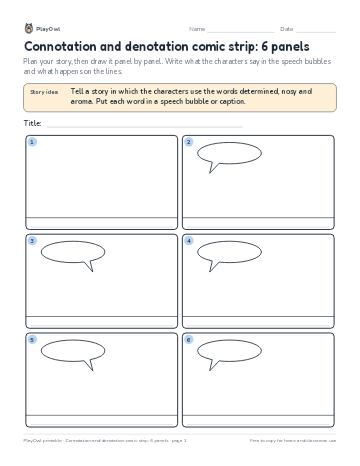 Connotation and denotation comic strip: 6 panels
English · Grade 6 · Worksheet · 1 page
Connotation and denotation comic strip: 6 panels
English · Grade 6 · Worksheet · 1 page
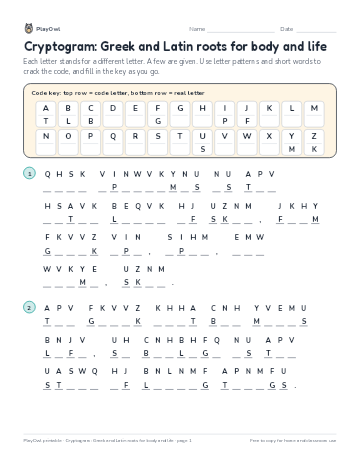 Cryptogram: Greek and Latin roots for body and life
English · Grade 6 · Puzzle · 1 page
Cryptogram: Greek and Latin roots for body and life
English · Grade 6 · Puzzle · 1 page
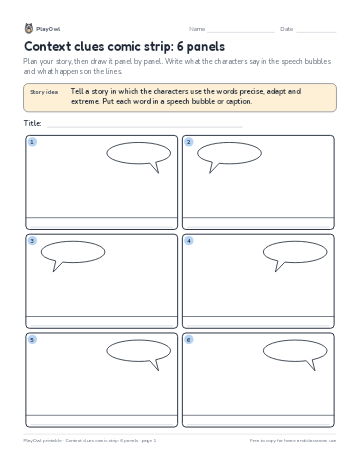 Context clues comic strip: 6 panels
English · Grade 5 · Worksheet · 1 page
Context clues comic strip: 6 panels
English · Grade 5 · Worksheet · 1 page
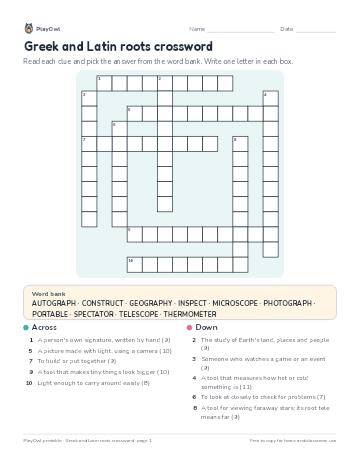 Greek and Latin roots crossword
English · Grade 5 · Puzzle · 1 page
Greek and Latin roots crossword
English · Grade 5 · Puzzle · 1 page
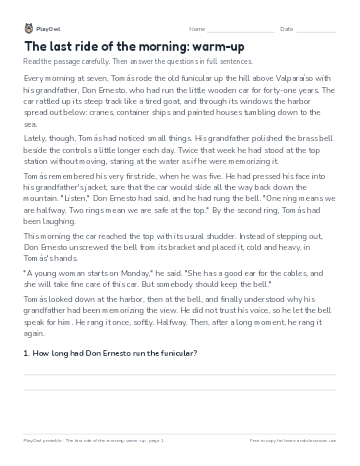 The last ride of the morning: warm-up
English · Grade 6 · Reading · 2 pages
The last ride of the morning: warm-up
English · Grade 6 · Reading · 2 pages
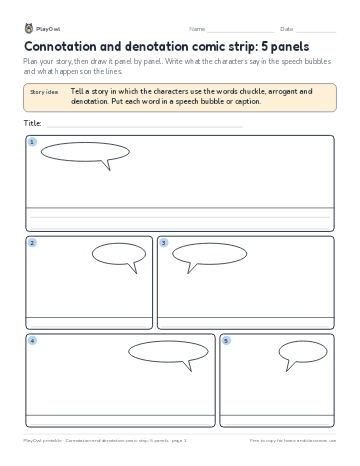 Connotation and denotation comic strip: 5 panels
English · Grade 7 · Worksheet · 1 page
Connotation and denotation comic strip: 5 panels
English · Grade 7 · Worksheet · 1 page
Printable generator
Make your own printables
Make brand-new sheets like this one, with answer keys, using the printable generator that comes with a PlayOwl plan. This sheet stays free.