Reading passage · History, Civics & Social Studies
Traveling the Silk Road · Grades 6–7
An original passage about the Silk Road and Tang and Song China with 7 questions that check details, inference and vocabulary.
- Grades 6–7 · ages 11 to 13
- Medium
- 30 to 40 minutes
- 2 pages
- Free
The answer key is a separate page for grown-ups. Sign in to download it.
The passage and its 7 questions
Directions: Read the passage carefully. Then answer the questions in full sentences.
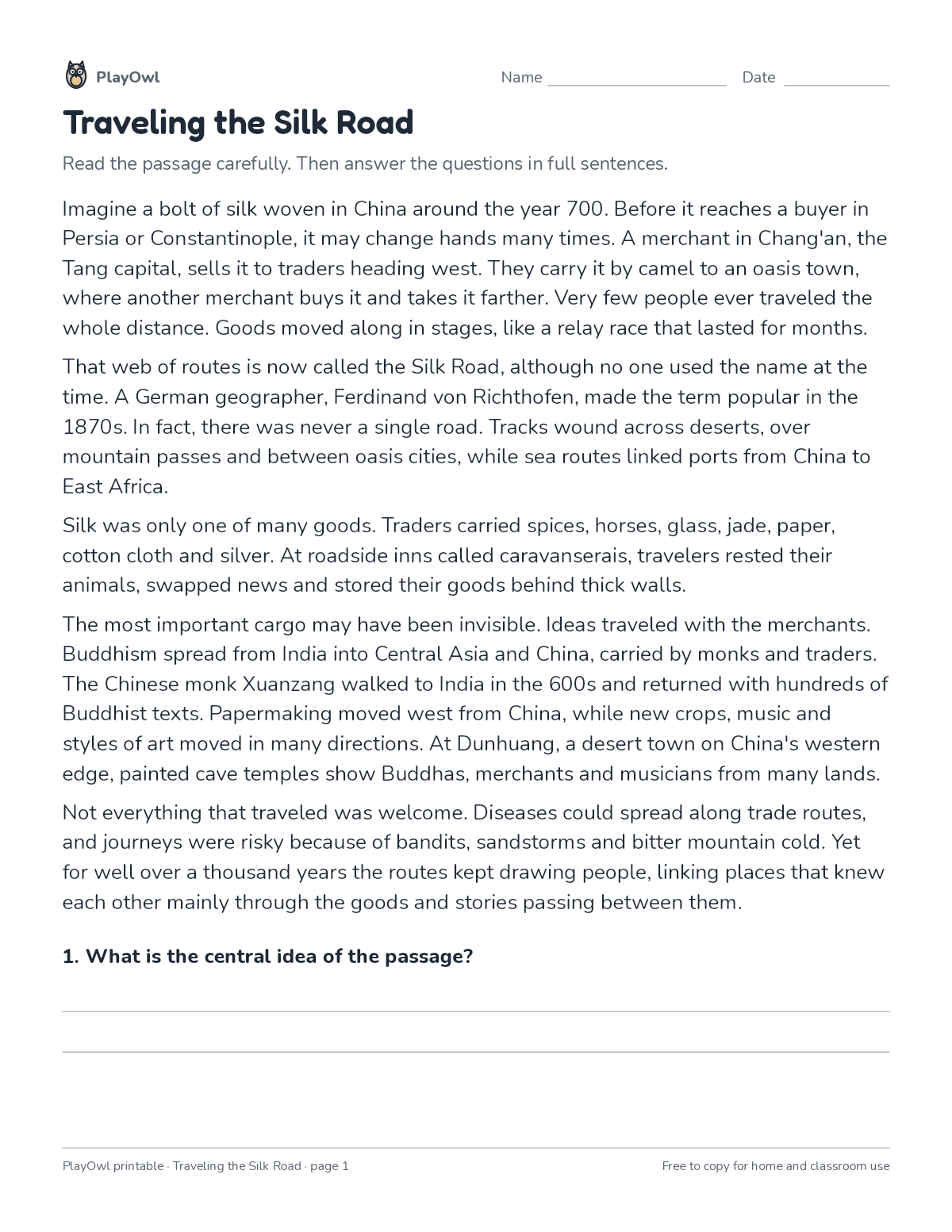
- Imagine a bolt of silk woven in China around the year 700. Before it reaches a buyer in
- Persia or Constantinople, it may change hands many times. A merchant in Chang'an, the
- Tang capital, sells it to traders heading west. They carry it by camel to an oasis town, where another merchant buys it and takes it farther. Very few people ever traveled the whole distance. Goods moved along in stages, like a relay race that lasted for months.
- That web of routes is now called the Silk Road, although no one used the name at the time. A German geographer, Ferdinand von Richthofen, made the term popular in the
- 1870s. In fact, there was never a single road. Tracks wound across deserts, over mountain passes and between oasis cities, while sea routes linked ports from China to
- East Africa.
- Silk was only one of many goods. Traders carried spices, horses, glass, jade, paper, cotton cloth and silver. At roadside inns called caravanserais, travelers rested their animals, swapped news and stored their goods behind thick walls.
- The most important cargo may have been invisible. Ideas traveled with the merchants.
- Buddhism spread from India into Central Asia and China, carried by monks and traders.
- The Chinese monk Xuanzang walked to India in the 600s and returned with hundreds of
- Buddhist texts. Papermaking moved west from China, while new crops, music and styles of art moved in many directions. At Dunhuang, a desert town on China's western edge, painted cave temples show Buddhas, merchants and musicians from many lands.
- Not everything that traveled was welcome. Diseases could spread along trade routes, and journeys were risky because of bandits, sandstorms and bitter mountain cold. Yet for well over a thousand years the routes kept drawing people, linking places that knew each other mainly through the goods and stories passing between them.
- 1. What is the central idea of the passage?
- 2. Why did very few merchants travel the whole route?
- 3. How did trade along the routes help Buddhism spread into China?
- 4. In paragraph 3, what is a 'caravanserai'? Which clues help you?
- 5. Why does the author say the most important cargo 'may have been invisible'?
- 6. Copy the sentence that shows the traders themselves did not use the name 'Silk
- Road.'
- 7. What question does the passage leave unanswered? How could you find out?
What your child practices
Your child practices the history and social studies skill “Change, continuity and causation”: describe how and why things changed over time and compare perspectives.
- Grades and ages
- Grades 6–7, ages 11 to 13
- Time
- About 30 to 40 minutes
- Subject
- History, Civics & Social Studies
- Level
- Medium for Grades 6–7
- Answer key
- Yes, for grown-ups who sign in
- Printing
- 2 pages, US Letter or A4, low-ink option
- Updated
How to use it
Read the passage once just for the story or the facts, then again with the questions in mind. Encourage underlining the words in the text that back up each answer. It is pitched at the expected level for Grades 6–7, for practice after the skill has been taught. Its 2 pages split well across two sittings.
An answer key comes with it as a separate page that grown-ups download after signing in.
Tip for grown-ups: Ask your child to point to the sentence that answers each question before writing it.
Done on paper? A grown-up can record it on the child's page in PlayOwl; downloading alone doesn't count as finished.
History, Civics & Social Studies · Grades 6–7
More like this
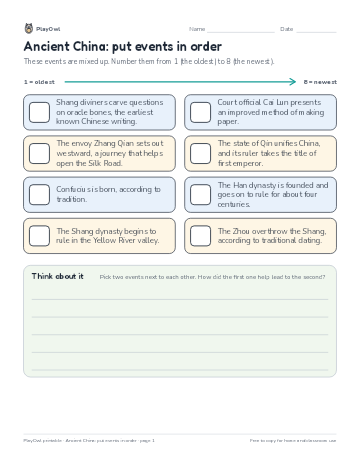 Ancient China: put events in order
History, Civics & Social Studies · 6–7 · Worksheet · 1 page
Ancient China: put events in order
History, Civics & Social Studies · 6–7 · Worksheet · 1 page
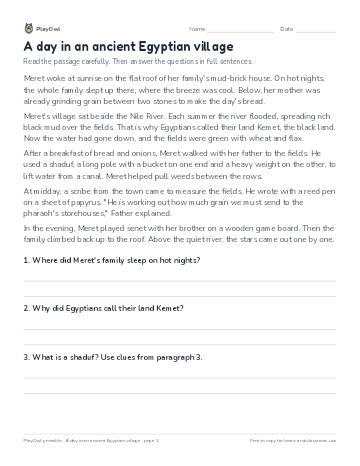 A day in an ancient Egyptian village
History, Civics & Social Studies · Grade 5 · Reading · 2 pages
A day in an ancient Egyptian village
History, Civics & Social Studies · Grade 5 · Reading · 2 pages
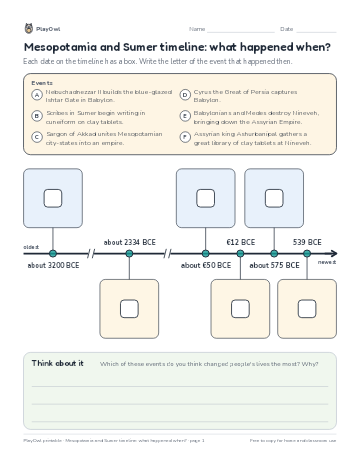 Mesopotamia and Sumer timeline: what happened when?
History, Civics & Social Studies · Grade 6 · Worksheet · 1 page
Mesopotamia and Sumer timeline: what happened when?
History, Civics & Social Studies · Grade 6 · Worksheet · 1 page
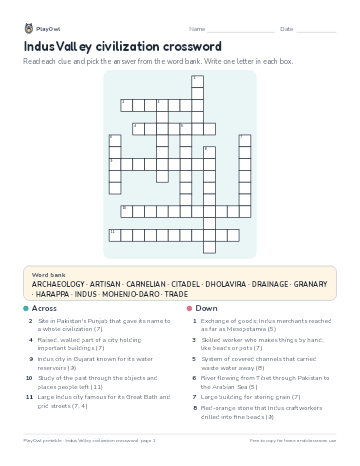 Indus Valley civilization crossword
History, Civics & Social Studies · Grade 6 · Puzzle · 1 page
Indus Valley civilization crossword
History, Civics & Social Studies · Grade 6 · Puzzle · 1 page
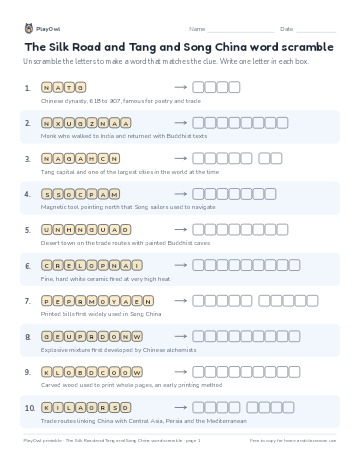 The Silk Road and Tang and Song China word scramble
History, Civics & Social Studies · Grade 6 · Puzzle · 1 page
The Silk Road and Tang and Song China word scramble
History, Civics & Social Studies · Grade 6 · Puzzle · 1 page
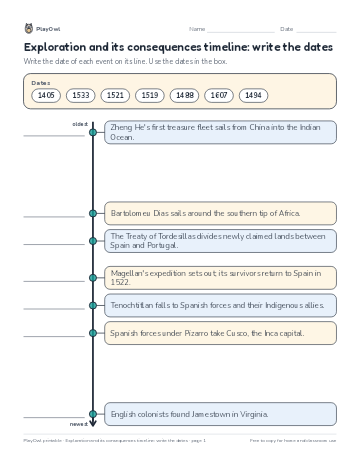 Exploration and its consequences timeline: write the dates
History, Civics & Social Studies · Grade 7 · Worksheet · 1 page
Exploration and its consequences timeline: write the dates
History, Civics & Social Studies · Grade 7 · Worksheet · 1 page
Printable generator
Make your own printables
Make brand-new sheets like this one, with answer keys, using the printable generator that comes with a PlayOwl plan. This sheet stays free.