Reading passage · English
The clocks in the sky: stretch · Grade 7
An original passage about academic vocabulary in context with 8 questions that check details, inference and vocabulary.
- Grade 7 · ages 12 to 13
- Hard
- 50 to 60 minutes
- 3 pages
- Free
Goes with the game Vocabulary Quest.
The answer key is a separate page for grown-ups. Sign in to download it.
The passage and its 8 questions
Directions: Read the passage carefully. Then answer the questions in full sentences.
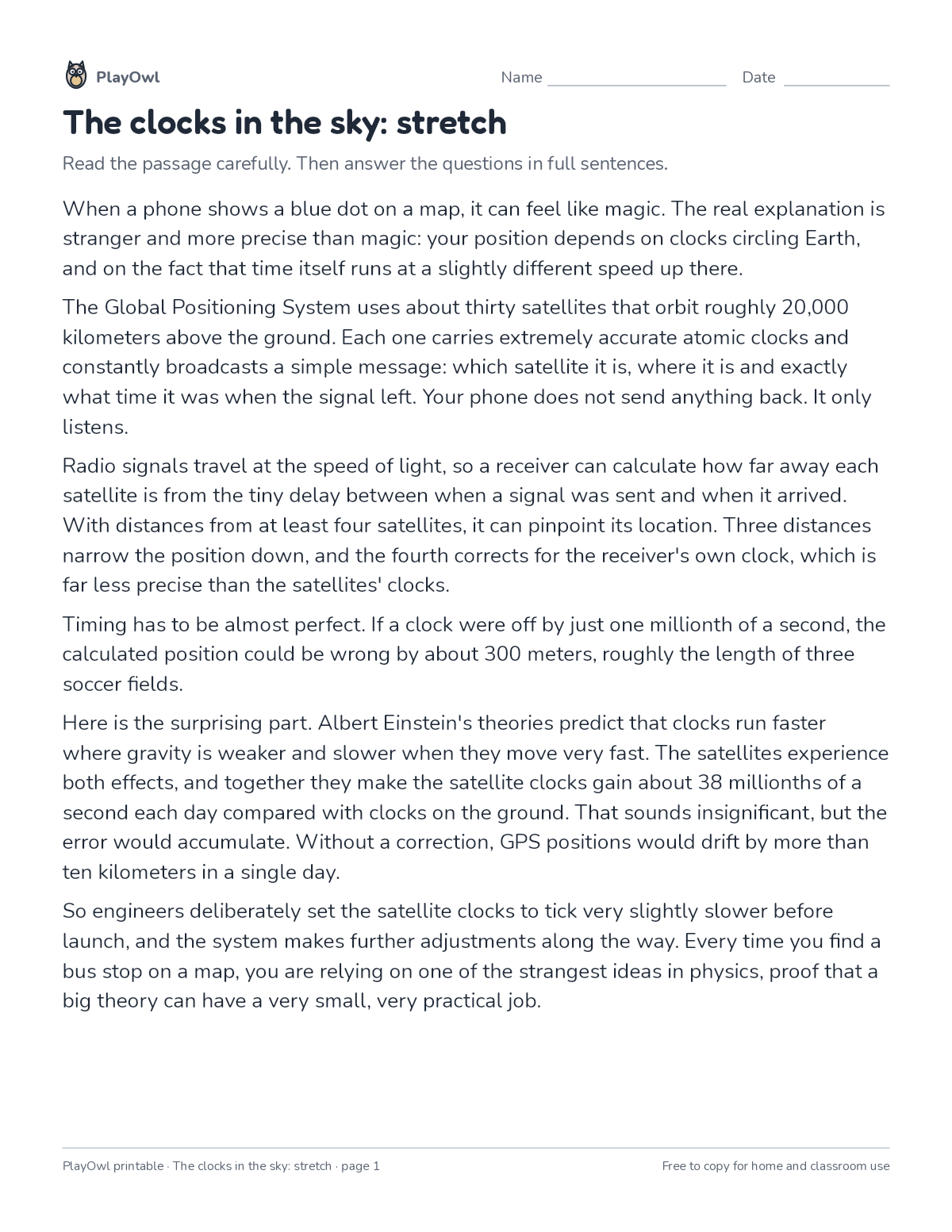
- When a phone shows a blue dot on a map, it can feel like magic. The real explanation is stranger and more precise than magic: your position depends on clocks circling Earth, and on the fact that time itself runs at a slightly different speed up there.
- The Global Positioning System uses about thirty satellites that orbit roughly 20,000 kilometers above the ground. Each one carries extremely accurate atomic clocks and constantly broadcasts a simple message: which satellite it is, where it is and exactly what time it was when the signal left. Your phone does not send anything back. It only listens.
- Radio signals travel at the speed of light, so a receiver can calculate how far away each satellite is from the tiny delay between when a signal was sent and when it arrived.
- With distances from at least four satellites, it can pinpoint its location. Three distances narrow the position down, and the fourth corrects for the receiver's own clock, which is far less precise than the satellites' clocks.
- Timing has to be almost perfect. If a clock were off by just one millionth of a second, the calculated position could be wrong by about 300 meters, roughly the length of three soccer fields.
- Here is the surprising part. Albert Einstein's theories predict that clocks run faster where gravity is weaker and slower when they move very fast. The satellites experience both effects, and together they make the satellite clocks gain about 38 millionths of a second each day compared with clocks on the ground. That sounds insignificant, but the error would accumulate. Without a correction, GPS positions would drift by more than ten kilometers in a single day.
- So engineers deliberately set the satellite clocks to tick very slightly slower before launch, and the system makes further adjustments along the way. Every time you find a bus stop on a map, you are relying on one of the strangest ideas in physics, proof that a big theory can have a very small, very practical job.
- 1. How many satellites must a receiver hear from to find its position, and what does the last one do?
- 2. The author writes, "It only listens." What can you infer about how many people can use GPS at the same time?
- 3. What does 'accumulate' mean in paragraph 5? Which words around it help you work it out?
- 4. Copy the sentence that explains why timing must be almost perfect.
- 5. Why does the author compare a 300-meter error to soccer fields?
- 6. What is the author's purpose in the final paragraph?
- 7. Find a word in the passage that was new or tricky for you. What do you think it means? Which words around it helped you?
- 8. Write a one-paragraph summary that a younger student could understand.
What your child practices
Your child practices the reading and English skill “Vocabulary in context”: use context to determine word meaning.
- Grades and ages
- Grade 7, ages 12 to 13
- Time
- About 50 to 60 minutes
- Subject
- English
- Level
- Hard for Grade 7
- Answer key
- Yes, for grown-ups who sign in
- Printing
- 3 pages, US Letter or A4, low-ink option
- Updated
How to use it
Read the passage once just for the story or the facts, then again with the questions in mind. Encourage underlining the words in the text that back up each answer. It is one of the harder sheets for Grade 7, best once the basics of the skill are secure. Its 3 pages split well across two sittings.
An answer key comes with it as a separate page that grown-ups download after signing in.
Tip for grown-ups: Ask your child to point to the sentence that answers each question before writing it.
Done on paper? A grown-up can record it on the child's page in PlayOwl; downloading alone doesn't count as finished.
English · Grade 7
More like this
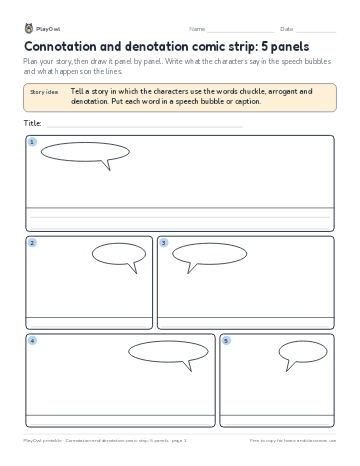 Connotation and denotation comic strip: 5 panels
English · Grade 7 · Worksheet · 1 page
Connotation and denotation comic strip: 5 panels
English · Grade 7 · Worksheet · 1 page
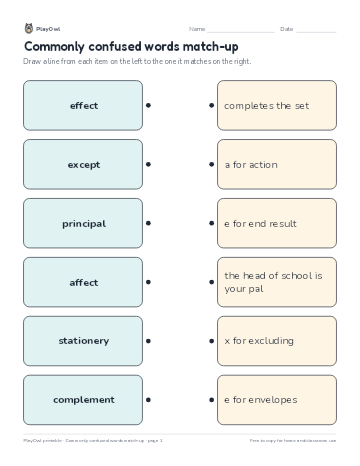 Commonly confused words match-up
English · Grade 7 · Worksheet · 1 page
Commonly confused words match-up
English · Grade 7 · Worksheet · 1 page
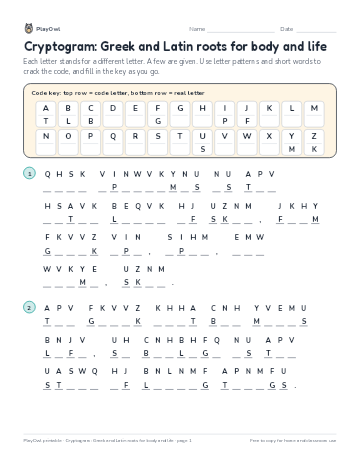 Cryptogram: Greek and Latin roots for body and life
English · Grade 6 · Puzzle · 1 page
Cryptogram: Greek and Latin roots for body and life
English · Grade 6 · Puzzle · 1 page
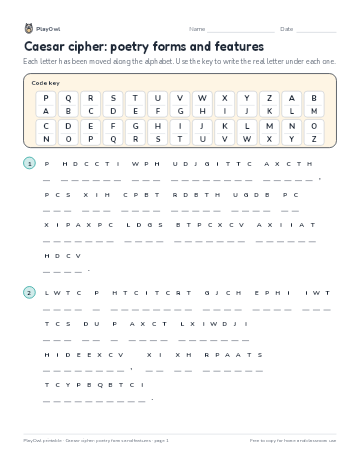 Caesar cipher: poetry forms and features
English · Grade 7 · Puzzle · 1 page
Caesar cipher: poetry forms and features
English · Grade 7 · Puzzle · 1 page
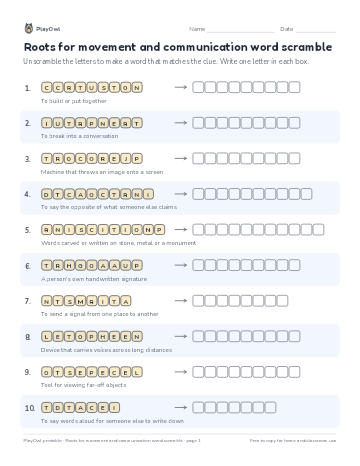 Roots for movement and communication word scramble
English · Grade 7 · Puzzle · 1 page
Roots for movement and communication word scramble
English · Grade 7 · Puzzle · 1 page
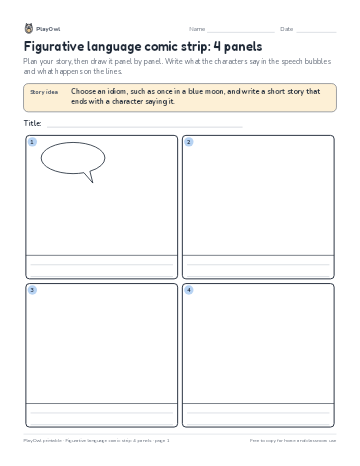 Figurative language comic strip: 4 panels
English · Grade 5 · Worksheet · 1 page
Figurative language comic strip: 4 panels
English · Grade 5 · Worksheet · 1 page
Printable generator
Make your own printables
Make brand-new sheets like this one, with answer keys, using the printable generator that comes with a PlayOwl plan. This sheet stays free.