Reading passage · English
The Great Moon Hoax of 1835: stretch · Grade 8
An original passage about media literacy: news, ads and online claims with 8 questions that check details, inference and vocabulary.
- Grade 8 · ages 13 to 14
- Hard
- 50 to 60 minutes
- 3 pages
- Free
Goes with the game Reading Detective.
The answer key is a separate page for grown-ups. Sign in to download it.
The passage and its 8 questions
Directions: Read the passage carefully. Then answer the questions in full sentences.
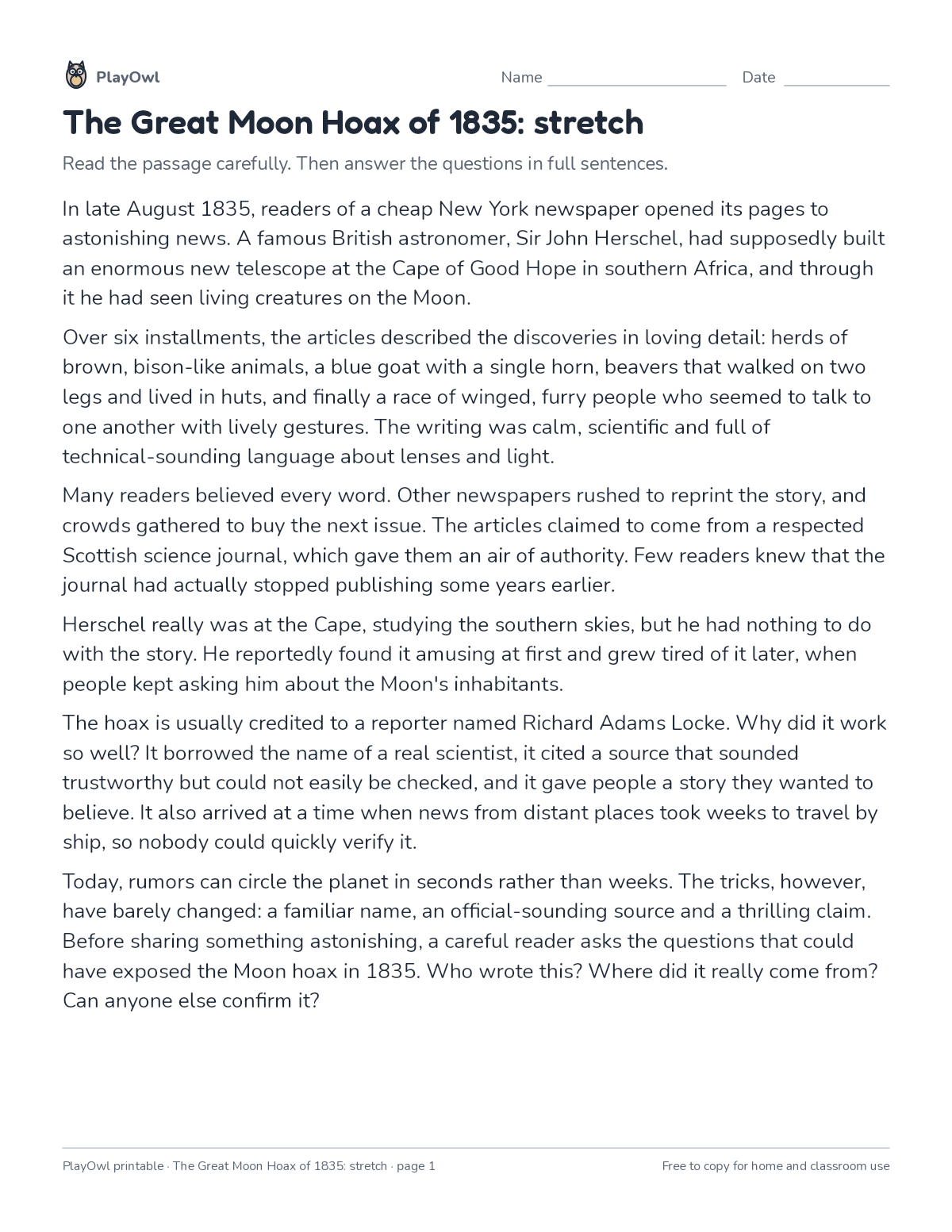
- In late August 1835, readers of a cheap New York newspaper opened its pages to astonishing news. A famous British astronomer, Sir John Herschel, had supposedly built an enormous new telescope at the Cape of Good Hope in southern Africa, and through it he had seen living creatures on the Moon.
- Over six installments, the articles described the discoveries in loving detail: herds of brown, bison-like animals, a blue goat with a single horn, beavers that walked on two legs and lived in huts, and finally a race of winged, furry people who seemed to talk to one another with lively gestures. The writing was calm, scientific and full of technical-sounding language about lenses and light.
- Many readers believed every word. Other newspapers rushed to reprint the story, and crowds gathered to buy the next issue. The articles claimed to come from a respected
- Scottish science journal, which gave them an air of authority. Few readers knew that the journal had actually stopped publishing some years earlier.
- Herschel really was at the Cape, studying the southern skies, but he had nothing to do with the story. He reportedly found it amusing at first and grew tired of it later, when people kept asking him about the Moon's inhabitants.
- The hoax is usually credited to a reporter named Richard Adams Locke. Why did it work so well? It borrowed the name of a real scientist, it cited a source that sounded trustworthy but could not easily be checked, and it gave people a story they wanted to believe. It also arrived at a time when news from distant places took weeks to travel by ship, so nobody could quickly verify it.
- Today, rumors can circle the planet in seconds rather than weeks. The tricks, however, have barely changed: a familiar name, an official-sounding source and a thrilling claim.
- Before sharing something astonishing, a careful reader asks the questions that could have exposed the Moon hoax in 1835. Who wrote this? Where did it really come from?
- Can anyone else confirm it?
- 1. Whose name did the articles borrow, and where was he really?
- 2. Why do you think the writer used calm, technical-sounding language instead of excited language?
- 3. What does the word 'verify' mean in paragraph 5?
- 4. Copy the sentence that explains why the claimed source made the story seem trustworthy.
- 5. The author names three tricks that "have barely changed." List them and give a modern example of one.
- 6. What is the author's purpose in the final paragraph?
- 7. Find a word in the passage that was new or tricky for you. What do you think it means? Which words around it helped you?
- 8. Write a one-paragraph summary that a younger student could understand.
What your child practices
Your child practices the reading and English skill “Cite text evidence”: choose the sentence that supports an answer.
- Grades and ages
- Grade 8, ages 13 to 14
- Time
- About 50 to 60 minutes
- Subject
- English
- Level
- Hard for Grade 8
- Answer key
- Yes, for grown-ups who sign in
- Printing
- 3 pages, US Letter or A4, low-ink option
- Updated
How to use it
Read the passage once just for the story or the facts, then again with the questions in mind. Encourage underlining the words in the text that back up each answer. It is one of the harder sheets for Grade 8, best once the basics of the skill are secure. Its 3 pages split well across two sittings.
An answer key comes with it as a separate page that grown-ups download after signing in.
Tip for grown-ups: Ask your child to point to the sentence that answers each question before writing it.
Done on paper? A grown-up can record it on the child's page in PlayOwl; downloading alone doesn't count as finished.
English · Grade 8
More like this
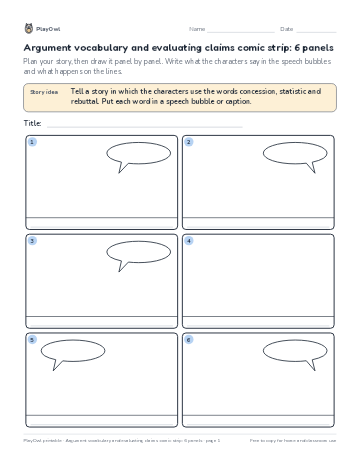 Argument vocabulary and evaluating claims comic strip: 6 panels
English · Grade 8 · Worksheet · 1 page
Argument vocabulary and evaluating claims comic strip: 6 panels
English · Grade 8 · Worksheet · 1 page
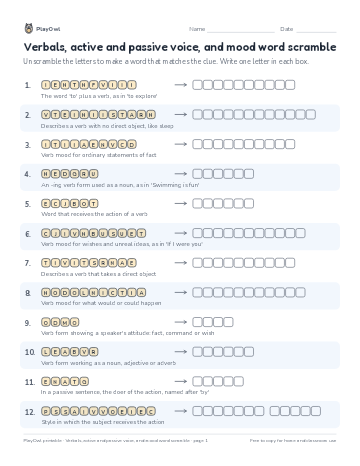 Verbals, active and passive voice, and mood word scramble
English · Grade 8 · Puzzle · 1 page
Verbals, active and passive voice, and mood word scramble
English · Grade 8 · Puzzle · 1 page
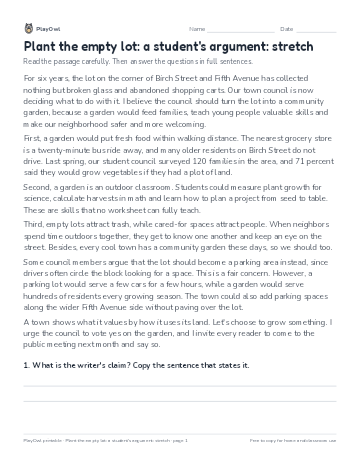 Plant the empty lot: a student's argument: stretch
English · 7–8 · Reading · 2 pages
Plant the empty lot: a student's argument: stretch
English · 7–8 · Reading · 2 pages
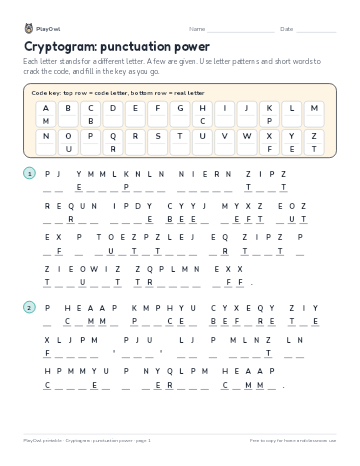 Cryptogram: punctuation power
English · Grade 8 · Puzzle · 1 page
Cryptogram: punctuation power
English · Grade 8 · Puzzle · 1 page
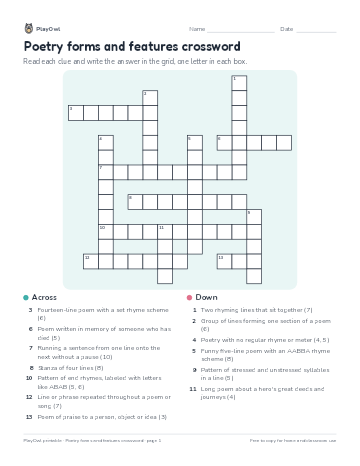 Poetry forms and features crossword
English · Grade 8 · Puzzle · 1 page
Poetry forms and features crossword
English · Grade 8 · Puzzle · 1 page
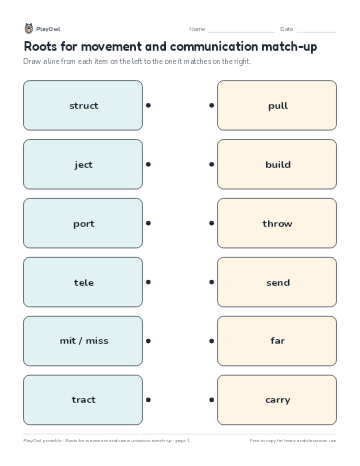 Roots for movement and communication match-up
English · Grade 8 · Worksheet · 1 page
Roots for movement and communication match-up
English · Grade 8 · Worksheet · 1 page
Printable generator
Make your own printables
Make brand-new sheets like this one, with answer keys, using the printable generator that comes with a PlayOwl plan. This sheet stays free.