Reading passage · History, Civics & Social Studies
Mansa Musa's journey to Mecca · Grade 8
An original passage about mali and Songhai empires with 7 questions that check details, inference and vocabulary.
- Grade 8 · ages 13 to 14
- Medium
- 30 to 40 minutes
- 2 pages
- Free
The answer key is a separate page for grown-ups. Sign in to download it.
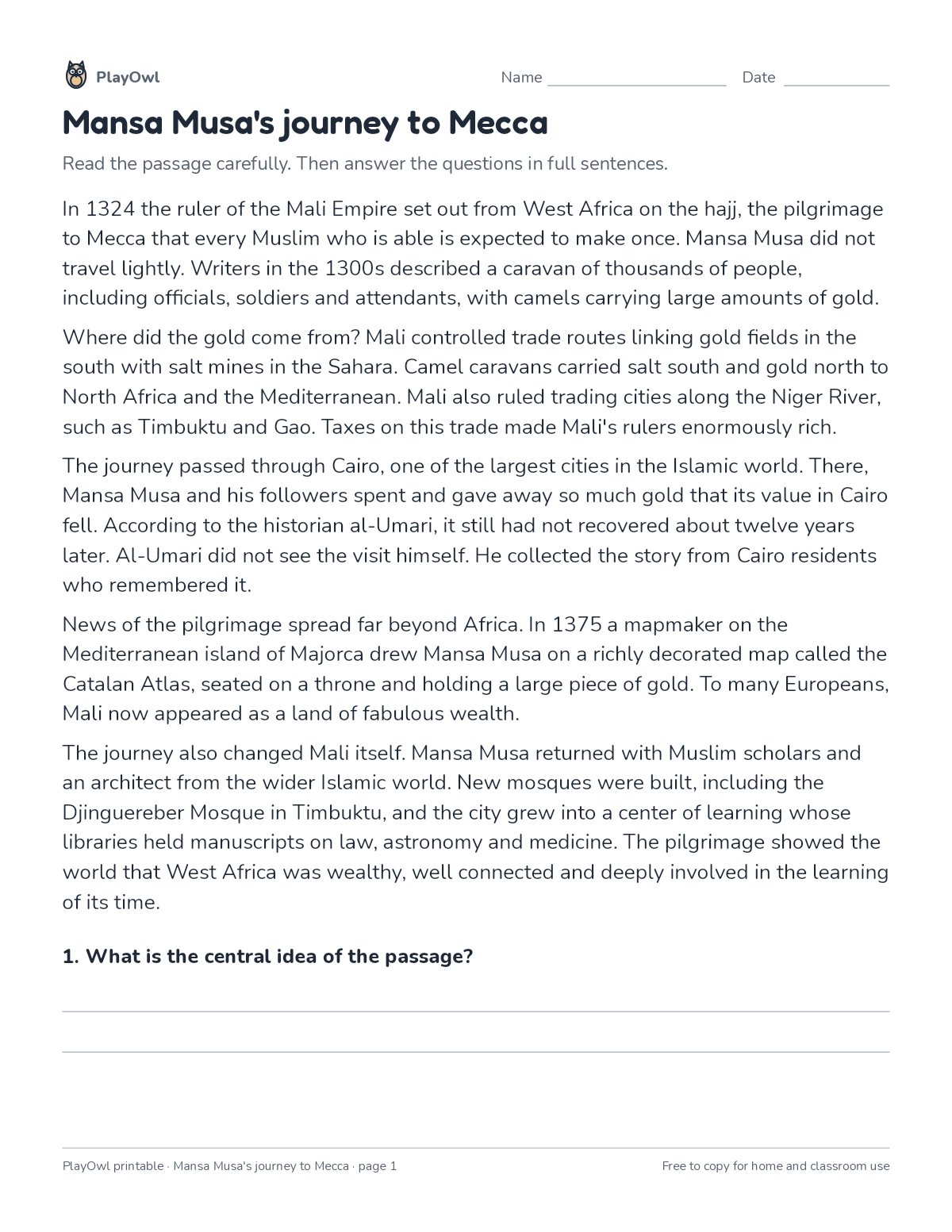
The passage and its 7 questions
Directions: Read the passage carefully. Then answer the questions in full sentences.
- In 1324 the ruler of the Mali Empire set out from West Africa on the hajj, the pilgrimage to Mecca that every Muslim who is able is expected to make once. Mansa Musa did not travel lightly. Writers in the 1300s described a caravan of thousands of people, including officials, soldiers and attendants, with camels carrying large amounts of gold.
- Where did the gold come from? Mali controlled trade routes linking gold fields in the south with salt mines in the Sahara. Camel caravans carried salt south and gold north to
- North Africa and the Mediterranean. Mali also ruled trading cities along the Niger River, such as Timbuktu and Gao. Taxes on this trade made Mali's rulers enormously rich.
- The journey passed through Cairo, one of the largest cities in the Islamic world. There,
- Mansa Musa and his followers spent and gave away so much gold that its value in Cairo fell. According to the historian al-Umari, it still had not recovered about twelve years later. Al-Umari did not see the visit himself. He collected the story from Cairo residents who remembered it.
- News of the pilgrimage spread far beyond Africa. In 1375 a mapmaker on the
- Mediterranean island of Majorca drew Mansa Musa on a richly decorated map called the
- Catalan Atlas, seated on a throne and holding a large piece of gold. To many Europeans,
- Mali now appeared as a land of fabulous wealth.
- The journey also changed Mali itself. Mansa Musa returned with Muslim scholars and an architect from the wider Islamic world. New mosques were built, including the
- Djinguereber Mosque in Timbuktu, and the city grew into a center of learning whose libraries held manuscripts on law, astronomy and medicine. The pilgrimage showed the world that West Africa was wealthy, well connected and deeply involved in the learning of its time.
- 1. What is the central idea of the passage?
- 2. What happened to the value of gold in Cairo, and why?
- 3. What does 'pilgrimage' mean in paragraph 1?
- 4. Al-Umari did not witness the visit. How should a historian use his account?
- 5. Copy the sentence that shows Europeans learned about Mansa Musa.
- 6. How did the pilgrimage change Timbuktu?
- 7. State the central idea and explain how one paragraph develops it.
What your child practices
Your child practices the history and social studies skill “Change, continuity and causation”: describe how and why things changed over time and compare perspectives.
- Grades and ages
- Grade 8, ages 13 to 14
- Time
- About 30 to 40 minutes
- Subject
- History, Civics & Social Studies
- Level
- Medium for Grade 8
- Answer key
- Yes, for grown-ups who sign in
- Printing
- 2 pages, US Letter or A4, low-ink option
- Updated
How to use it
Read the passage once just for the story or the facts, then again with the questions in mind. Encourage underlining the words in the text that back up each answer. It is pitched at the expected level for Grade 8, for practice after the skill has been taught. Its 2 pages split well across two sittings.
An answer key comes with it as a separate page that grown-ups download after signing in.
Tip for grown-ups: Ask your child to point to the sentence that answers each question before writing it.
Done on paper? A grown-up can record it on the child's page in PlayOwl; downloading alone doesn't count as finished.
History, Civics & Social Studies · Grade 8
More like this
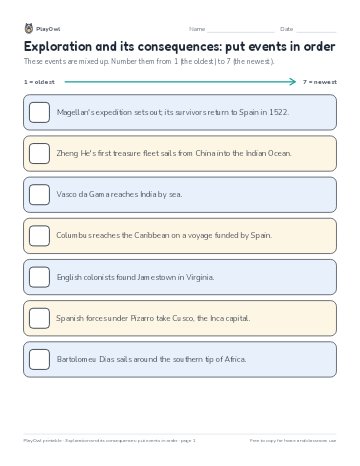 Exploration and its consequences: put events in order
History, Civics & Social Studies · Grade 8 · Worksheet · 1 page
Exploration and its consequences: put events in order
History, Civics & Social Studies · Grade 8 · Worksheet · 1 page
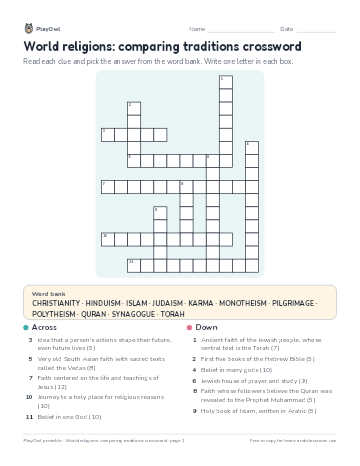 World religions: comparing traditions crossword
History, Civics & Social Studies · Grade 8 · Puzzle · 1 page
World religions: comparing traditions crossword
History, Civics & Social Studies · Grade 8 · Puzzle · 1 page
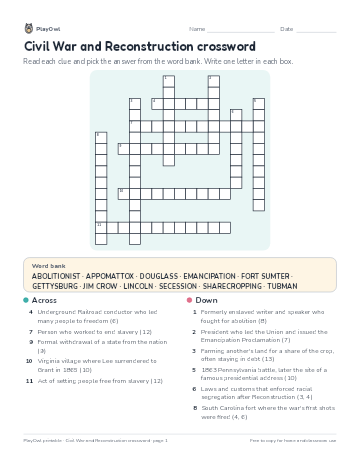 Civil War and Reconstruction crossword
History, Civics & Social Studies · Grade 9 · Puzzle · 1 page
Civil War and Reconstruction crossword
History, Civics & Social Studies · Grade 9 · Puzzle · 1 page
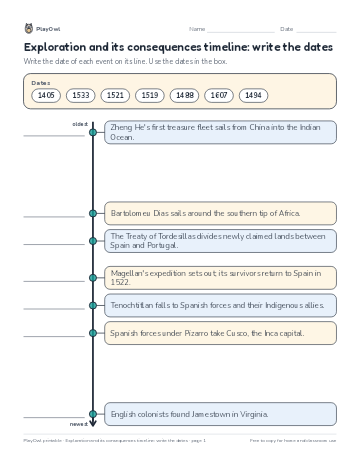 Exploration and its consequences timeline: write the dates
History, Civics & Social Studies · Grade 7 · Worksheet · 1 page
Exploration and its consequences timeline: write the dates
History, Civics & Social Studies · Grade 7 · Worksheet · 1 page
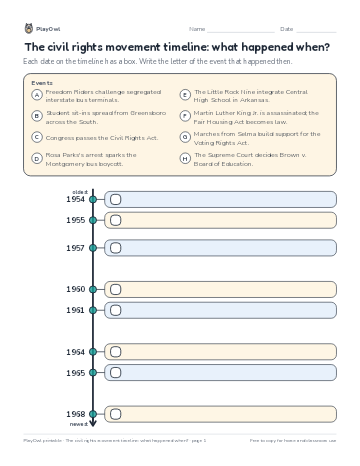 The civil rights movement timeline: what happened when?
History, Civics & Social Studies · Grade 9 · Worksheet · 1 page
The civil rights movement timeline: what happened when?
History, Civics & Social Studies · Grade 9 · Worksheet · 1 page
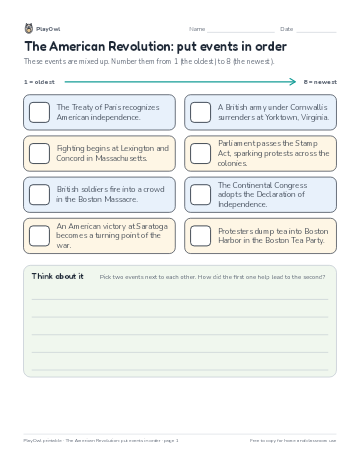 The American Revolution: put events in order
History, Civics & Social Studies · Grade 8 · Worksheet · 1 page
The American Revolution: put events in order
History, Civics & Social Studies · Grade 8 · Worksheet · 1 page
Printable generator
Make your own printables
Make brand-new sheets like this one, with answer keys, using the printable generator that comes with a PlayOwl plan. This sheet stays free.