Reading passage · Science
How we learned that carbon dioxide traps heat · Grade 9
An original passage about climate science and solutions with 7 questions that check details, inference and vocabulary.
- Grade 9 · ages 14 to 15
- Medium
- 30 to 40 minutes
- 2 pages
- Free
The answer key is a separate page for grown-ups. Sign in to download it.
The passage and its 7 questions
Directions: Read the passage carefully. Then answer the questions in full sentences.
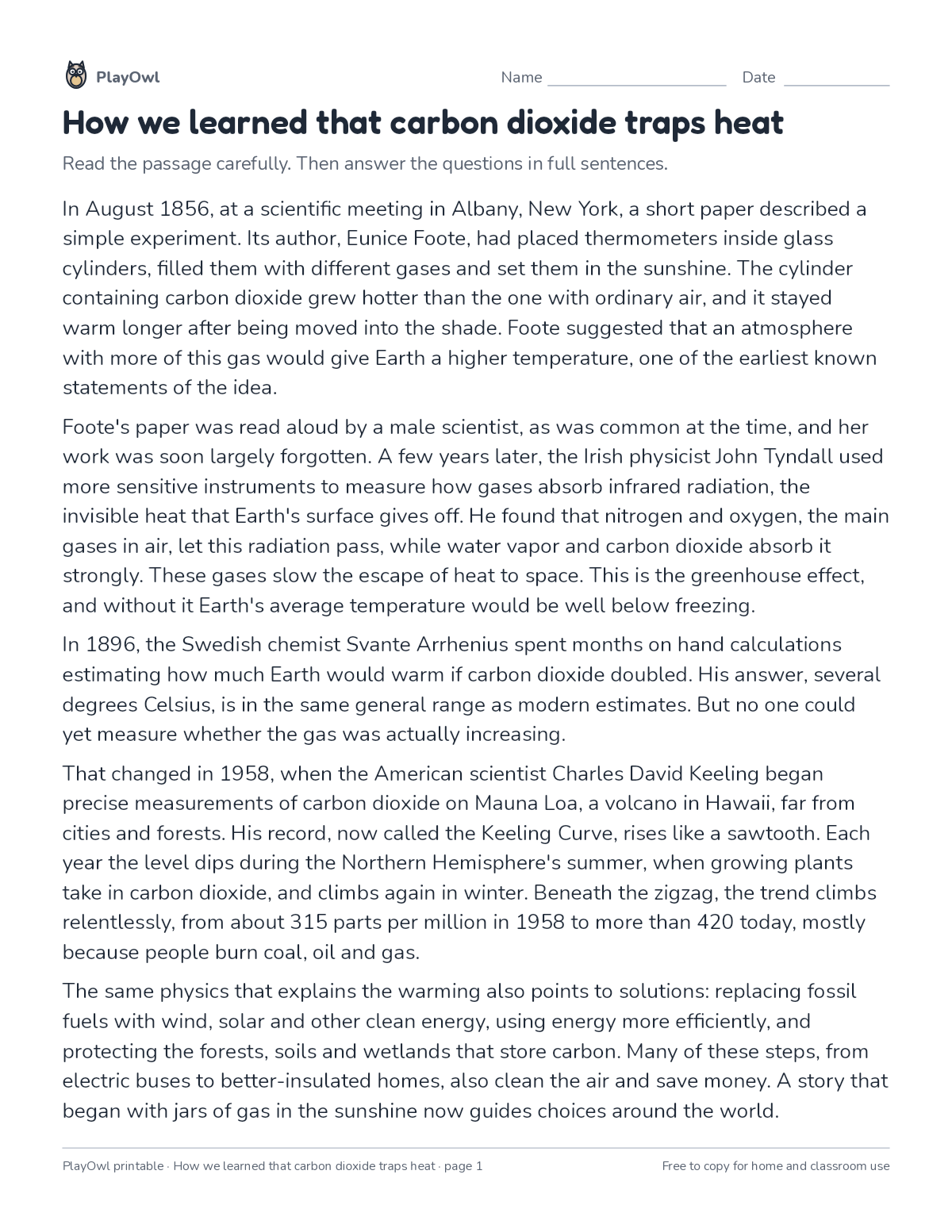
- In August 1856, at a scientific meeting in Albany, New York, a short paper described a simple experiment. Its author, Eunice Foote, had placed thermometers inside glass cylinders, filled them with different gases and set them in the sunshine. The cylinder containing carbon dioxide grew hotter than the one with ordinary air, and it stayed warm longer after being moved into the shade. Foote suggested that an atmosphere with more of this gas would give Earth a higher temperature, one of the earliest known statements of the idea.
- Foote's paper was read aloud by a male scientist, as was common at the time, and her work was soon largely forgotten. A few years later, the Irish physicist John Tyndall used more sensitive instruments to measure how gases absorb infrared radiation, the invisible heat that Earth's surface gives off. He found that nitrogen and oxygen, the main gases in air, let this radiation pass, while water vapor and carbon dioxide absorb it strongly. These gases slow the escape of heat to space. This is the greenhouse effect, and without it Earth's average temperature would be well below freezing.
- In 1896, the Swedish chemist Svante Arrhenius spent months on hand calculations estimating how much Earth would warm if carbon dioxide doubled. His answer, several degrees Celsius, is in the same general range as modern estimates. But no one could yet measure whether the gas was actually increasing.
- That changed in 1958, when the American scientist Charles David Keeling began precise measurements of carbon dioxide on Mauna Loa, a volcano in Hawaii, far from cities and forests. His record, now called the Keeling Curve, rises like a sawtooth. Each year the level dips during the Northern Hemisphere's summer, when growing plants take in carbon dioxide, and climbs again in winter. Beneath the zigzag, the trend climbs relentlessly, from about 315 parts per million in 1958 to more than 420 today, mostly because people burn coal, oil and gas.
- The same physics that explains the warming also points to solutions: replacing fossil fuels with wind, solar and other clean energy, using energy more efficiently, and protecting the forests, soils and wetlands that store carbon. Many of these steps, from electric buses to better-insulated homes, also clean the air and save money. A story that began with jars of gas in the sunshine now guides choices around the world.
- 1. Describe Eunice Foote's experiment and what she found.
- 2. How did John Tyndall's work build on Foote's?
- 3. What does "relentlessly" mean in paragraph 4?
- 4. Copy the sentence that explains why the Keeling Curve zigzags each year.
- 5. Why was it useful to measure carbon dioxide on Mauna Loa rather than in a city?
- 6. Name two solutions from the final paragraph and one extra benefit they can bring.
- 7. Rewrite the opening sentence for a different audience and explain your choices.
What your child practices
Your child practices science for Grade 9 with this reading passage.
- Grades and ages
- Grade 9, ages 14 to 15
- Time
- About 30 to 40 minutes
- Subject
- Science
- Level
- Medium for Grade 9
- Answer key
- Yes, for grown-ups who sign in
- Printing
- 2 pages, US Letter or A4, low-ink option
- Updated
How to use it
Read the passage once just for the story or the facts, then again with the questions in mind. Encourage underlining the words in the text that back up each answer. It is pitched at the expected level for Grade 9, for practice after the topic has been taught. Its 2 pages split well across two sittings.
An answer key comes with it as a separate page that grown-ups download after signing in.
Tip for grown-ups: Ask your child to point to the sentence that answers each question before writing it.
Done on paper? A grown-up can record it on the child's page in PlayOwl; downloading alone doesn't count as finished.
Science · Grade 9
More like this
 Chemical bonding: fill in the blanks
Science · Grade 9 · Reading · 1 page
Chemical bonding: fill in the blanks
Science · Grade 9 · Reading · 1 page
 Label the parts of the eye: tricky word bank
Science · 5–10 · Worksheet · 1 page
Label the parts of the eye: tricky word bank
Science · 5–10 · Worksheet · 1 page
 Label a plant cell: tricky word bank
Science · Grade 9 · Worksheet · 1 page
Label a plant cell: tricky word bank
Science · Grade 9 · Worksheet · 1 page
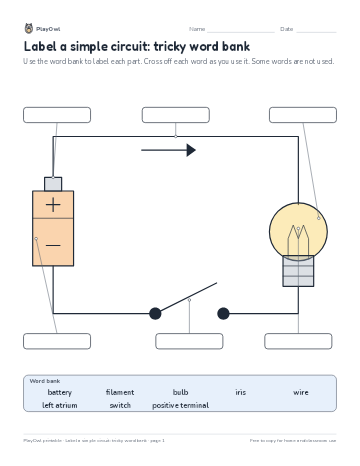 Label a simple circuit: tricky word bank
Science · Grade 9 · Worksheet · 1 page
Label a simple circuit: tricky word bank
Science · Grade 9 · Worksheet · 1 page
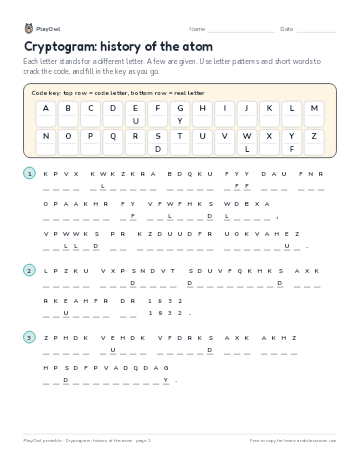 Cryptogram: history of the atom
Science · Grade 9 · Puzzle · 1 page
Cryptogram: history of the atom
Science · Grade 9 · Puzzle · 1 page
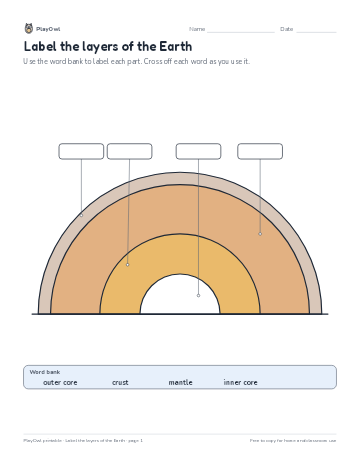 Label the layers of the Earth
Science · 8–9 · Worksheet · 1 page
Label the layers of the Earth
Science · 8–9 · Worksheet · 1 page
Printable generator
Make your own printables
Make brand-new sheets like this one, with answer keys, using the printable generator that comes with a PlayOwl plan. This sheet stays free.