Reading passage · History, Civics & Social Studies
Why the Constitution gained a Bill of Rights · Grade 9
An original passage about the Constitution and Bill of Rights with 7 questions that check details, inference and vocabulary.
- Grade 9 · ages 14 to 15
- Medium
- 45 to 55 minutes
- 3 pages
- Free
The answer key is a separate page for grown-ups. Sign in to download it.
The passage and its 7 questions
Directions: Read the passage carefully. Then answer the questions in full sentences.
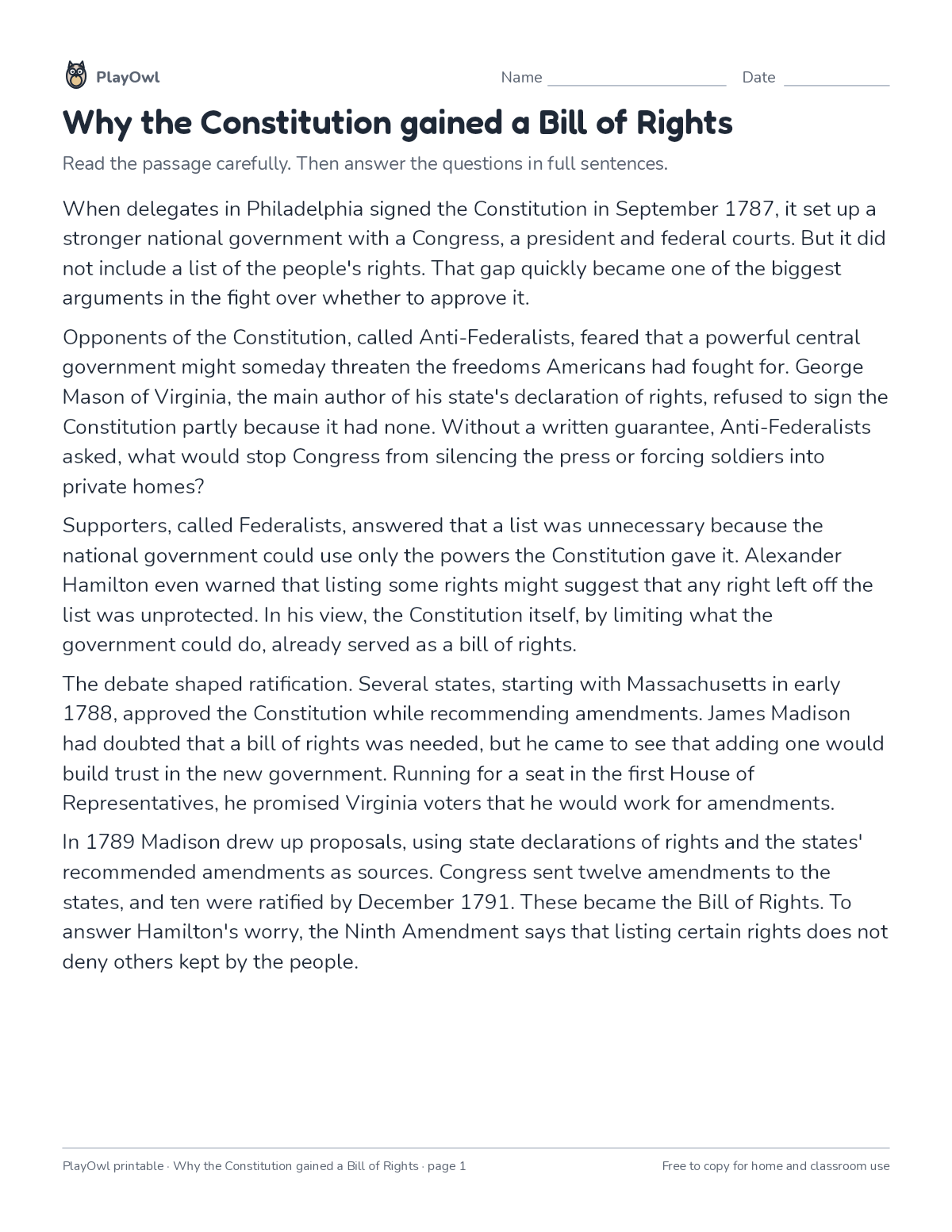
- When delegates in Philadelphia signed the Constitution in September 1787, it set up a stronger national government with a Congress, a president and federal courts. But it did not include a list of the people's rights. That gap quickly became one of the biggest arguments in the fight over whether to approve it.
- Opponents of the Constitution, called Anti-Federalists, feared that a powerful central government might someday threaten the freedoms Americans had fought for. George
- Mason of Virginia, the main author of his state's declaration of rights, refused to sign the
- Constitution partly because it had none. Without a written guarantee, Anti-Federalists asked, what would stop Congress from silencing the press or forcing soldiers into private homes?
- Supporters, called Federalists, answered that a list was unnecessary because the national government could use only the powers the Constitution gave it. Alexander
- Hamilton even warned that listing some rights might suggest that any right left off the list was unprotected. In his view, the Constitution itself, by limiting what the government could do, already served as a bill of rights.
- The debate shaped ratification. Several states, starting with Massachusetts in early
- 1788, approved the Constitution while recommending amendments. James Madison had doubted that a bill of rights was needed, but he came to see that adding one would build trust in the new government. Running for a seat in the first House of
- Representatives, he promised Virginia voters that he would work for amendments.
- In 1789 Madison drew up proposals, using state declarations of rights and the states' recommended amendments as sources. Congress sent twelve amendments to the states, and ten were ratified by December 1791. These became the Bill of Rights. To answer Hamilton's worry, the Ninth Amendment says that listing certain rights does not deny others kept by the people.
- One of the two unratified proposals had a surprising future. It said that a pay raise
- Congress voted for itself could not take effect until after the next election. A campaign to revive it began in the 1980s, enough states approved it, and in 1992 it became the
- Twenty-seventh Amendment, more than two hundred years after Madison first proposed it.
- 1. What was the Anti-Federalists' main objection to the Constitution?
- 2. Why did Hamilton think a list of rights could be dangerous?
- 3. How did the Ninth Amendment answer Hamilton's concern?
- 4. What does 'ratification' mean in paragraph 4?
- 5. Why might Madison have changed his mind about a bill of rights?
- 6. Copy the sentence that shows how the states influenced the Bill of Rights.
- 7. Analyze how the author structures the passage to build an argument or explanation.
What your child practices
Your child practices the history and social studies skill “Rules, government and participation”: explain how rules, institutions and civic participation work at different levels.
- Grades and ages
- Grade 9, ages 14 to 15
- Time
- About 45 to 55 minutes
- Subject
- History, Civics & Social Studies
- Level
- Medium for Grade 9
- Answer key
- Yes, for grown-ups who sign in
- Printing
- 3 pages, US Letter or A4, low-ink option
- Updated
How to use it
Read the passage once just for the story or the facts, then again with the questions in mind. Encourage underlining the words in the text that back up each answer. It is pitched at the expected level for Grade 9, for practice after the skill has been taught. Its 3 pages split well across two sittings.
An answer key comes with it as a separate page that grown-ups download after signing in.
Tip for grown-ups: Ask your child to point to the sentence that answers each question before writing it.
Done on paper? A grown-up can record it on the child's page in PlayOwl; downloading alone doesn't count as finished.
History, Civics & Social Studies · Grade 9
More like this
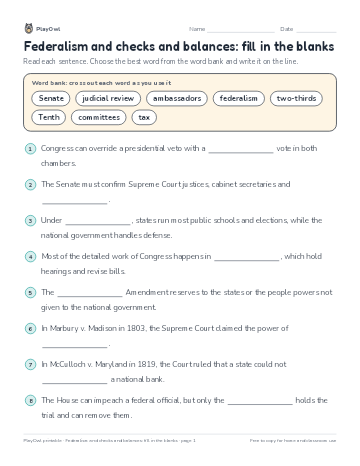 Federalism and checks and balances: fill in the blanks
History, Civics & Social Studies · 9–10 · Reading · 1 page
Federalism and checks and balances: fill in the blanks
History, Civics & Social Studies · 9–10 · Reading · 1 page
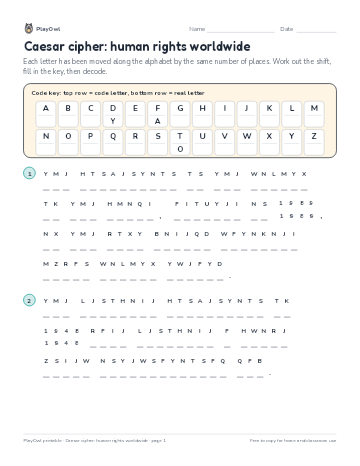 Caesar cipher: human rights worldwide
History, Civics & Social Studies · Grade 10 · Puzzle · 1 page
Caesar cipher: human rights worldwide
History, Civics & Social Studies · Grade 10 · Puzzle · 1 page
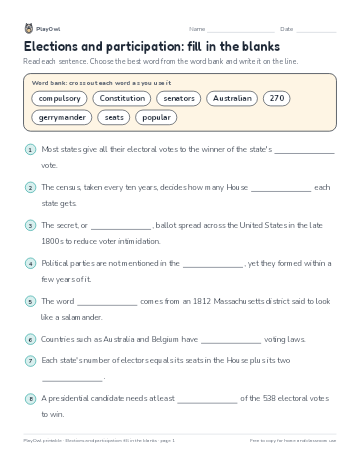 Elections and participation: fill in the blanks
History, Civics & Social Studies · Grade 12 · Reading · 1 page
Elections and participation: fill in the blanks
History, Civics & Social Studies · Grade 12 · Reading · 1 page
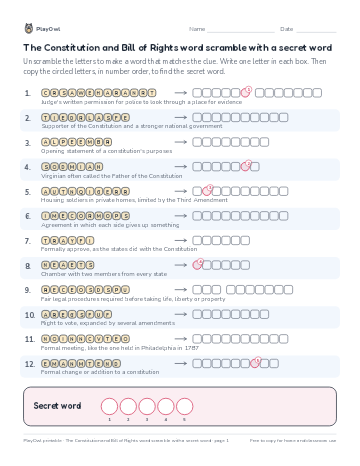 The Constitution and Bill of Rights word scramble with a secret word
History, Civics & Social Studies · Grade 8 · Puzzle · 1 page
The Constitution and Bill of Rights word scramble with a secret word
History, Civics & Social Studies · Grade 8 · Puzzle · 1 page
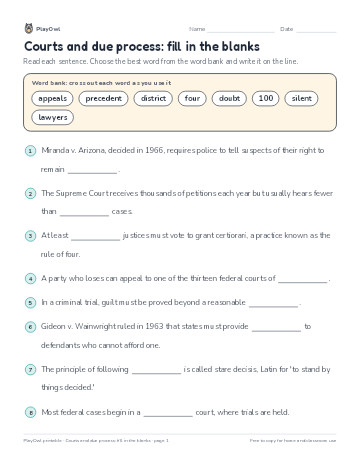 Courts and due process: fill in the blanks
History, Civics & Social Studies · Grade 11 · Reading · 1 page
Courts and due process: fill in the blanks
History, Civics & Social Studies · Grade 11 · Reading · 1 page
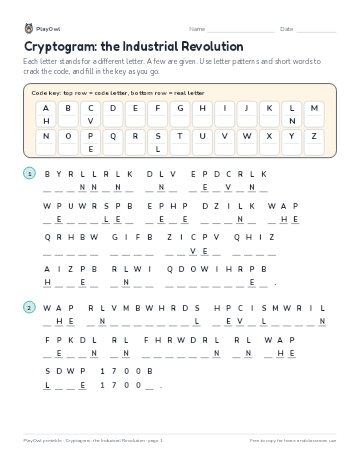 Cryptogram: the Industrial Revolution
History, Civics & Social Studies · Grade 9 · Puzzle · 1 page
Cryptogram: the Industrial Revolution
History, Civics & Social Studies · Grade 9 · Puzzle · 1 page
Printable generator
Make your own printables
Make brand-new sheets like this one, with answer keys, using the printable generator that comes with a PlayOwl plan. This sheet stays free.