Reading passage · English
What I did not say: stretch · Grade 10
An original passage about narrative craft and point of view with 8 questions that check details, inference and vocabulary.
- Grade 10 · ages 15 to 16
- Hard
- 50 to 60 minutes
- 3 pages
- Free
The answer key is a separate page for grown-ups. Sign in to download it.
The passage and its 8 questions
Directions: Read the passage carefully. Then answer the questions in full sentences.
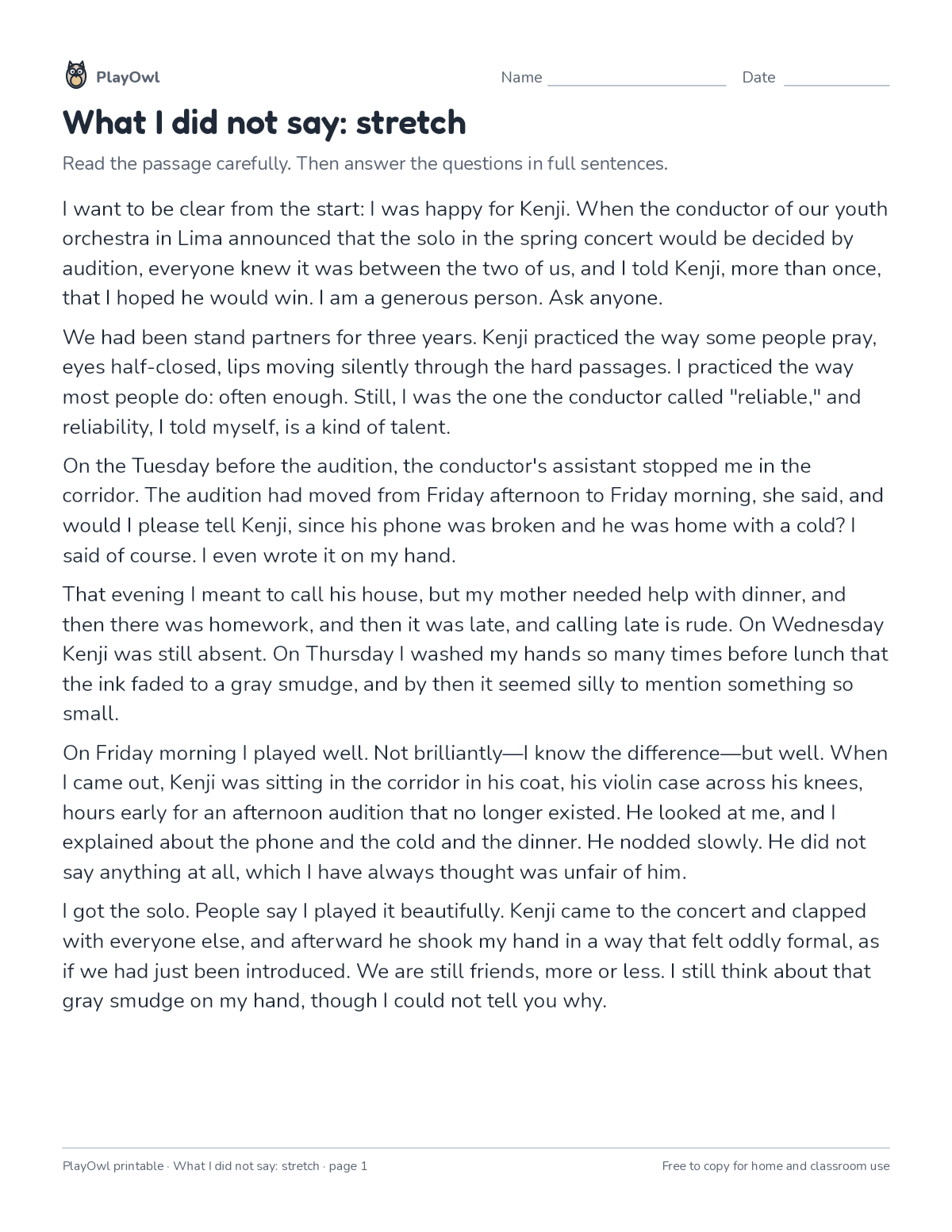
- I want to be clear from the start: I was happy for Kenji. When the conductor of our youth orchestra in Lima announced that the solo in the spring concert would be decided by audition, everyone knew it was between the two of us, and I told Kenji, more than once, that I hoped he would win. I am a generous person. Ask anyone.
- We had been stand partners for three years. Kenji practiced the way some people pray, eyes half-closed, lips moving silently through the hard passages. I practiced the way most people do: often enough. Still, I was the one the conductor called "reliable," and reliability, I told myself, is a kind of talent.
- On the Tuesday before the audition, the conductor's assistant stopped me in the corridor. The audition had moved from Friday afternoon to Friday morning, she said, and would I please tell Kenji, since his phone was broken and he was home with a cold? I said of course. I even wrote it on my hand.
- That evening I meant to call his house, but my mother needed help with dinner, and then there was homework, and then it was late, and calling late is rude. On Wednesday
- Kenji was still absent. On Thursday I washed my hands so many times before lunch that the ink faded to a gray smudge, and by then it seemed silly to mention something so small.
- On Friday morning I played well. Not brilliantly—I know the difference—but well. When
- I came out, Kenji was sitting in the corridor in his coat, his violin case across his knees, hours early for an afternoon audition that no longer existed. He looked at me, and I explained about the phone and the cold and the dinner. He nodded slowly. He did not say anything at all, which I have always thought was unfair of him.
- I got the solo. People say I played it beautifully. Kenji came to the concert and clapped with everyone else, and afterward he shook my hand in a way that felt oddly formal, as if we had just been introduced. We are still friends, more or less. I still think about that gray smudge on my hand, though I could not tell you why.
- 1. On the surface, the story is about an audition. What is it really about?
- 2. The narrator says, 'I am a generous person. Ask anyone.' Why might a careful reader doubt him?
- 3. In paragraph 6, Kenji shakes hands 'in a way that felt oddly formal.' What does the word 'formal' suggest about the friendship now?
- 4. How does the author use the ink on the narrator's hand as a symbol?
- 5. Copy the sentence in which the narrator's excuses pile up, and explain how its structure reveals his self-justification.
- 6. Is the narrator's failure deliberate? Argue for one reading using evidence from the story.
- 7. Find a word in the passage that was new or tricky for you. What do you think it means? Which words around it helped you?
- 8. Write a counterargument or alternative view and respond to it.
What your child practices
Your child practices the reading and English skill “Make inferences”: infer what happened using clues in a text.
- Grades and ages
- Grade 10, ages 15 to 16
- Time
- About 50 to 60 minutes
- Subject
- English
- Level
- Hard for Grade 10
- Answer key
- Yes, for grown-ups who sign in
- Printing
- 3 pages, US Letter or A4, low-ink option
- Updated
How to use it
Read the passage once just for the story or the facts, then again with the questions in mind. Encourage underlining the words in the text that back up each answer. It is one of the harder sheets for Grade 10, best once the basics of the skill are secure. Its 3 pages split well across two sittings.
An answer key comes with it as a separate page that grown-ups download after signing in.
Tip for grown-ups: Ask your child to point to the sentence that answers each question before writing it.
Done on paper? A grown-up can record it on the child's page in PlayOwl; downloading alone doesn't count as finished.
English · Grade 10
More like this
 Narrative craft and point of view crossword
English · Grade 10 · Puzzle · 1 page
Narrative craft and point of view crossword
English · Grade 10 · Puzzle · 1 page
 The day the sky disobeyed: warm-up
English · Grade 8 · Reading · 2 pages
The day the sky disobeyed: warm-up
English · Grade 8 · Reading · 2 pages
 Poetry comic strip: 6 panels
English · Grade 10 · Worksheet · 1 page
Poetry comic strip: 6 panels
English · Grade 10 · Worksheet · 1 page
 The clock that found the sea: warm-up
English · Grade 10 · Reading · 2 pages
The clock that found the sea: warm-up
English · Grade 10 · Reading · 2 pages
 The lighthouse keeper's map
English · 3–5 · Reading · 1 page
The lighthouse keeper's map
English · 3–5 · Reading · 1 page
 The last buttonhole: stretch
English · Grade 9 · Reading · 2 pages
The last buttonhole: stretch
English · Grade 9 · Reading · 2 pages
Printable generator
Make your own printables
Make brand-new sheets like this one, with answer keys, using the printable generator that comes with a PlayOwl plan. This sheet stays free.