Reading passage · English
The clock that found the sea: warm-up · Grade 10
An original passage about research and sources with 4 questions that check details, inference and vocabulary.
- Grade 10 · ages 15 to 16
- Easy
- 25 to 35 minutes
- 2 pages
- Free
The answer key is a separate page for grown-ups. Sign in to download it.
The passage and its 4 questions
Directions: Read the passage carefully. Then answer the questions in full sentences.
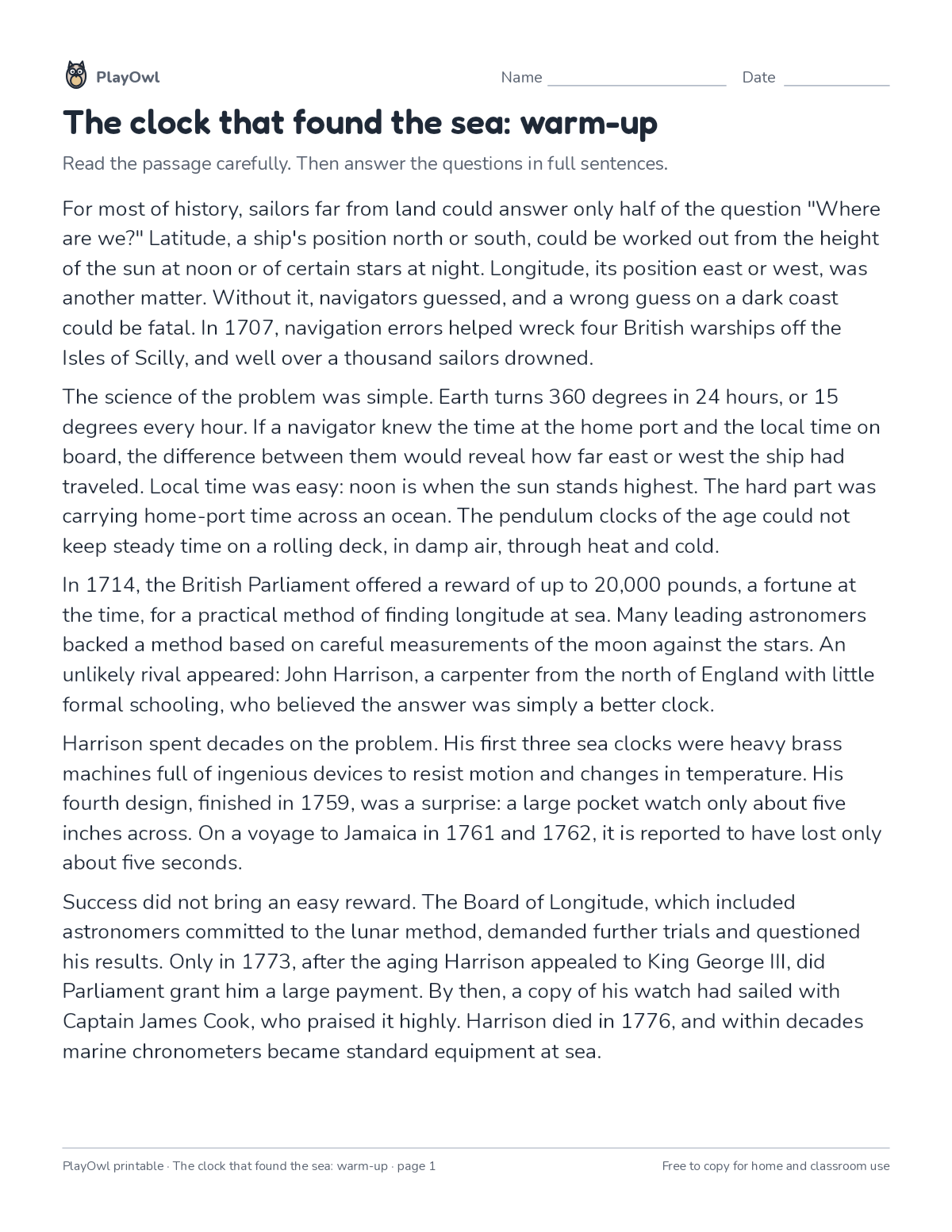
- For most of history, sailors far from land could answer only half of the question "Where are we?" Latitude, a ship's position north or south, could be worked out from the height of the sun at noon or of certain stars at night. Longitude, its position east or west, was another matter. Without it, navigators guessed, and a wrong guess on a dark coast could be fatal. In 1707, navigation errors helped wreck four British warships off the
- Isles of Scilly, and well over a thousand sailors drowned.
- The science of the problem was simple. Earth turns 360 degrees in 24 hours, or 15 degrees every hour. If a navigator knew the time at the home port and the local time on board, the difference between them would reveal how far east or west the ship had traveled. Local time was easy: noon is when the sun stands highest. The hard part was carrying home-port time across an ocean. The pendulum clocks of the age could not keep steady time on a rolling deck, in damp air, through heat and cold.
- In 1714, the British Parliament offered a reward of up to 20,000 pounds, a fortune at the time, for a practical method of finding longitude at sea. Many leading astronomers backed a method based on careful measurements of the moon against the stars. An unlikely rival appeared: John Harrison, a carpenter from the north of England with little formal schooling, who believed the answer was simply a better clock.
- Harrison spent decades on the problem. His first three sea clocks were heavy brass machines full of ingenious devices to resist motion and changes in temperature. His fourth design, finished in 1759, was a surprise: a large pocket watch only about five inches across. On a voyage to Jamaica in 1761 and 1762, it is reported to have lost only about five seconds.
- Success did not bring an easy reward. The Board of Longitude, which included astronomers committed to the lunar method, demanded further trials and questioned his results. Only in 1773, after the aging Harrison appealed to King George III, did
- Parliament grant him a large payment. By then, a copy of his watch had sailed with
- Captain James Cook, who praised it highly. Harrison died in 1776, and within decades marine chronometers became standard equipment at sea.
- The story is often told as a lone genius defeating stubborn experts, but it is more tangled than that. The lunar method also worked, and navigators used both for years.
- What Harrison proved was that a problem of the heavens could be solved by craft as well as by theory.
- 1. What problem does the passage describe, and how did Harrison's approach differ from the astronomers'?
- 2. Why might the astronomers on the Board of Longitude have been slow to accept
- Harrison's results?
- 3. In paragraph 3, Harrison is called 'an unlikely rival.' What does 'unlikely' suggest, and why is it apt?
- 4. Evaluate the strongest and weakest evidence in the passage.
What your child practices
Your child practices the reading and English skill “Cite text evidence”: choose the sentence that supports an answer.
- Grades and ages
- Grade 10, ages 15 to 16
- Time
- About 25 to 35 minutes
- Subject
- English
- Level
- Easy for Grade 10
- Answer key
- Yes, for grown-ups who sign in
- Printing
- 2 pages, US Letter or A4, low-ink option
- Updated
How to use it
Read the passage once just for the story or the facts, then again with the questions in mind. Encourage underlining the words in the text that back up each answer. It is one of the easier sheets for Grade 10, good as a warm-up or a first look at the skill. Its 2 pages split well across two sittings.
An answer key comes with it as a separate page that grown-ups download after signing in.
Tip for grown-ups: Ask your child to point to the sentence that answers each question before writing it.
Done on paper? A grown-up can record it on the child's page in PlayOwl; downloading alone doesn't count as finished.
English · Grade 10
More like this
 Caesar cipher: rhetorical devices
English · 10–12 · Puzzle · 1 page
Caesar cipher: rhetorical devices
English · 10–12 · Puzzle · 1 page
 Narrative craft and point of view crossword
English · Grade 10 · Puzzle · 1 page
Narrative craft and point of view crossword
English · Grade 10 · Puzzle · 1 page
 What I did not say: stretch
English · Grade 10 · Reading · 3 pages
What I did not say: stretch
English · Grade 10 · Reading · 3 pages
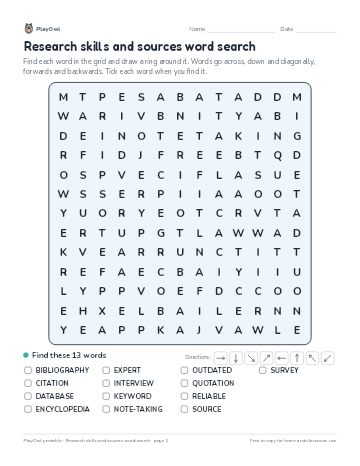 Research skills and sources word search
English · Grade 6 · Puzzle · 1 page
Research skills and sources word search
English · Grade 6 · Puzzle · 1 page
 Media literacy comic strip: 5 panels
English · Grade 8 · Worksheet · 1 page
Media literacy comic strip: 5 panels
English · Grade 8 · Worksheet · 1 page
 Research and sources comic strip: 5 panels
English · Grade 9 · Worksheet · 1 page
Research and sources comic strip: 5 panels
English · Grade 9 · Worksheet · 1 page
Printable generator
Make your own printables
Make brand-new sheets like this one, with answer keys, using the printable generator that comes with a PlayOwl plan. This sheet stays free.