Reading passage · History, Civics & Social Studies
How Gideon's case reached the Supreme Court · Grades 10–12
An original passage about courts and due process with 7 questions that check details, inference and vocabulary.
- Grades 10–12 · ages 15 to 18
- Medium
- 45 to 55 minutes
- 3 pages
- Free
The answer key is a separate page for grown-ups. Sign in to download it.
The passage and its 7 questions
Directions: Read the passage carefully. Then answer the questions in full sentences.
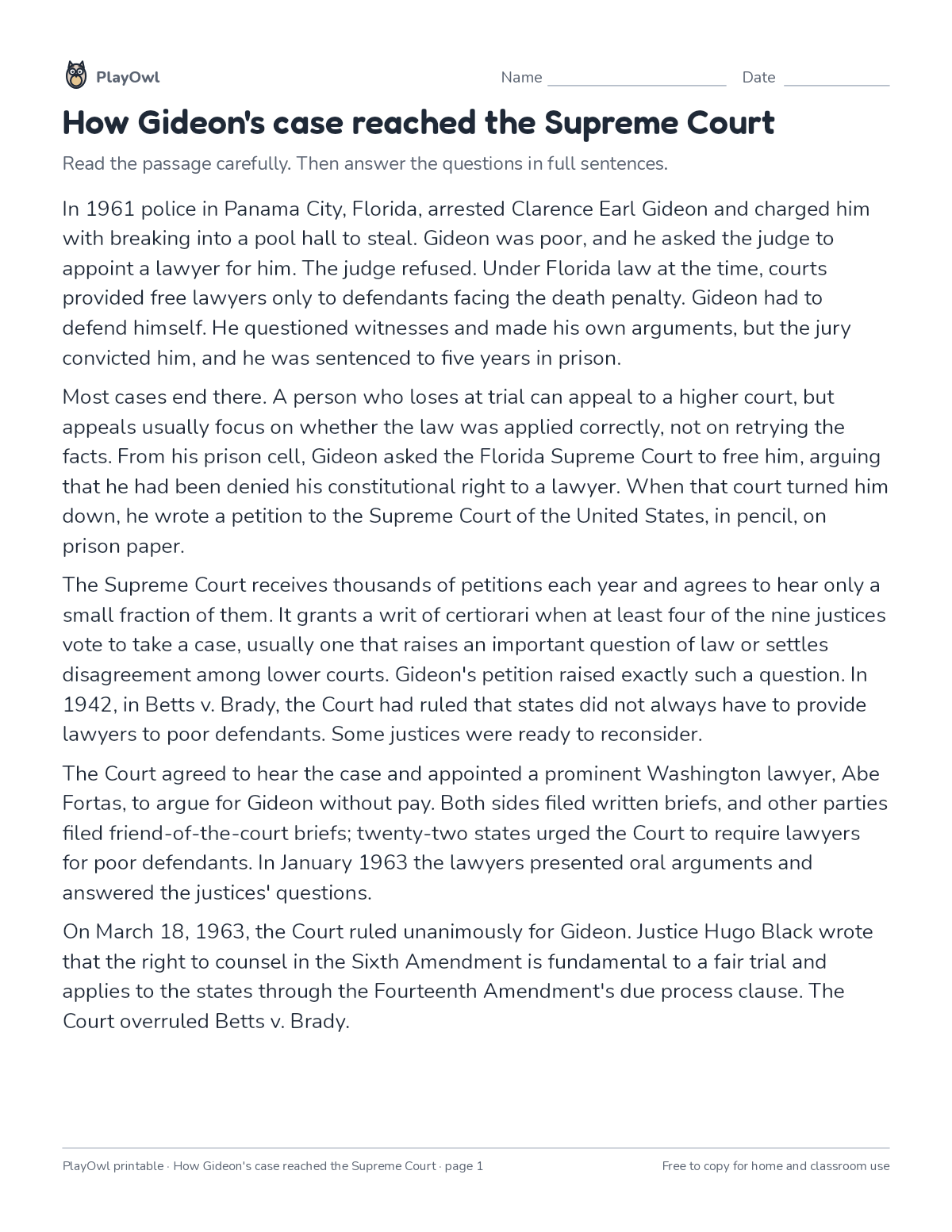
- In 1961 police in Panama City, Florida, arrested Clarence Earl Gideon and charged him with breaking into a pool hall to steal. Gideon was poor, and he asked the judge to appoint a lawyer for him. The judge refused. Under Florida law at the time, courts provided free lawyers only to defendants facing the death penalty. Gideon had to defend himself. He questioned witnesses and made his own arguments, but the jury convicted him, and he was sentenced to five years in prison.
- Most cases end there. A person who loses at trial can appeal to a higher court, but appeals usually focus on whether the law was applied correctly, not on retrying the facts. From his prison cell, Gideon asked the Florida Supreme Court to free him, arguing that he had been denied his constitutional right to a lawyer. When that court turned him down, he wrote a petition to the Supreme Court of the United States, in pencil, on prison paper.
- The Supreme Court receives thousands of petitions each year and agrees to hear only a small fraction of them. It grants a writ of certiorari when at least four of the nine justices vote to take a case, usually one that raises an important question of law or settles disagreement among lower courts. Gideon's petition raised exactly such a question. In
- 1942, in Betts v. Brady, the Court had ruled that states did not always have to provide lawyers to poor defendants. Some justices were ready to reconsider.
- The Court agreed to hear the case and appointed a prominent Washington lawyer, Abe
- Fortas, to argue for Gideon without pay. Both sides filed written briefs, and other parties filed friend-of-the-court briefs; twenty-two states urged the Court to require lawyers for poor defendants. In January 1963 the lawyers presented oral arguments and answered the justices' questions.
- On March 18, 1963, the Court ruled unanimously for Gideon. Justice Hugo Black wrote that the right to counsel in the Sixth Amendment is fundamental to a fair trial and applies to the states through the Fourteenth Amendment's due process clause. The
- Court overruled Betts v. Brady.
- The ruling did not set Gideon free; it gave him a new trial. This time a lawyer represented him, questioned the witnesses closely and exposed weaknesses in the case against him. The jury found Gideon not guilty. Across the country, states created or expanded public defender systems so that people who cannot afford a lawyer would have one.
- 1. Why did the trial judge refuse to appoint a lawyer for Gideon?
- 2. What must happen for the Supreme Court to agree to hear a case?
- 3. Why was Gideon's petition a strong candidate for the Court to hear?
- 4. What does 'overruled' mean in paragraph 5?
- 5. What were the effects of the decision, both for Gideon and for the country?
- 6. Copy the sentence that explains how the Sixth Amendment came to apply to the states.
- 7. Explain how the passage connects to a current issue or another text you know.
What your child practices
Your child practices the history and social studies skill “Rules, government and participation”: explain how rules, institutions and civic participation work at different levels.
- Grades and ages
- Grades 10–12, ages 15 to 18
- Time
- About 45 to 55 minutes
- Subject
- History, Civics & Social Studies
- Level
- Medium for Grades 10–12
- Answer key
- Yes, for grown-ups who sign in
- Printing
- 3 pages, US Letter or A4, low-ink option
- Updated
How to use it
Read the passage once just for the story or the facts, then again with the questions in mind. Encourage underlining the words in the text that back up each answer. It is pitched at the expected level for Grades 10–12, for practice after the skill has been taught. Its 3 pages split well across two sittings.
An answer key comes with it as a separate page that grown-ups download after signing in.
Tip for grown-ups: Ask your child to point to the sentence that answers each question before writing it.
Done on paper? A grown-up can record it on the child's page in PlayOwl; downloading alone doesn't count as finished.
History, Civics & Social Studies · Grades 10–12
More like this
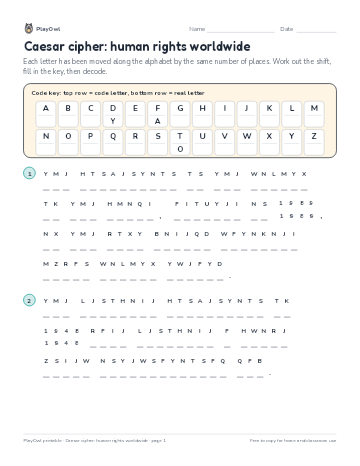 Caesar cipher: human rights worldwide
History, Civics & Social Studies · Grade 10 · Puzzle · 1 page
Caesar cipher: human rights worldwide
History, Civics & Social Studies · Grade 10 · Puzzle · 1 page
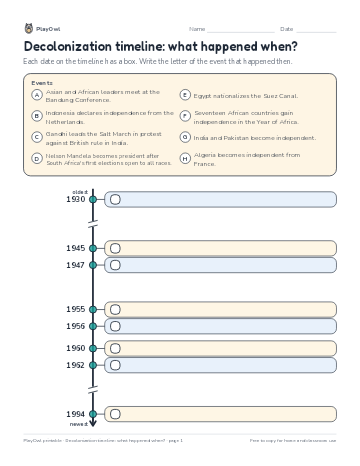 Decolonization timeline: what happened when?
History, Civics & Social Studies · Grade 11 · Worksheet · 1 page
Decolonization timeline: what happened when?
History, Civics & Social Studies · Grade 11 · Worksheet · 1 page
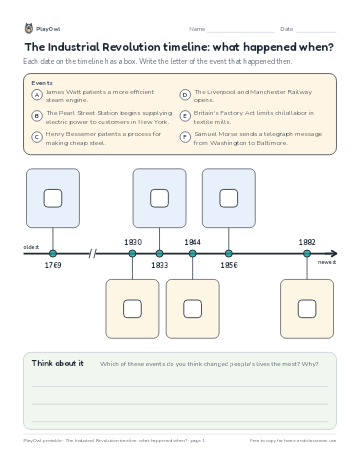 The Industrial Revolution timeline: what happened when?
History, Civics & Social Studies · Grade 10 · Worksheet · 1 page
The Industrial Revolution timeline: what happened when?
History, Civics & Social Studies · Grade 10 · Worksheet · 1 page
 The Montgomery bus boycott
History, Civics & Social Studies · Grade 11 · Reading · 3 pages
The Montgomery bus boycott
History, Civics & Social Studies · Grade 11 · Reading · 3 pages
 The world wars: put events in order
History, Civics & Social Studies · Grade 10 · Worksheet · 1 page
The world wars: put events in order
History, Civics & Social Studies · Grade 10 · Worksheet · 1 page
 The civil rights movement word search
History, Civics & Social Studies · Grade 10 · Puzzle · 1 page
The civil rights movement word search
History, Civics & Social Studies · Grade 10 · Puzzle · 1 page
Printable generator
Make your own printables
Make brand-new sheets like this one, with answer keys, using the printable generator that comes with a PlayOwl plan. This sheet stays free.