Reading passage · English
The numbers that argued back: stretch · Grades 11–12
An original passage about academic research and citation with 8 questions that check details, inference and vocabulary.
- Grades 11–12 · ages 16 to 18
- Hard
- 55 to 65 minutes
- 3 pages
- Free
The answer key is a separate page for grown-ups. Sign in to download it.
The passage and its 9 questions
Directions: Read the passage carefully. Then answer the questions in full sentences.
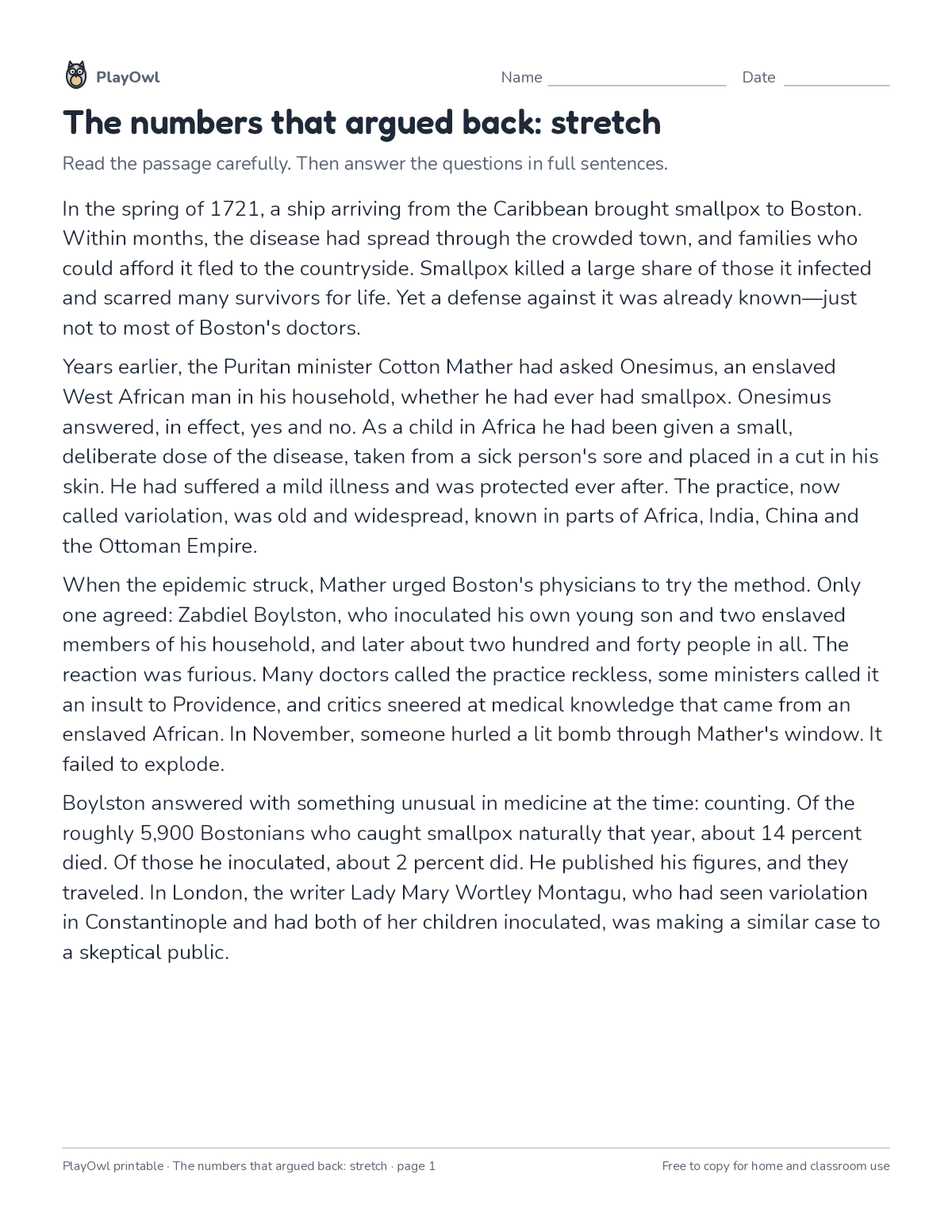
- In the spring of 1721, a ship arriving from the Caribbean brought smallpox to Boston.
- Within months, the disease had spread through the crowded town, and families who could afford it fled to the countryside. Smallpox killed a large share of those it infected and scarred many survivors for life. Yet a defense against it was already known—just not to most of Boston's doctors.
- Years earlier, the Puritan minister Cotton Mather had asked Onesimus, an enslaved
- West African man in his household, whether he had ever had smallpox. Onesimus answered, in effect, yes and no. As a child in Africa he had been given a small, deliberate dose of the disease, taken from a sick person's sore and placed in a cut in his skin. He had suffered a mild illness and was protected ever after. The practice, now called variolation, was old and widespread, known in parts of Africa, India, China and the Ottoman Empire.
- When the epidemic struck, Mather urged Boston's physicians to try the method. Only one agreed: Zabdiel Boylston, who inoculated his own young son and two enslaved members of his household, and later about two hundred and forty people in all. The reaction was furious. Many doctors called the practice reckless, some ministers called it an insult to Providence, and critics sneered at medical knowledge that came from an enslaved African. In November, someone hurled a lit bomb through Mather's window. It failed to explode.
- Boylston answered with something unusual in medicine at the time: counting. Of the roughly 5,900 Bostonians who caught smallpox naturally that year, about 14 percent died. Of those he inoculated, about 2 percent did. He published his figures, and they traveled. In London, the writer Lady Mary Wortley Montagu, who had seen variolation in Constantinople and had both of her children inoculated, was making a similar case to a skeptical public.
- Variolation was not safe. It could kill, and inoculated patients could spread the disease to others. But the numbers changed the terms of the debate: the question was no longer whether a remedy was strange or foreign, but whether it worked better than the alternative. That shift prepared the ground for Edward Jenner's safer cowpox vaccine in
- 1796 and, nearly two centuries later, for the global campaign that eradicated smallpox in 1980.
- It is tempting to tell this story as a triumph of reason over fear. It is also a story about whose knowledge counts. The idea that saved lives in Boston arrived not in a learned journal but in the memory of a man the town did not consider free.
- 1. What is the author's central claim about the significance of the 1721 Boston inoculation debate?
- 2. Why might some critics have attacked the source of the idea rather than its results?
- What fallacy does this resemble?
- 3. In paragraph 3, critics 'sneered.' How would the meaning change if the author had written 'objected'?
- 4. Why does the author include the paragraph that begins 'Variolation was not safe'?
- How does it affect the passage's credibility?
- 5. Copy the sentence that best supports the idea that numbers changed the debate, and explain how.
- 6. Name two primary sources a researcher could consult to verify this passage's claims.
- 7. Find a word in the passage that was new or tricky for you. What do you think it means? Which words around it helped you?
- 8. Rewrite the opening sentence for a different audience and explain your choices.
What your child practices
Your child practices the reading and English skill “Cite text evidence”: choose the sentence that supports an answer.
- Grades and ages
- Grades 11–12, ages 16 to 18
- Time
- About 55 to 65 minutes
- Subject
- English
- Level
- Hard for Grades 11–12
- Answer key
- Yes, for grown-ups who sign in
- Printing
- 3 pages, US Letter or A4, low-ink option
- Updated
How to use it
Read the passage once just for the story or the facts, then again with the questions in mind. Encourage underlining the words in the text that back up each answer. It is one of the harder sheets for Grades 11–12, best once the basics of the skill are secure. Its 3 pages split well across two sittings.
An answer key comes with it as a separate page that grown-ups download after signing in.
Tip for grown-ups: Ask your child to point to the sentence that answers each question before writing it.
Done on paper? A grown-up can record it on the child's page in PlayOwl; downloading alone doesn't count as finished.
English · Grades 11–12
More like this
 A modest proposal for rating everyone: stretch
English · Grade 11 · Reading · 3 pages
A modest proposal for rating everyone: stretch
English · Grade 11 · Reading · 3 pages
 Literary criticism comic strip: 5 panels
English · Grade 12 · Worksheet · 1 page
Literary criticism comic strip: 5 panels
English · Grade 12 · Worksheet · 1 page
 Until it looks right: warm-up
English · Grade 11 · Reading · 2 pages
Until it looks right: warm-up
English · Grade 11 · Reading · 2 pages
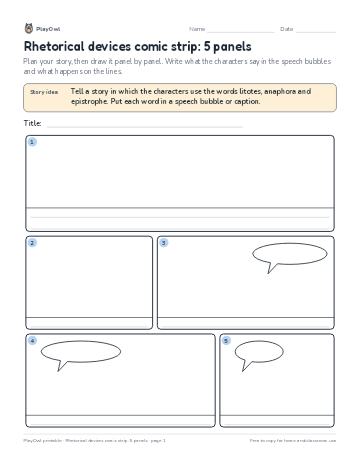 Rhetorical devices comic strip: 5 panels
English · Grade 11 · Worksheet · 1 page
Rhetorical devices comic strip: 5 panels
English · Grade 11 · Worksheet · 1 page
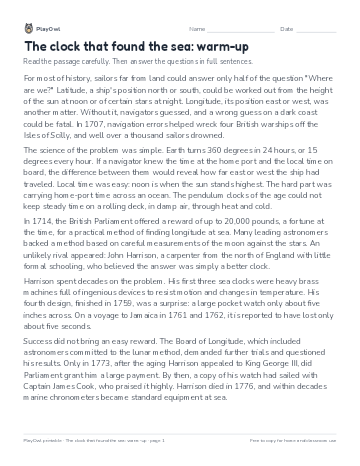 The clock that found the sea: warm-up
English · Grade 10 · Reading · 2 pages
The clock that found the sea: warm-up
English · Grade 10 · Reading · 2 pages
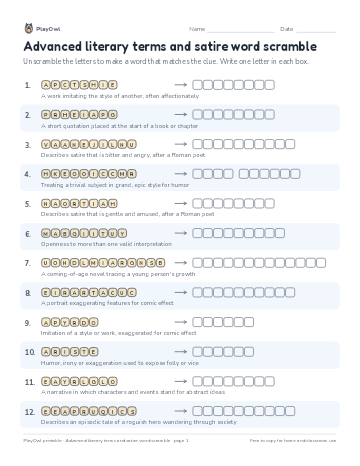 Advanced literary terms and satire word scramble
English · Grade 12 · Puzzle · 1 page
Advanced literary terms and satire word scramble
English · Grade 12 · Puzzle · 1 page
Printable generator
Make your own printables
Make brand-new sheets like this one, with answer keys, using the printable generator that comes with a PlayOwl plan. This sheet stays free.