Reading passage · Science
Photo 51 and the shape of life · Grade 11
An original passage about DNA and molecular genetics with 7 questions that check details, inference and vocabulary.
- Grade 11 · ages 16 to 17
- Medium
- 30 to 40 minutes
- 2 pages
- Free
The answer key is a separate page for grown-ups. Sign in to download it.
The passage and its 7 questions
Directions: Read the passage carefully. Then answer the questions in full sentences.
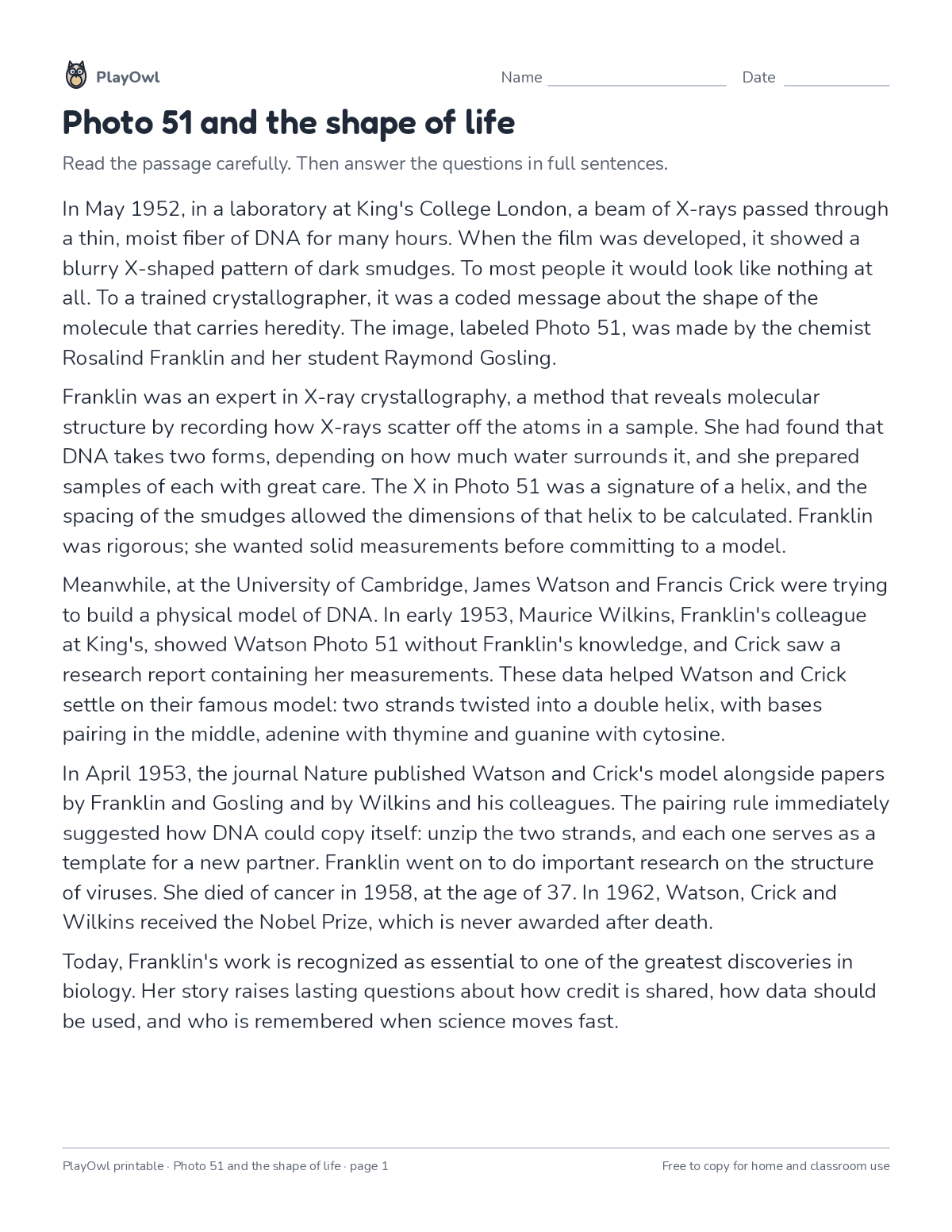
- In May 1952, in a laboratory at King's College London, a beam of X-rays passed through a thin, moist fiber of DNA for many hours. When the film was developed, it showed a blurry X-shaped pattern of dark smudges. To most people it would look like nothing at all. To a trained crystallographer, it was a coded message about the shape of the molecule that carries heredity. The image, labeled Photo 51, was made by the chemist
- Rosalind Franklin and her student Raymond Gosling.
- Franklin was an expert in X-ray crystallography, a method that reveals molecular structure by recording how X-rays scatter off the atoms in a sample. She had found that
- DNA takes two forms, depending on how much water surrounds it, and she prepared samples of each with great care. The X in Photo 51 was a signature of a helix, and the spacing of the smudges allowed the dimensions of that helix to be calculated. Franklin was rigorous; she wanted solid measurements before committing to a model.
- Meanwhile, at the University of Cambridge, James Watson and Francis Crick were trying to build a physical model of DNA. In early 1953, Maurice Wilkins, Franklin's colleague at King's, showed Watson Photo 51 without Franklin's knowledge, and Crick saw a research report containing her measurements. These data helped Watson and Crick settle on their famous model: two strands twisted into a double helix, with bases pairing in the middle, adenine with thymine and guanine with cytosine.
- In April 1953, the journal Nature published Watson and Crick's model alongside papers by Franklin and Gosling and by Wilkins and his colleagues. The pairing rule immediately suggested how DNA could copy itself: unzip the two strands, and each one serves as a template for a new partner. Franklin went on to do important research on the structure of viruses. She died of cancer in 1958, at the age of 37. In 1962, Watson, Crick and
- Wilkins received the Nobel Prize, which is never awarded after death.
- Today, Franklin's work is recognized as essential to one of the greatest discoveries in biology. Her story raises lasting questions about how credit is shared, how data should be used, and who is remembered when science moves fast.
- 1. What is Photo 51, and who made it?
- 2. How did the X-shaped pattern help reveal DNA's structure?
- 3. What does the word "rigorous" mean in paragraph 2?
- 4. Copy the sentence that explains how base pairing suggested a way for DNA to copy itself.
- 5. Why does the author mention that the Nobel Prize is never awarded after death?
- 6. What ethical questions does the passage raise? Explain one in your own words.
- 7. Rewrite the opening sentence for a different audience and explain your choices.
What your child practices
Your child practices science for Grade 11 with this reading passage.
- Grades and ages
- Grade 11, ages 16 to 17
- Time
- About 30 to 40 minutes
- Subject
- Science
- Level
- Medium for Grade 11
- Answer key
- Yes, for grown-ups who sign in
- Printing
- 2 pages, US Letter or A4, low-ink option
- Updated
How to use it
Read the passage once just for the story or the facts, then again with the questions in mind. Encourage underlining the words in the text that back up each answer. It is pitched at the expected level for Grade 11, for practice after the topic has been taught. Its 2 pages split well across two sittings.
An answer key comes with it as a separate page that grown-ups download after signing in.
Tip for grown-ups: Ask your child to point to the sentence that answers each question before writing it.
Done on paper? A grown-up can record it on the child's page in PlayOwl; downloading alone doesn't count as finished.
Science · Grade 11
More like this
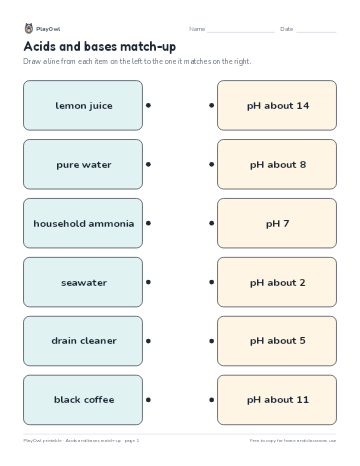 Acids and bases match-up
Science · Grade 11 · Worksheet · 1 page
Acids and bases match-up
Science · Grade 11 · Worksheet · 1 page
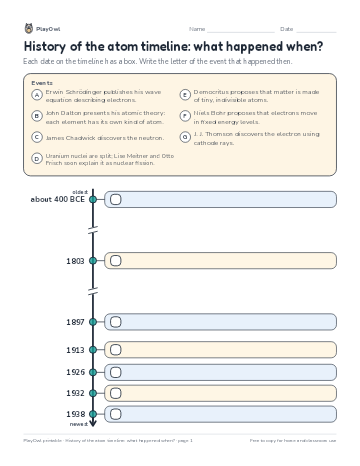 History of the atom timeline: what happened when?
Science · Grade 11 · Worksheet · 1 page
History of the atom timeline: what happened when?
Science · Grade 11 · Worksheet · 1 page
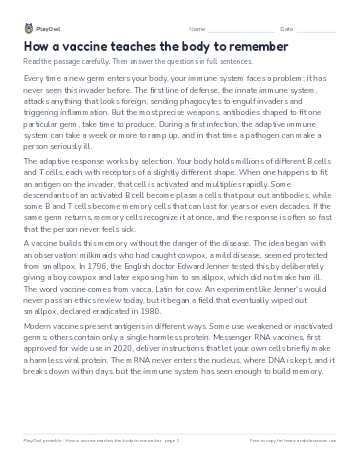 How a vaccine teaches the body to remember
Science · 10–12 · Reading · 3 pages
How a vaccine teaches the body to remember
Science · 10–12 · Reading · 3 pages
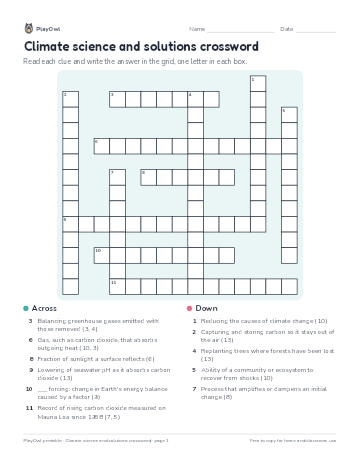 Climate science and solutions crossword
Science · Grade 11 · Puzzle · 1 page
Climate science and solutions crossword
Science · Grade 11 · Puzzle · 1 page
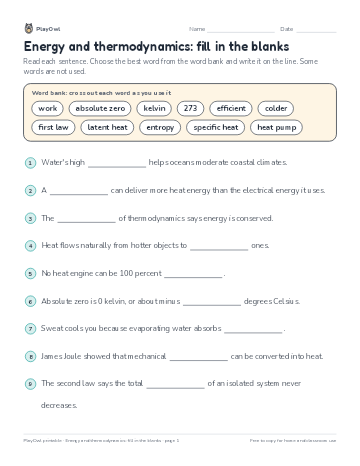 Energy and thermodynamics: fill in the blanks
Science · Grade 11 · Reading · 1 page
Energy and thermodynamics: fill in the blanks
Science · Grade 11 · Reading · 1 page
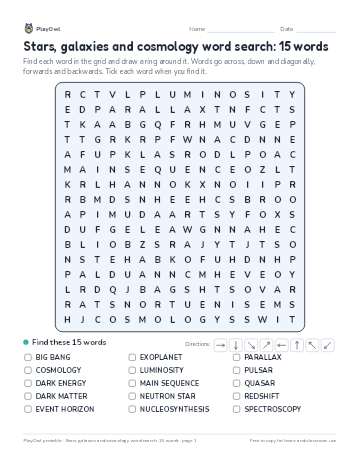 Stars, galaxies and cosmology word search: 15 words
Science · Grade 11 · Puzzle · 1 page
Stars, galaxies and cosmology word search: 15 words
Science · Grade 11 · Puzzle · 1 page
Printable generator
Make your own printables
Make brand-new sheets like this one, with answer keys, using the printable generator that comes with a PlayOwl plan. This sheet stays free.