Reading passage · English
Who owns the night: warm-up · Grade 12
An original passage about rhetorical analysis and classical oratory with 4 questions that check details, inference and vocabulary.
- Grade 12 · ages 17 to 18
- Easy
- 25 to 35 minutes
- 2 pages
- Free
The answer key is a separate page for grown-ups. Sign in to download it.
The passage and its 4 questions
Directions: Read the passage carefully. Then answer the questions in full sentences.
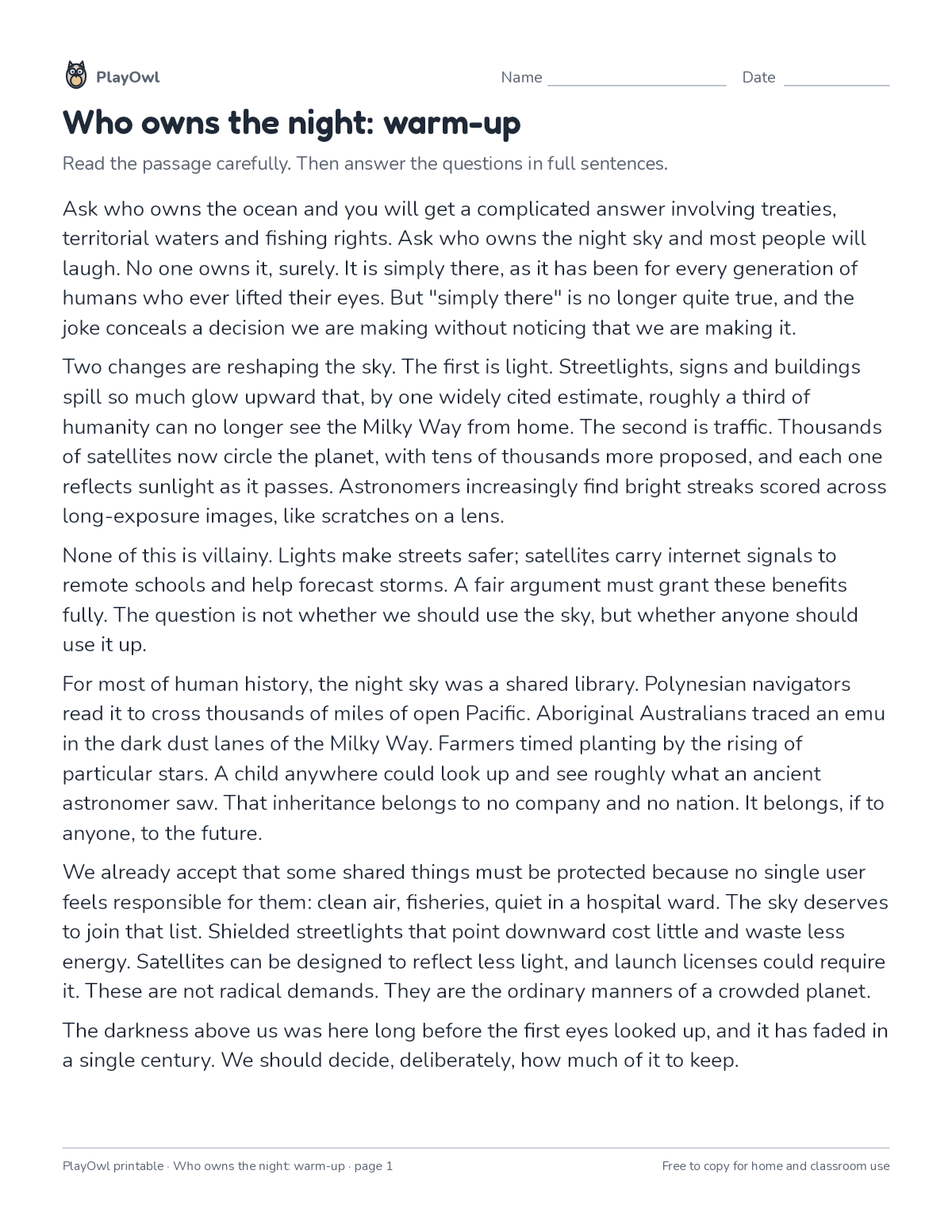
- Ask who owns the ocean and you will get a complicated answer involving treaties, territorial waters and fishing rights. Ask who owns the night sky and most people will laugh. No one owns it, surely. It is simply there, as it has been for every generation of humans who ever lifted their eyes. But "simply there" is no longer quite true, and the joke conceals a decision we are making without noticing that we are making it.
- Two changes are reshaping the sky. The first is light. Streetlights, signs and buildings spill so much glow upward that, by one widely cited estimate, roughly a third of humanity can no longer see the Milky Way from home. The second is traffic. Thousands of satellites now circle the planet, with tens of thousands more proposed, and each one reflects sunlight as it passes. Astronomers increasingly find bright streaks scored across long-exposure images, like scratches on a lens.
- None of this is villainy. Lights make streets safer; satellites carry internet signals to remote schools and help forecast storms. A fair argument must grant these benefits fully. The question is not whether we should use the sky, but whether anyone should use it up.
- For most of human history, the night sky was a shared library. Polynesian navigators read it to cross thousands of miles of open Pacific. Aboriginal Australians traced an emu in the dark dust lanes of the Milky Way. Farmers timed planting by the rising of particular stars. A child anywhere could look up and see roughly what an ancient astronomer saw. That inheritance belongs to no company and no nation. It belongs, if to anyone, to the future.
- We already accept that some shared things must be protected because no single user feels responsible for them: clean air, fisheries, quiet in a hospital ward. The sky deserves to join that list. Shielded streetlights that point downward cost little and waste less energy. Satellites can be designed to reflect less light, and launch licenses could require it. These are not radical demands. They are the ordinary manners of a crowded planet.
- The darkness above us was here long before the first eyes looked up, and it has faded in a single century. We should decide, deliberately, how much of it to keep.
- 1. What is the writer's central claim, and what practical steps does the writer propose?
- 2. Why does the writer begin by comparing the night sky to the ocean?
- 3. In paragraph 3, the writer distinguishes 'use the sky' from 'use it up.' Explain the difference and why the wording is effective.
- 4. Identify an assumption the author makes and discuss whether it holds.
What your child practices
Your child practices reading and English for Grade 12 with this reading passage.
- Grades and ages
- Grade 12, ages 17 to 18
- Time
- About 25 to 35 minutes
- Subject
- English
- Level
- Easy for Grade 12
- Answer key
- Yes, for grown-ups who sign in
- Printing
- 2 pages, US Letter or A4, low-ink option
- Updated
How to use it
Read the passage once just for the story or the facts, then again with the questions in mind. Encourage underlining the words in the text that back up each answer. It is one of the easier sheets for Grade 12, good as a warm-up or a first look at the topic. Its 2 pages split well across two sittings.
An answer key comes with it as a separate page that grown-ups download after signing in.
Tip for grown-ups: Ask your child to point to the sentence that answers each question before writing it.
Done on paper? A grown-up can record it on the child's page in PlayOwl; downloading alone doesn't count as finished.
English · Grade 12
More like this
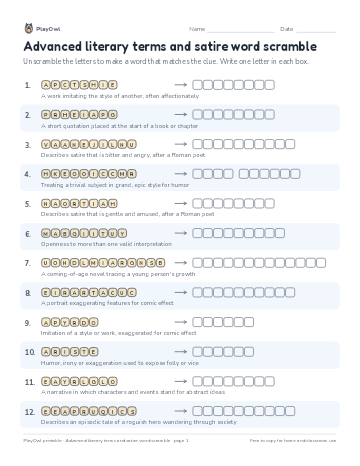 Advanced literary terms and satire word scramble
English · Grade 12 · Puzzle · 1 page
Advanced literary terms and satire word scramble
English · Grade 12 · Puzzle · 1 page
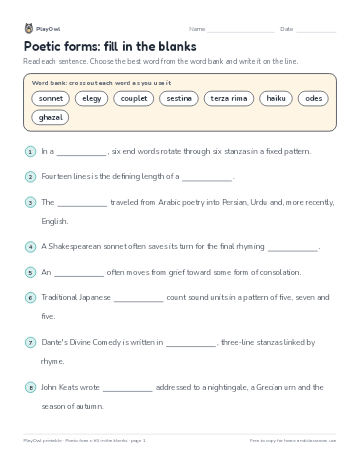 Poetic forms: fill in the blanks
English · 11–12 · Reading · 1 page
Poetic forms: fill in the blanks
English · 11–12 · Reading · 1 page
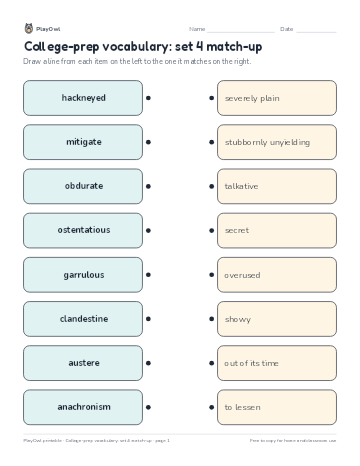 College-prep vocabulary: set 4 match-up
English · Grade 12 · Worksheet · 1 page
College-prep vocabulary: set 4 match-up
English · Grade 12 · Worksheet · 1 page
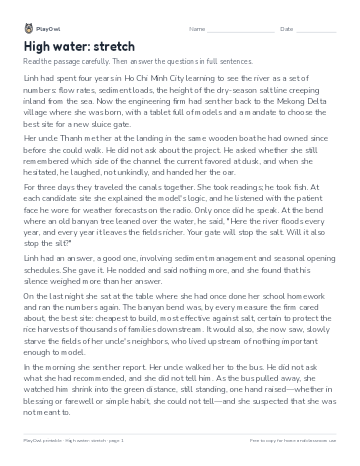 High water: stretch
English · Grade 12 · Reading · 3 pages
High water: stretch
English · Grade 12 · Reading · 3 pages
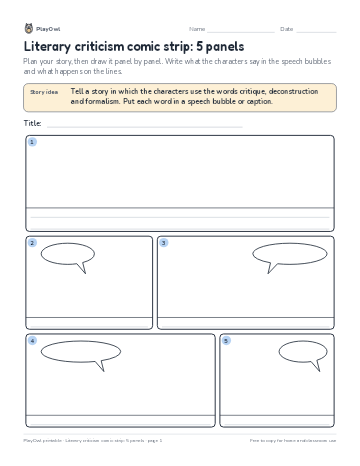 Literary criticism comic strip: 5 panels
English · Grade 12 · Worksheet · 1 page
Literary criticism comic strip: 5 panels
English · Grade 12 · Worksheet · 1 page
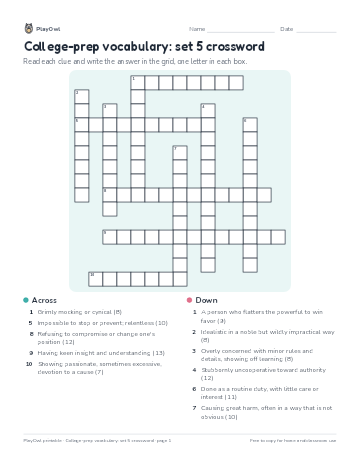 College-prep vocabulary: set 5 crossword
English · Grade 12 · Puzzle · 1 page
College-prep vocabulary: set 5 crossword
English · Grade 12 · Puzzle · 1 page
Printable generator
Make your own printables
Make brand-new sheets like this one, with answer keys, using the printable generator that comes with a PlayOwl plan. This sheet stays free.