Reading passage · English
High water: stretch · Grade 12
An original passage about literary criticism: critical lenses with 8 questions that check details, inference and vocabulary.
- Grade 12 · ages 17 to 18
- Hard
- 50 to 60 minutes
- 3 pages
- Free
The answer key is a separate page for grown-ups. Sign in to download it.
The passage and its 8 questions
Directions: Read the passage carefully. Then answer the questions in full sentences.
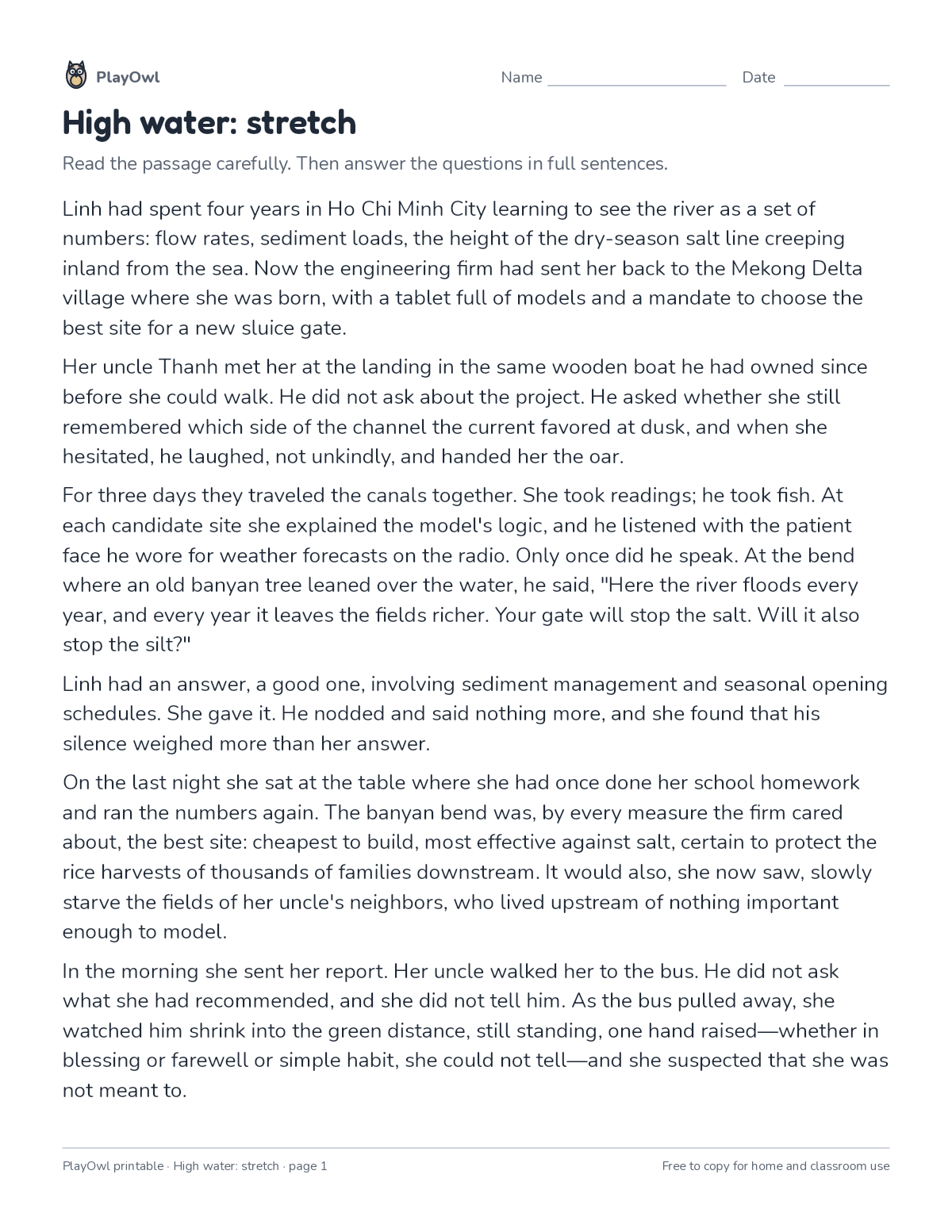
- Linh had spent four years in Ho Chi Minh City learning to see the river as a set of numbers: flow rates, sediment loads, the height of the dry-season salt line creeping inland from the sea. Now the engineering firm had sent her back to the Mekong Delta village where she was born, with a tablet full of models and a mandate to choose the best site for a new sluice gate.
- Her uncle Thanh met her at the landing in the same wooden boat he had owned since before she could walk. He did not ask about the project. He asked whether she still remembered which side of the channel the current favored at dusk, and when she hesitated, he laughed, not unkindly, and handed her the oar.
- For three days they traveled the canals together. She took readings; he took fish. At each candidate site she explained the model's logic, and he listened with the patient face he wore for weather forecasts on the radio. Only once did he speak. At the bend where an old banyan tree leaned over the water, he said, "Here the river floods every year, and every year it leaves the fields richer. Your gate will stop the salt. Will it also stop the silt?"
- Linh had an answer, a good one, involving sediment management and seasonal opening schedules. She gave it. He nodded and said nothing more, and she found that his silence weighed more than her answer.
- On the last night she sat at the table where she had once done her school homework and ran the numbers again. The banyan bend was, by every measure the firm cared about, the best site: cheapest to build, most effective against salt, certain to protect the rice harvests of thousands of families downstream. It would also, she now saw, slowly starve the fields of her uncle's neighbors, who lived upstream of nothing important enough to model.
- In the morning she sent her report. Her uncle walked her to the bus. He did not ask what she had recommended, and she did not tell him. As the bus pulled away, she watched him shrink into the green distance, still standing, one hand raised—whether in blessing or farewell or simple habit, she could not tell—and she suspected that she was not meant to.
- 1. What conflict does Linh face, and why might the author leave her decision unstated?
- 2. What does Uncle Thanh's question about the current at dusk suggest about how he views her education?
- 3. In paragraph 4, his silence 'weighed more than her answer.' What does the word
- 'weighed' suggest?
- 4. How does the phrase 'who lived upstream of nothing important enough to model' reveal the story's critique?
- 5. Choose one critical lens (Marxist, ecocritical or postcolonial) and explain what it reveals about this story.
- 6. Copy the sentence that best captures the story's final ambiguity.
- 7. Find a word in the passage that was new or tricky for you. What do you think it means? Which words around it helped you?
- 8. Write a counterargument or alternative view and respond to it.
What your child practices
Your child practices reading and English for Grade 12 with this reading passage.
- Grades and ages
- Grade 12, ages 17 to 18
- Time
- About 50 to 60 minutes
- Subject
- English
- Level
- Hard for Grade 12
- Answer key
- Yes, for grown-ups who sign in
- Printing
- 3 pages, US Letter or A4, low-ink option
- Updated
How to use it
Read the passage once just for the story or the facts, then again with the questions in mind. Encourage underlining the words in the text that back up each answer. It is one of the harder sheets for Grade 12, best once the basics of the topic are secure. Its 3 pages split well across two sittings.
An answer key comes with it as a separate page that grown-ups download after signing in.
Tip for grown-ups: Ask your child to point to the sentence that answers each question before writing it.
Done on paper? A grown-up can record it on the child's page in PlayOwl; downloading alone doesn't count as finished.
English · Grade 12
More like this
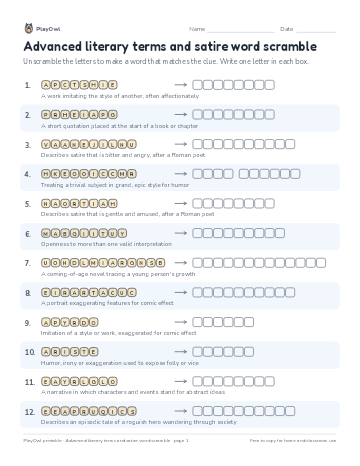 Advanced literary terms and satire word scramble
English · Grade 12 · Puzzle · 1 page
Advanced literary terms and satire word scramble
English · Grade 12 · Puzzle · 1 page
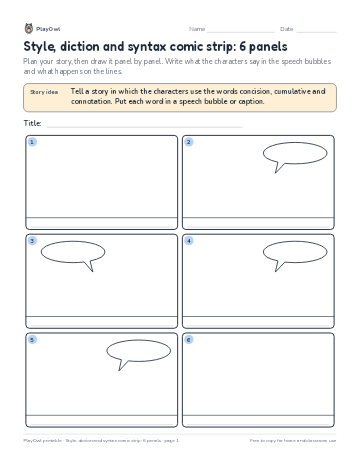 Style, diction and syntax comic strip: 6 panels
English · Grade 12 · Worksheet · 1 page
Style, diction and syntax comic strip: 6 panels
English · Grade 12 · Worksheet · 1 page
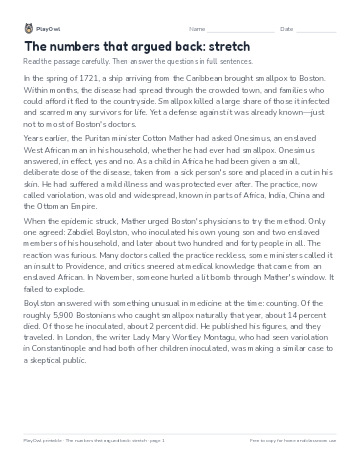 The numbers that argued back: stretch
English · 11–12 · Reading · 3 pages
The numbers that argued back: stretch
English · 11–12 · Reading · 3 pages
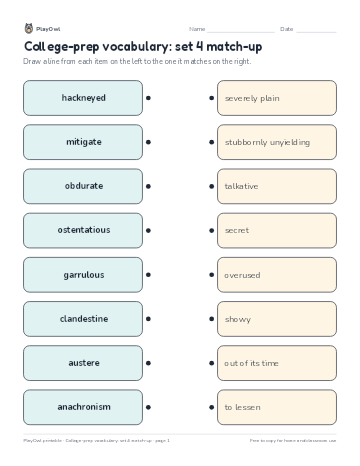 College-prep vocabulary: set 4 match-up
English · Grade 12 · Worksheet · 1 page
College-prep vocabulary: set 4 match-up
English · Grade 12 · Worksheet · 1 page
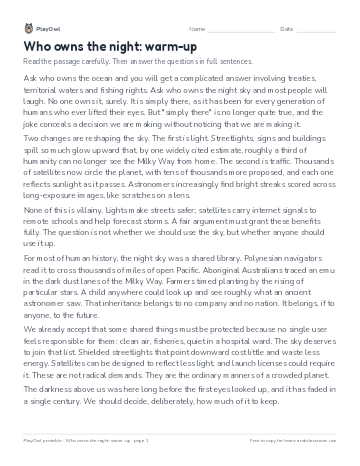 Who owns the night: warm-up
English · Grade 12 · Reading · 2 pages
Who owns the night: warm-up
English · Grade 12 · Reading · 2 pages
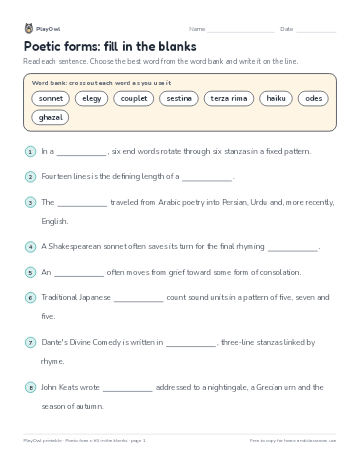 Poetic forms: fill in the blanks
English · 11–12 · Reading · 1 page
Poetic forms: fill in the blanks
English · 11–12 · Reading · 1 page
Printable generator
Make your own printables
Make brand-new sheets like this one, with answer keys, using the printable generator that comes with a PlayOwl plan. This sheet stays free.