Reading passage · History, Civics & Social Studies
Letters from a Roman fort · Grades 6–8
An original passage about thinking like a historian with 7 questions that check details, inference and vocabulary.
- Grades 6–8 · ages 11 to 14
- Medium
- 30 to 40 minutes
- 2 pages
- Free
The answer key is a separate page for grown-ups. Sign in to download it.
The passage and its 7 questions
Directions: Read the passage carefully. Then answer the questions in full sentences.
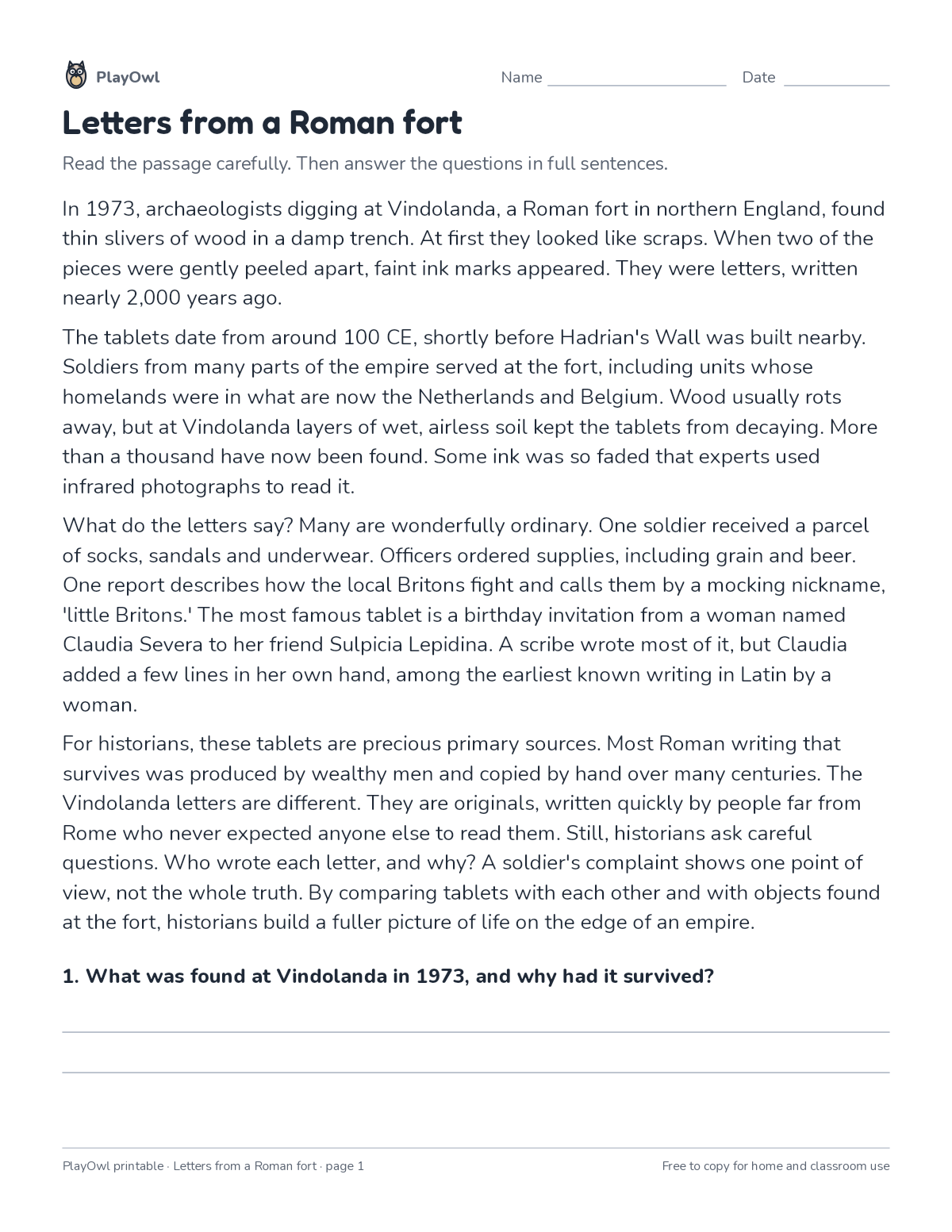
- In 1973, archaeologists digging at Vindolanda, a Roman fort in northern England, found thin slivers of wood in a damp trench. At first they looked like scraps. When two of the pieces were gently peeled apart, faint ink marks appeared. They were letters, written nearly 2,000 years ago.
- The tablets date from around 100 CE, shortly before Hadrian's Wall was built nearby.
- Soldiers from many parts of the empire served at the fort, including units whose homelands were in what are now the Netherlands and Belgium. Wood usually rots away, but at Vindolanda layers of wet, airless soil kept the tablets from decaying. More than a thousand have now been found. Some ink was so faded that experts used infrared photographs to read it.
- What do the letters say? Many are wonderfully ordinary. One soldier received a parcel of socks, sandals and underwear. Officers ordered supplies, including grain and beer.
- One report describes how the local Britons fight and calls them by a mocking nickname,
- 'little Britons.' The most famous tablet is a birthday invitation from a woman named
- Claudia Severa to her friend Sulpicia Lepidina. A scribe wrote most of it, but Claudia added a few lines in her own hand, among the earliest known writing in Latin by a woman.
- For historians, these tablets are precious primary sources. Most Roman writing that survives was produced by wealthy men and copied by hand over many centuries. The
- Vindolanda letters are different. They are originals, written quickly by people far from
- Rome who never expected anyone else to read them. Still, historians ask careful questions. Who wrote each letter, and why? A soldier's complaint shows one point of view, not the whole truth. By comparing tablets with each other and with objects found at the fort, historians build a fuller picture of life on the edge of an empire.
- 1. What was found at Vindolanda in 1973, and why had it survived?
- 2. Why are the Vindolanda tablets called primary sources?
- 3. How are these letters different from most Roman writing that survives, and why does that matter?
- 4. In paragraph 3, a report uses a 'mocking nickname.' What does 'mocking' mean, and what does the nickname reveal about the writer?
- 5. Copy the sentence that shows how historians check what a single tablet tells them.
- 6. If you could add one modern object to an archive for historians 2,000 years from now, what would it be and why?
- 7. Write a one-paragraph summary that a younger student could understand.
What your child practices
Your child practices the history and social studies skill “Question and use sources”: ask questions about the past and present and use evidence from sources to answer them.
- Grades and ages
- Grades 6–8, ages 11 to 14
- Time
- About 30 to 40 minutes
- Subject
- History, Civics & Social Studies
- Level
- Medium for Grades 6–8
- Answer key
- Yes, for grown-ups who sign in
- Printing
- 2 pages, US Letter or A4, low-ink option
- Updated
How to use it
Read the passage once just for the story or the facts, then again with the questions in mind. Encourage underlining the words in the text that back up each answer. It is pitched at the expected level for Grades 6–8, for practice after the skill has been taught. Its 2 pages split well across two sittings.
An answer key comes with it as a separate page that grown-ups download after signing in.
Tip for grown-ups: Ask your child to point to the sentence that answers each question before writing it.
Done on paper? A grown-up can record it on the child's page in PlayOwl; downloading alone doesn't count as finished.
History, Civics & Social Studies · Grades 6–8
More like this
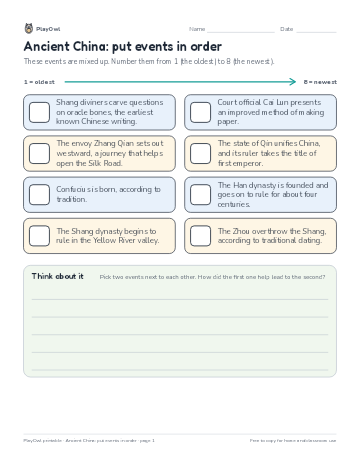 Ancient China: put events in order
History, Civics & Social Studies · 6–7 · Worksheet · 1 page
Ancient China: put events in order
History, Civics & Social Studies · 6–7 · Worksheet · 1 page
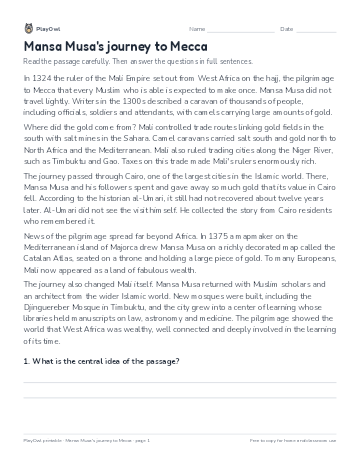 Mansa Musa's journey to Mecca
History, Civics & Social Studies · Grade 8 · Reading · 2 pages
Mansa Musa's journey to Mecca
History, Civics & Social Studies · Grade 8 · Reading · 2 pages
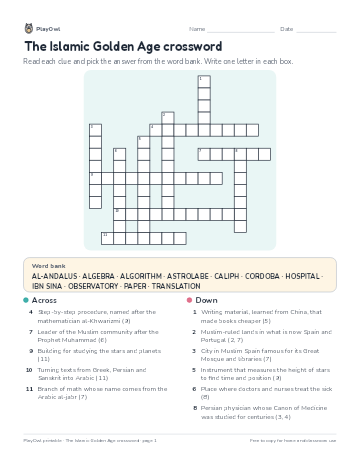 The Islamic Golden Age crossword
History, Civics & Social Studies · Grade 7 · Puzzle · 1 page
The Islamic Golden Age crossword
History, Civics & Social Studies · Grade 7 · Puzzle · 1 page
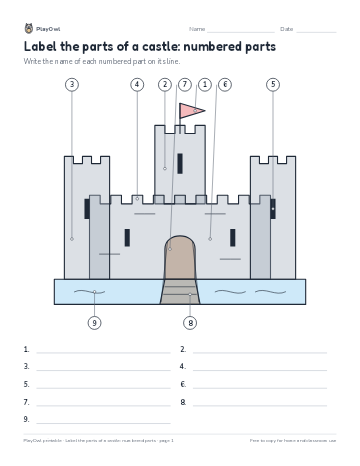 Label the parts of a castle: numbered parts
History, Civics & Social Studies · 5–6 · Worksheet · 1 page
Label the parts of a castle: numbered parts
History, Civics & Social Studies · 5–6 · Worksheet · 1 page
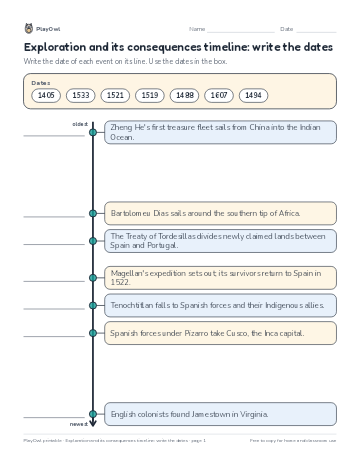 Exploration and its consequences timeline: write the dates
History, Civics & Social Studies · Grade 7 · Worksheet · 1 page
Exploration and its consequences timeline: write the dates
History, Civics & Social Studies · Grade 7 · Worksheet · 1 page
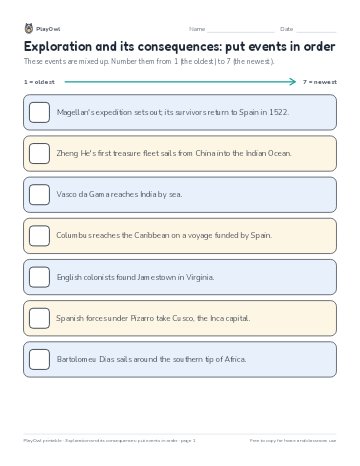 Exploration and its consequences: put events in order
History, Civics & Social Studies · Grade 8 · Worksheet · 1 page
Exploration and its consequences: put events in order
History, Civics & Social Studies · Grade 8 · Worksheet · 1 page
Printable generator
Make your own printables
Make brand-new sheets like this one, with answer keys, using the printable generator that comes with a PlayOwl plan. This sheet stays free.