Reading passage · English
The morning the Moon came to our courtyard: warm-up · Grade 7
An original passage about point of view and narrators with 4 questions that check details, inference and vocabulary.
- Grade 7 · ages 12 to 13
- Easy
- 20 to 30 minutes
- 2 pages
- Free
Goes with the game Reading Detective.
The answer key is a separate page for grown-ups. Sign in to download it.
The passage and its 4 questions
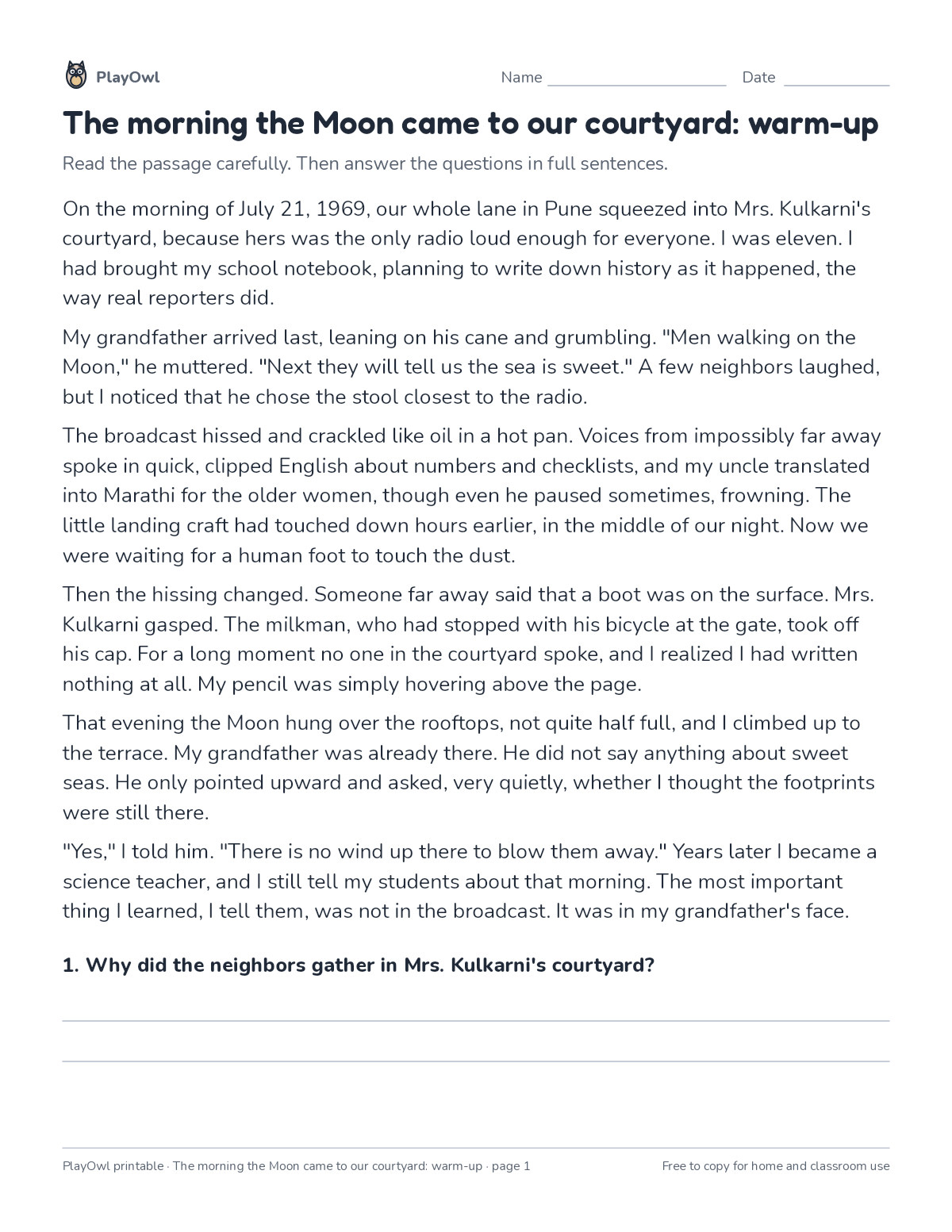
Directions: Read the passage carefully. Then answer the questions in full sentences.
- On the morning of July 21, 1969, our whole lane in Pune squeezed into Mrs. Kulkarni's courtyard, because hers was the only radio loud enough for everyone. I was eleven. I had brought my school notebook, planning to write down history as it happened, the way real reporters did.
- My grandfather arrived last, leaning on his cane and grumbling. "Men walking on the
- Moon," he muttered. "Next they will tell us the sea is sweet." A few neighbors laughed, but I noticed that he chose the stool closest to the radio.
- The broadcast hissed and crackled like oil in a hot pan. Voices from impossibly far away spoke in quick, clipped English about numbers and checklists, and my uncle translated into Marathi for the older women, though even he paused sometimes, frowning. The little landing craft had touched down hours earlier, in the middle of our night. Now we were waiting for a human foot to touch the dust.
- Then the hissing changed. Someone far away said that a boot was on the surface. Mrs.
- Kulkarni gasped. The milkman, who had stopped with his bicycle at the gate, took off his cap. For a long moment no one in the courtyard spoke, and I realized I had written nothing at all. My pencil was simply hovering above the page.
- That evening the Moon hung over the rooftops, not quite half full, and I climbed up to the terrace. My grandfather was already there. He did not say anything about sweet seas. He only pointed upward and asked, very quietly, whether I thought the footprints were still there.
- "Yes," I told him. "There is no wind up there to blow them away." Years later I became a science teacher, and I still tell my students about that morning. The most important thing I learned, I tell them, was not in the broadcast. It was in my grandfather's face.
- 1. Why did the neighbors gather in Mrs. Kulkarni's courtyard?
- 2. From which point of view is the story told? Who is the narrator, and when is she telling it?
- 3. The grandfather grumbles, yet chooses the stool closest to the radio. What does this suggest about him?
- 4. Choose a word the author used on purpose. What effect does it have?
What your child practices
Your child practices the reading and English skill “Make inferences”: infer what happened using clues in a text.
- Grades and ages
- Grade 7, ages 12 to 13
- Time
- About 20 to 30 minutes
- Subject
- English
- Level
- Easy for Grade 7
- Answer key
- Yes, for grown-ups who sign in
- Printing
- 2 pages, US Letter or A4, low-ink option
- Updated
How to use it
Read the passage once just for the story or the facts, then again with the questions in mind. Encourage underlining the words in the text that back up each answer. It is one of the easier sheets for Grade 7, good as a warm-up or a first look at the skill. Its 2 pages split well across two sittings.
An answer key comes with it as a separate page that grown-ups download after signing in.
Tip for grown-ups: Ask your child to point to the sentence that answers each question before writing it.
Done on paper? A grown-up can record it on the child's page in PlayOwl; downloading alone doesn't count as finished.
English · Grade 7
More like this
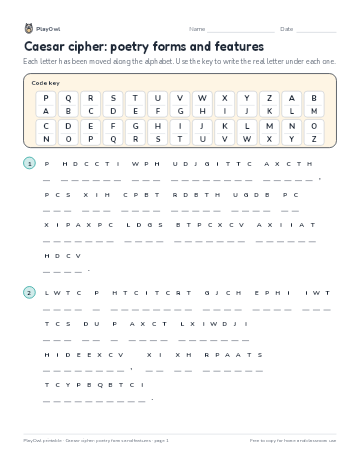 Caesar cipher: poetry forms and features
English · Grade 7 · Puzzle · 1 page
Caesar cipher: poetry forms and features
English · Grade 7 · Puzzle · 1 page
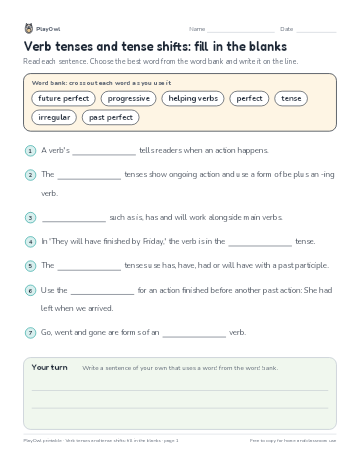 Verb tenses and tense shifts: fill in the blanks
English · Grade 7 · Reading · 1 page
Verb tenses and tense shifts: fill in the blanks
English · Grade 7 · Reading · 1 page
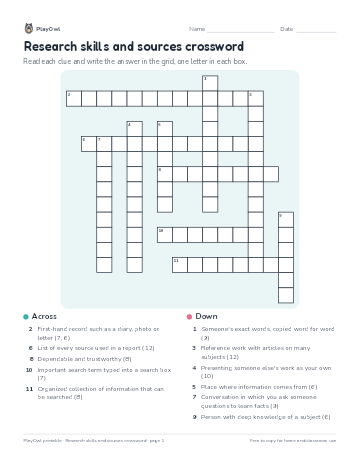 Research skills and sources crossword
English · Grade 7 · Puzzle · 1 page
Research skills and sources crossword
English · Grade 7 · Puzzle · 1 page
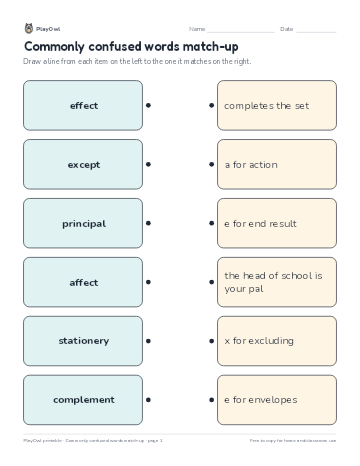 Commonly confused words match-up
English · Grade 7 · Worksheet · 1 page
Commonly confused words match-up
English · Grade 7 · Worksheet · 1 page
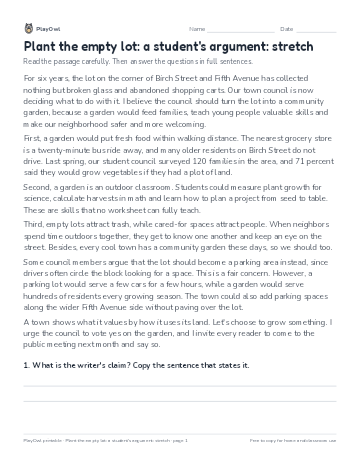 Plant the empty lot: a student's argument: stretch
English · 7–8 · Reading · 2 pages
Plant the empty lot: a student's argument: stretch
English · 7–8 · Reading · 2 pages
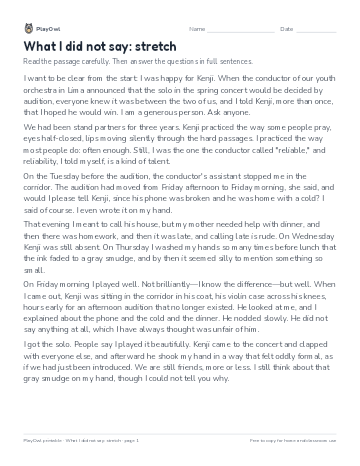 What I did not say: stretch
English · Grade 10 · Reading · 3 pages
What I did not say: stretch
English · Grade 10 · Reading · 3 pages
Printable generator
Make your own printables
Make brand-new sheets like this one, with answer keys, using the printable generator that comes with a PlayOwl plan. This sheet stays free.