Reading passage · English
The case for a broken toaster: warm-up · Grade 9
An original passage about building an argument with 4 questions that check details, inference and vocabulary.
- Grade 9 · ages 14 to 15
- Easy
- 20 to 30 minutes
- 2 pages
- Free
The answer key is a separate page for grown-ups. Sign in to download it.
The passage and its 4 questions
Directions: Read the passage carefully. Then answer the questions in full sentences.
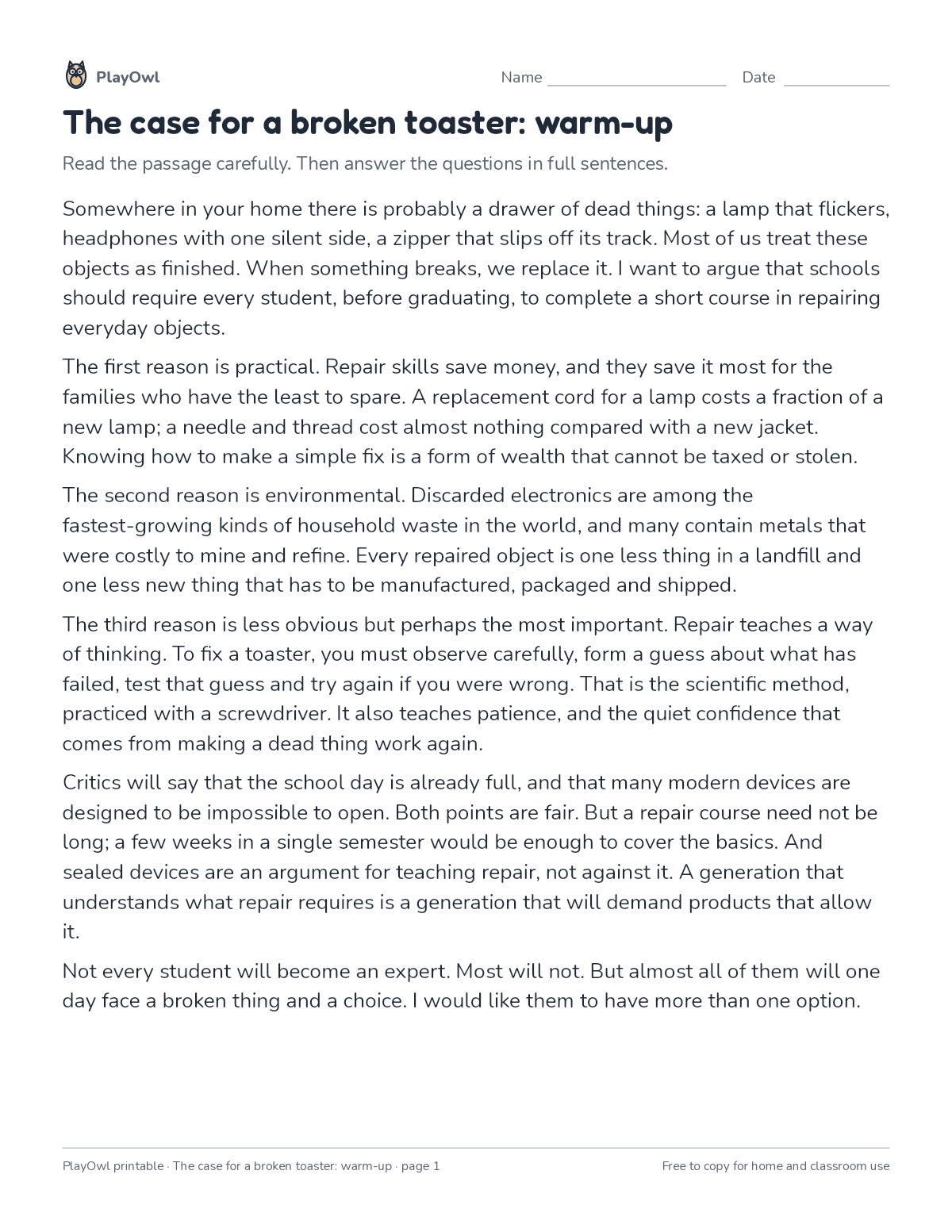
- Somewhere in your home there is probably a drawer of dead things: a lamp that flickers, headphones with one silent side, a zipper that slips off its track. Most of us treat these objects as finished. When something breaks, we replace it. I want to argue that schools should require every student, before graduating, to complete a short course in repairing everyday objects.
- The first reason is practical. Repair skills save money, and they save it most for the families who have the least to spare. A replacement cord for a lamp costs a fraction of a new lamp; a needle and thread cost almost nothing compared with a new jacket.
- Knowing how to make a simple fix is a form of wealth that cannot be taxed or stolen.
- The second reason is environmental. Discarded electronics are among the fastest-growing kinds of household waste in the world, and many contain metals that were costly to mine and refine. Every repaired object is one less thing in a landfill and one less new thing that has to be manufactured, packaged and shipped.
- The third reason is less obvious but perhaps the most important. Repair teaches a way of thinking. To fix a toaster, you must observe carefully, form a guess about what has failed, test that guess and try again if you were wrong. That is the scientific method, practiced with a screwdriver. It also teaches patience, and the quiet confidence that comes from making a dead thing work again.
- Critics will say that the school day is already full, and that many modern devices are designed to be impossible to open. Both points are fair. But a repair course need not be long; a few weeks in a single semester would be enough to cover the basics. And sealed devices are an argument for teaching repair, not against it. A generation that understands what repair requires is a generation that will demand products that allow it.
- Not every student will become an expert. Most will not. But almost all of them will one day face a broken thing and a choice. I would like them to have more than one option.
- 1. What is the writer's claim, and what three reasons support it?
- 2. Why does the writer call repair skills 'a form of wealth that cannot be taxed or stolen'?
- 3. In paragraph 4, what does the phrase 'practiced with a screwdriver' suggest about the scientific method?
- 4. Write a counterargument or alternative view and respond to it.
What your child practices
Your child practices reading and English for Grade 9 with this reading passage.
- Grades and ages
- Grade 9, ages 14 to 15
- Time
- About 20 to 30 minutes
- Subject
- English
- Level
- Easy for Grade 9
- Answer key
- Yes, for grown-ups who sign in
- Printing
- 2 pages, US Letter or A4, low-ink option
- Updated
How to use it
Read the passage once just for the story or the facts, then again with the questions in mind. Encourage underlining the words in the text that back up each answer. It is one of the easier sheets for Grade 9, good as a warm-up or a first look at the topic. Its 2 pages split well across two sittings.
An answer key comes with it as a separate page that grown-ups download after signing in.
Tip for grown-ups: Ask your child to point to the sentence that answers each question before writing it.
Done on paper? A grown-up can record it on the child's page in PlayOwl; downloading alone doesn't count as finished.
English · Grade 9
More like this
 College-prep vocabulary set 1 comic strip: 6 panels
English · Grade 9 · Worksheet · 1 page
College-prep vocabulary set 1 comic strip: 6 panels
English · Grade 9 · Worksheet · 1 page
 The last buttonhole: stretch
English · Grade 9 · Reading · 2 pages
The last buttonhole: stretch
English · Grade 9 · Reading · 2 pages
 The clock that found the sea: stretch
English · Grade 9 · Reading · 3 pages
The clock that found the sea: stretch
English · Grade 9 · Reading · 3 pages
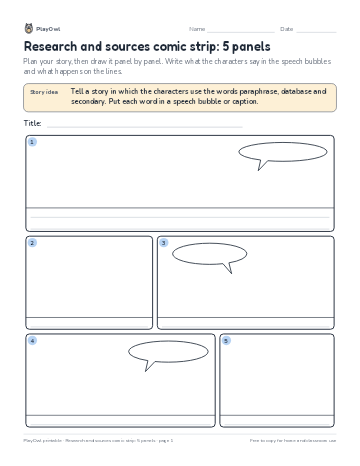 Research and sources comic strip: 5 panels
English · Grade 9 · Worksheet · 1 page
Research and sources comic strip: 5 panels
English · Grade 9 · Worksheet · 1 page
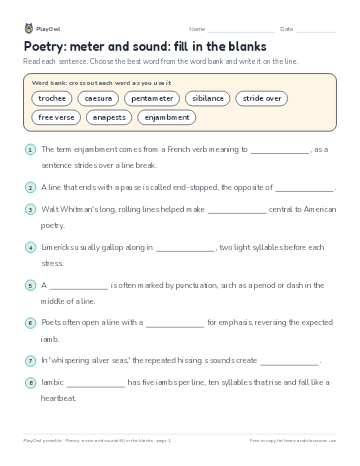 Poetry: meter and sound: fill in the blanks
English · Grade 9 · Reading · 1 page
Poetry: meter and sound: fill in the blanks
English · Grade 9 · Reading · 1 page
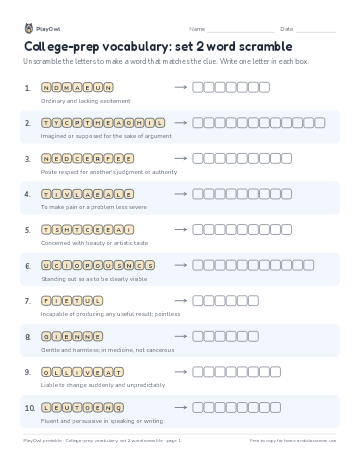 College-prep vocabulary: set 2 word scramble
English · Grade 9 · Puzzle · 1 page
College-prep vocabulary: set 2 word scramble
English · Grade 9 · Puzzle · 1 page
Printable generator
Make your own printables
Make brand-new sheets like this one, with answer keys, using the printable generator that comes with a PlayOwl plan. This sheet stays free.