Reading passage · History, Civics & Social Studies
The Haitian Revolution · Grades 9–10
An original passage about the age of revolutions with 7 questions that check details, inference and vocabulary.
- Grades 9–10 · ages 14 to 16
- Medium
- 45 to 55 minutes
- 3 pages
- Free
The answer key is a separate page for grown-ups. Sign in to download it.
The passage and its 7 questions
Directions: Read the passage carefully. Then answer the questions in full sentences.
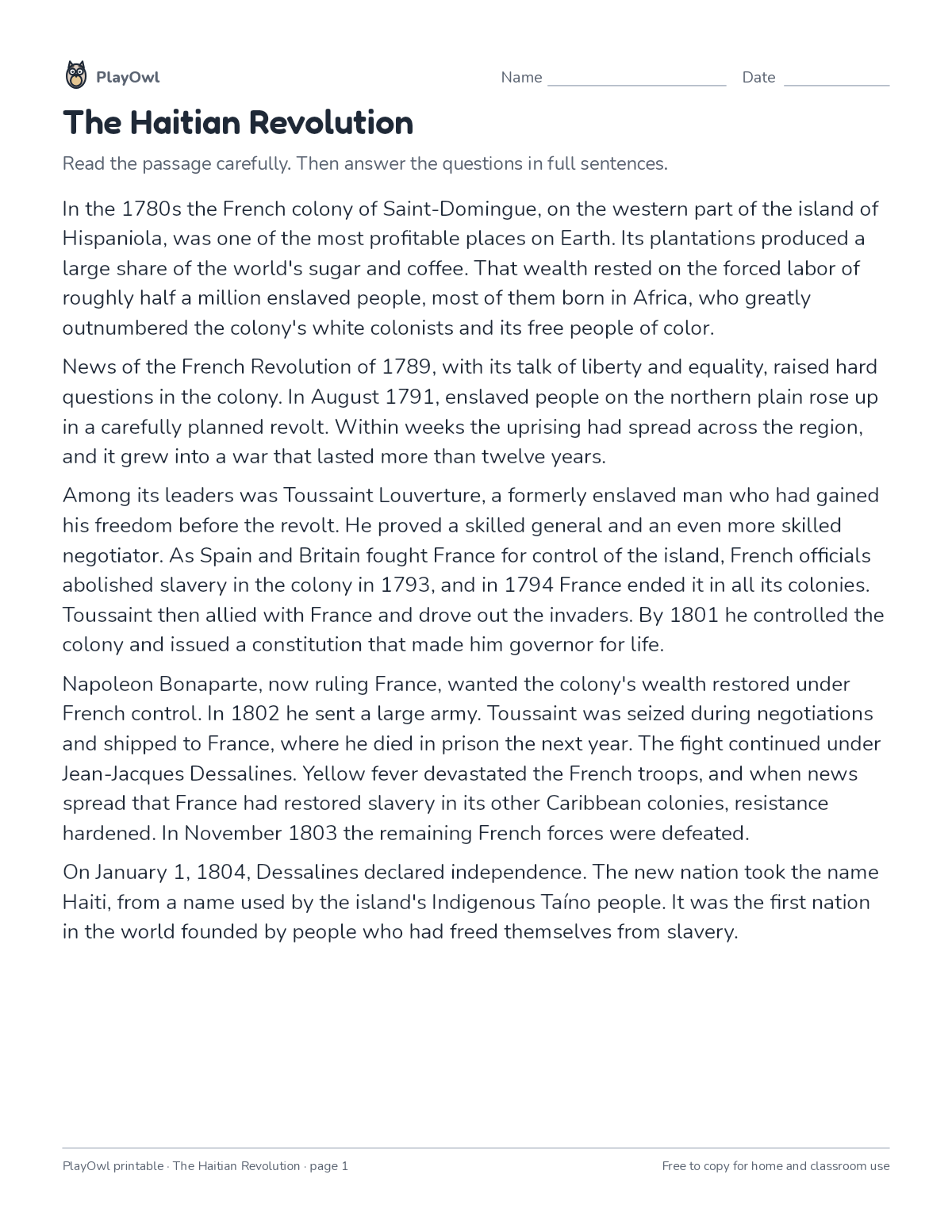
- In the 1780s the French colony of Saint-Domingue, on the western part of the island of
- Hispaniola, was one of the most profitable places on Earth. Its plantations produced a large share of the world's sugar and coffee. That wealth rested on the forced labor of roughly half a million enslaved people, most of them born in Africa, who greatly outnumbered the colony's white colonists and its free people of color.
- News of the French Revolution of 1789, with its talk of liberty and equality, raised hard questions in the colony. In August 1791, enslaved people on the northern plain rose up in a carefully planned revolt. Within weeks the uprising had spread across the region, and it grew into a war that lasted more than twelve years.
- Among its leaders was Toussaint Louverture, a formerly enslaved man who had gained his freedom before the revolt. He proved a skilled general and an even more skilled negotiator. As Spain and Britain fought France for control of the island, French officials abolished slavery in the colony in 1793, and in 1794 France ended it in all its colonies.
- Toussaint then allied with France and drove out the invaders. By 1801 he controlled the colony and issued a constitution that made him governor for life.
- Napoleon Bonaparte, now ruling France, wanted the colony's wealth restored under
- French control. In 1802 he sent a large army. Toussaint was seized during negotiations and shipped to France, where he died in prison the next year. The fight continued under
- Jean-Jacques Dessalines. Yellow fever devastated the French troops, and when news spread that France had restored slavery in its other Caribbean colonies, resistance hardened. In November 1803 the remaining French forces were defeated.
- On January 1, 1804, Dessalines declared independence. The new nation took the name
- Haiti, from a name used by the island's Indigenous Taíno people. It was the first nation in the world founded by people who had freed themselves from slavery.
- The revolution's effects reached far beyond the island. With his army in
- Saint-Domingue collapsing, Napoleon gave up his plans for an empire in the Americas and in 1803 sold the vast Louisiana territory to the United States. Enslaved people across the Americas heard of Haiti's victory, while slaveholding governments feared it, and many refused to recognize the new country. In 1825 France demanded a huge payment from Haiti in exchange for recognition, a debt that burdened the country's economy for generations.
- 1. Why was Saint-Domingue so valuable to France?
- 2. How did the French Revolution influence events in Saint-Domingue?
- 3. What two factors helped Dessalines's forces defeat the French army?
- 4. In paragraph 6, what does 'recognize' mean when used about a country?
- 5. Explain how the Haitian Revolution affected the United States.
- 6. Copy the sentence that explains what made Haiti's founding unique.
- 7. Rewrite the opening sentence for a different audience and explain your choices.
What your child practices
Your child practices the history and social studies skill “Change, continuity and causation”: describe how and why things changed over time and compare perspectives.
- Grades and ages
- Grades 9–10, ages 14 to 16
- Time
- About 45 to 55 minutes
- Subject
- History, Civics & Social Studies
- Level
- Medium for Grades 9–10
- Answer key
- Yes, for grown-ups who sign in
- Printing
- 3 pages, US Letter or A4, low-ink option
- Updated
How to use it
Read the passage once just for the story or the facts, then again with the questions in mind. Encourage underlining the words in the text that back up each answer. It is pitched at the expected level for Grades 9–10, for practice after the skill has been taught. Its 3 pages split well across two sittings.
An answer key comes with it as a separate page that grown-ups download after signing in.
Tip for grown-ups: Ask your child to point to the sentence that answers each question before writing it.
Done on paper? A grown-up can record it on the child's page in PlayOwl; downloading alone doesn't count as finished.
History, Civics & Social Studies · Grades 9–10
More like this
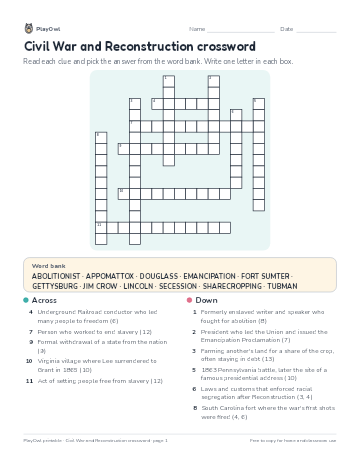 Civil War and Reconstruction crossword
History, Civics & Social Studies · Grade 9 · Puzzle · 1 page
Civil War and Reconstruction crossword
History, Civics & Social Studies · Grade 9 · Puzzle · 1 page
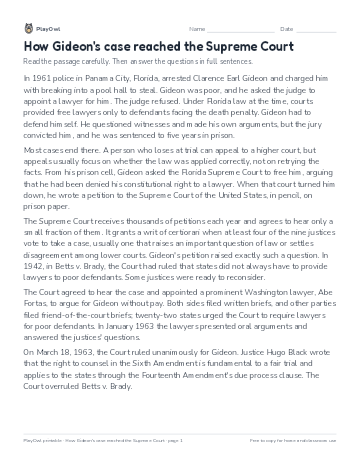 How Gideon's case reached the Supreme Court
History, Civics & Social Studies · 10–12 · Reading · 3 pages
How Gideon's case reached the Supreme Court
History, Civics & Social Studies · 10–12 · Reading · 3 pages
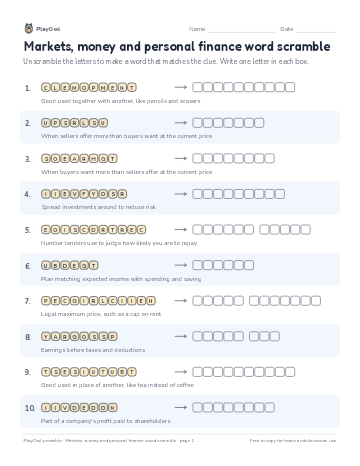 Markets, money and personal finance word scramble
History, Civics & Social Studies · Grade 9 · Puzzle · 1 page
Markets, money and personal finance word scramble
History, Civics & Social Studies · Grade 9 · Puzzle · 1 page
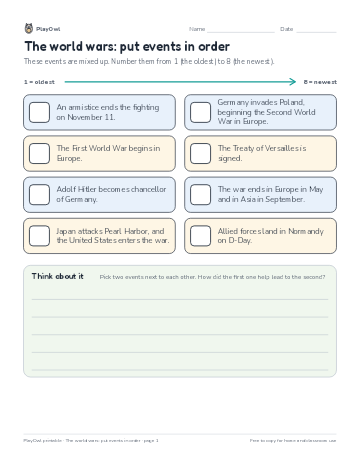 The world wars: put events in order
History, Civics & Social Studies · Grade 10 · Worksheet · 1 page
The world wars: put events in order
History, Civics & Social Studies · Grade 10 · Worksheet · 1 page
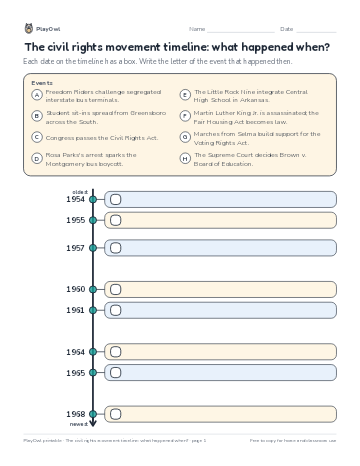 The civil rights movement timeline: what happened when?
History, Civics & Social Studies · Grade 9 · Worksheet · 1 page
The civil rights movement timeline: what happened when?
History, Civics & Social Studies · Grade 9 · Worksheet · 1 page
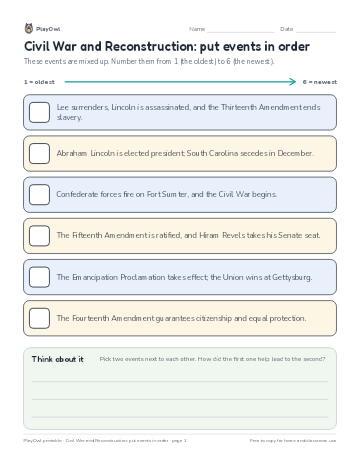 Civil War and Reconstruction: put events in order
History, Civics & Social Studies · Grade 9 · Worksheet · 1 page
Civil War and Reconstruction: put events in order
History, Civics & Social Studies · Grade 9 · Worksheet · 1 page
Printable generator
Make your own printables
Make brand-new sheets like this one, with answer keys, using the printable generator that comes with a PlayOwl plan. This sheet stays free.