How do phone towers pass along a moving call?
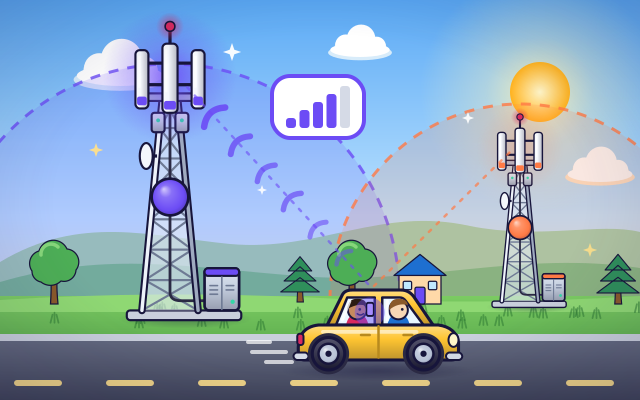
Phone towers split the land into cells. As you travel, your call hops from one tower to the next without stopping.
The big idea: A phone sends radio waves to the nearest tower. When you move away, that signal fades, so the network passes your call to a tower with a stronger signal. This is called a handoff.
It's like a relay race: one runner hands the baton to the next without stopping, so the baton keeps moving the whole way.
The interactive parts didn't load. The explanations below still work; try reloading the page.
A call on the move
- Mia calls Grandpa from the back seat. The car speeds along the road, kilometer after kilometer, yet the call never stops. How does it keep up?
- Mia's phone turns her voice into radio waves, which you cannot see. They fly to the antennas on the nearest tower, and the tower sends Grandpa's voice back the same way.
- Seen from above, the land is split into patches called cells, each with its own tower. That is why mobile phones are also called cell phones.
- As the car leaves tower A behind, its signal gets weaker. At the same time the signal from tower B, up ahead, gets stronger. The phone measures both.
- When tower B becomes the stronger one, the network passes the call to it. This handoff takes a fraction of a second, so Mia hears nothing at all.
- Every tower is linked by cables to the rest of the network. They carry Mia's voice on to Grandpa. Tower after tower passes the call along, like a relay race.
Look inside a tower site
Tap each part of the tower site. Watch what it does when you find it.
- Panel antennas. The tall white panels are antennas. They send radio waves out to phones and catch the waves that phones send back.
- Radio units. The radio units sit just behind the antennas. They turn the data of a call into radio waves, and turn incoming waves back into data.
- Mast. The mast lifts the antennas high above trees and houses. From up there the radio waves have a clear path, so they reach farther.
- Equipment cabinet. Inside the cabinet are computers that handle every call the tower carries. They decide which phone gets which radio channel and when.
- Fiber cable. A cable buried in the ground joins the tower to the rest of the network. It carries calls as flashes of light inside thin glass threads.
- Backup battery. If the electricity fails, a backup battery keeps the tower running for a while, so people can still make calls.
- Phone. A phone has small antennas hidden inside. It listens for towers all the time and shows the signal strength as bars.
Where does the call change towers?
Drag the car between the towers and watch the signal bars and the colored link. Then switch the middle tower off and drive through again.
Experiment: The car drives from tower A to tower B. Where does the call move to tower B?
- Drag the car slowly from tower A toward tower B.
- Watch the bars beside each tower and the color of the link.
- Switch the middle tower off, then drive through the middle again.
What we found: The call moves near the middle, where the next tower's signal becomes stronger than the old one. The new tower takes over before the old signal is gone, so the call never stops. With a tower switched off there is a gap that no signal reaches, and the call drops there.
Turn on JavaScript to try it yourself.
Cover the road
Build towers so the call never drops between home and Grandpa's house. For 3 stars, use only 3 towers.
How a call follows you
A mobile phone is a small radio. When you talk, it turns your voice into data and sends it on radio waves to the nearest phone tower. The tower sends the other person's voice back to you in the same way. Radio waves travel at the speed of light, so this feels instant.
One tower cannot cover a whole country. Radio waves get weaker the farther they travel, and hills and buildings block them. So phone companies build many towers and split the land into patches called cells, each with its own tower. That is where the name cell phone comes from. In a city a cell may be only a few hundred meters wide. In the countryside it can be many kilometers wide.
As you move, your phone keeps measuring the signals from the towers around it. When a neighbor's signal becomes stronger than the one you are using, the network moves your call to that tower. This is a handoff. The new tower gets ready first, and the switch itself takes only a fraction of a second, so you do not hear it.
A relay race is a good picture of this, but not a perfect one. Runners swap the baton at fixed places. A phone network decides the moment by measuring signals, so the swap happens wherever the next tower becomes the better choice. If no tower reaches you at all, there is nobody to take the baton, and the call drops. People call such a place a dead zone.
Key words
- Cell
- The patch of land that one tower covers.
- Base station
- A phone tower site: antennas, radios and the computers that run them.
- Handoff (handover)
- Passing a call from one tower to the next while you keep talking.
- Signal strength
- How strong a tower's radio waves are when they reach your phone. The bars on a phone show it.
- Dead zone
- A place that no tower's signal reaches well enough for a call.
- Backhaul
- The cables that join a tower to the rest of the network.
Check your thinking
-
How does your voice get from your phone to the tower?
Show the answer
On radio waves that you cannot see. The phone is a small radio. It sends your voice as radio waves to the tower's antennas.
-
Why does the network move your call to another tower as you travel?
Show the answer
The next tower's signal has become stronger than the old one. Signals fade with distance. When a nearer tower is stronger, the call moves to it.
-
You are on a call and drive into a place that no tower reaches. What happens?
Show the answer
The call drops, because there is no signal to carry it. A handoff needs a tower to hand the call to. With no signal there is a dead zone.
-
Why does a network wait until the neighbor is stronger by a few decibels before it hands off?
Show the answer
It stops the call from ping-ponging back and forth when the signals flutter. Signals rise and fall by a few decibels as you move. A margin (hysteresis) means one clear switch instead of many.
-
Why are the antennas put high up on a mast?
Show the answer
So the radio waves have a clear path over trees and houses. Up high, fewer things block the waves, so the tower reaches farther.
-
How does the call get from the tower to the person far away?
Show the answer
Through cables that join the towers to the rest of the network. Radio covers only the last stretch. Cables, mostly glass fiber, carry the call onward.
You're a Computers & communication expert!
You watched, looked inside, tried it, solved the challenge and went deeper. Pick another question below, or switch the age at the top to see this topic another way.
More about computers & communication
 #347
Computers & communication
How do spam filters recognize unwanted messages?
Sort fictional messages using clues and compare correct detections with mistakes.
#347
Computers & communication
How do spam filters recognize unwanted messages?
Sort fictional messages using clues and compare correct detections with mistakes.
 #348
Computers & communication
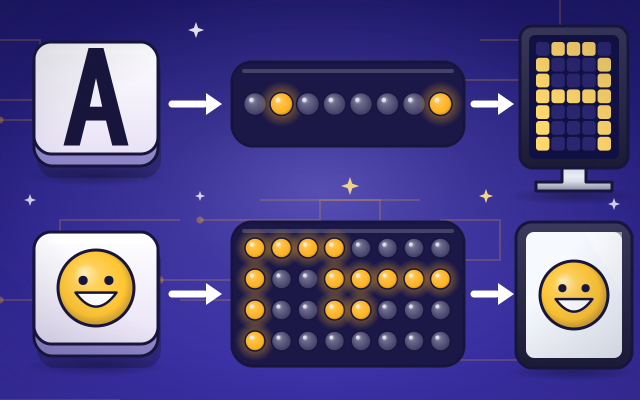
How do computers store letters and emojis?
Match characters to numerical codes and turn stored codes back into symbols.
#348
Computers & communication
How do computers store letters and emojis?
Match characters to numerical codes and turn stored codes back into symbols.
 #349
Computers & communication
How can messages survive small transmission errors?
Damage an encoded message and use extra information to detect or repair errors.
#349
Computers & communication
How can messages survive small transmission errors?
Damage an encoded message and use extra information to detect or repair errors.
 #350
Computers & communication
How do computers sort large lists?
Try different sorting strategies and compare the number of steps required.
#350
Computers & communication
How do computers sort large lists?
Try different sorting strategies and compare the number of steps required.
Keep exploring
Games to play next
- Robot RoutesSnap together arrow, repeat and dance blocks to guide Bolt the robot home.
- Bug DetectiveA robot program almost works. Run it, spot the buggy block, and fix it.
- Safe Message DetectiveRead made-up messages, pop-ups and posts, spot the clues, and choose the safe, kind thing to do.
Guide for grown-ups
- How to start homeschooling: a step-by-step guide for familiesA guide for parents · 7 min read
Coding games by grade
Computer skills worksheets by grade
- Preschool Computer Skills Worksheets
- Pre-K Computer Skills Worksheets
- Kindergarten Computer Skills Worksheets
- 1st Grade Computer Skills Worksheets
- 2nd Grade Computer Skills Worksheets
- 3rd Grade Computer Skills Worksheets
- 4th Grade Computer Skills Worksheets
- 5th Grade Computer Skills Worksheets
- 6th Grade Computer Skills Worksheets
- 7th Grade Computer Skills Worksheets
- 8th Grade Computer Skills Worksheets