How can messages survive small transmission errors?
Messages pick up mistakes on their journey. A few extra check squares let the receiver find a flipped square and flip it back.
The big idea: A message is sent with extra check bits worked out from the message itself. If a bit flips on the way, the checks no longer fit, and the receiver can tell where the mistake is.
It's like spelling a name out loud as B for banana, E for egg. The extra words let the listener fix a letter they heard wrongly.
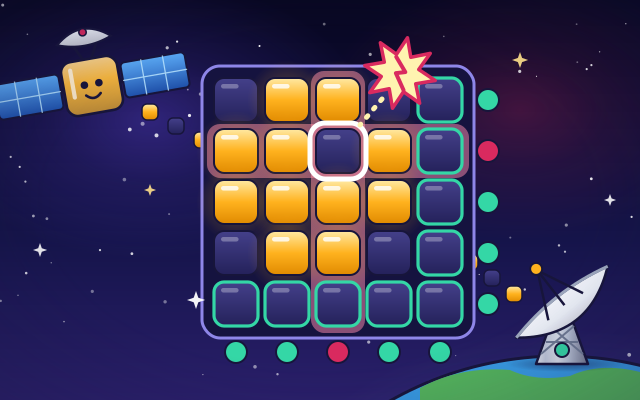
The interactive parts didn't load. The explanations below still work; try reloading the page.
Finding a flipped bit
- A space probe sends a picture home. The picture travels as a long stream of bits, each one either on or off, across millions of kilometers.
- On the way, a burst of radio noise hits the signal and one bit flips from on to off. Now the picture that arrives has a wrong square.
- One fix is to send every bit three times and let the receiver take a vote. If one copy flips, the other two still agree. It works, but the message is three times as long.
- A smarter trick adds one check square to each row, set so that the row always has an even number of lit squares. If a square flips, its row turns odd, and the receiver knows something is wrong.
- Now add a check square under each column as well. A flipped square makes one row odd and one column odd. Where they cross is the mistake, so the receiver flips it back.
- The picture arrives perfect. Cleverer versions of this trick protect QR codes, discs, phone calls and everything saved on a computer.
Look inside a protected message
Tap each part of the message and its journey. Watch what it does.
- Data squares. These sixteen squares are the real message: here, a tiny picture. Each square is one bit, lit for 1 and dark for 0.
- Row checks. Each row gets one extra square. It is lit or dark, whichever makes the number of lit squares in that row even.
- Column checks. Each column gets an extra square as well, so every column also has an even number of lit squares.
- Corner check. The corner square checks the check squares. If one of them is flipped on the way, the corner helps to show it.
- Noise. Noise is anything that muddles the signal on its way: a radio crackle, a scratch on a disc, a weak signal. It can flip a bit.
- Checker. The receiver counts the lit squares in every row and column. An even count shows green. An odd count shows red: something in that line was flipped.
- Fixer. The flipped square sits where the red row and the red column cross. The receiver flips it back, and the message is right again.
Damage the message
Tap any square to flip it, as noise would. Watch the lamps beside the rows and under the columns. Then flip a second square.
Experiment: One square gets flipped on the way. Can the check squares show which one it was?
- Tap one square and look at the lamps. Press Check and repair.
- Now tap two different squares and press Check and repair again.
- Try two squares in the same row. Which lamps turn red?
What we found: One flipped square makes exactly one row and one column odd, and they cross at the mistake, so the receiver can repair it. Two flipped squares make too many lines odd, or hide each other. The receiver can tell that something is wrong but not where, so it has to ask for the message again.
Turn on JavaScript to try it yourself.
Repair three messages
Three messages arrive, each with one flipped square. Use the counts to find the odd row and odd column, then tap the square to repair it.
How messages fix themselves
Everything a computer sends is made of bits: tiny signals that are either on or off. On the way, a bit can get flipped. A crackle of radio noise, a scratch on a disc or a weak signal can turn an on into an off. One wrong bit might change a letter in a word, or a dot in a picture.
The answer is to send a little extra. The simplest way is to say everything three times and take a vote, but that makes the message three times as long. A smarter way is to add check bits. In the grid on this page, each row gets one extra square, chosen so the row always has an even number of lit squares. Each column gets one as well.
When the message arrives, the receiver counts every row and column. If a square was flipped, its row is now odd and its column is odd. Where the odd row and the odd column cross is the flipped square, so the receiver flips it back. Nobody had to send the message again.
The trick has limits. If two squares flip, the receiver can still tell that something is wrong, but not where, so it asks for the message again. Spelling a name with extra words, B for banana, works the same way, though people choose the words and computers do it with arithmetic. Stronger codes of this kind are why a scratched disc still plays and a torn QR code still scans.
Key words
- Bit
- The smallest piece of data: on or off, 1 or 0.
- Noise
- Anything that muddles a signal on its way and can flip a bit.
- Check bit (parity bit)
- An extra bit added so that a row has an even number of 1s.
- Error detection
- Noticing that a message was changed on the way, even if you cannot tell where.
- Error correction
- Finding exactly which bit is wrong and flipping it back, without asking for the message again.
- Redundancy
- Extra information sent along with a message to keep it safe.
Check your thinking
-
One row has an odd number of lit squares, and so does one column. Where is the flipped square?
Show the answer
Where that row and that column cross. A flipped square upsets its own row and its own column. Only one square is in both.
-
Why send extra check bits, when they are not part of the message?
Show the answer
So the receiver can find and fix a bit that was flipped on the way. Check bits are worked out from the message. If the message changes, they no longer fit, and that shows where the damage is.
-
Two squares in the same row are flipped. What does the receiver see?
Show the answer
The row looks fine, but two columns are odd, so it knows something is wrong but not where. Two flips in one row cancel out in that row, but each upsets its own column. Two red columns and no red row cannot point to one square.
-
Sending every bit three times also fixes mistakes. Why are check squares usually better?
Show the answer
They need far fewer extra bits. Saying everything three times triples the message. A few check squares protect it with much less extra to send.
-
Four bits at the corners of a rectangle are all flipped. Why does the parity grid miss this?
Show the answer
Each affected row and column has two flips, so every parity is still even. Parity only records whether a count is odd or even. Two flips in a line cancel, so this pattern leaves an all-even syndrome. Stronger codes are needed for noisier channels.
You're a Computers & communication expert!
You watched, looked inside, tried it, solved the challenge and went deeper. Pick another question below, or switch the age at the top to see this topic another way.
More about computers & communication
 #350
Computers & communication
How do computers sort large lists?
Try different sorting strategies and compare the number of steps required.
#350
Computers & communication
How do computers sort large lists?
Try different sorting strategies and compare the number of steps required.
 #49
Computers & communication
How does a camera take a picture?
Follow light through a lens to a sensor. Adjust focus and lighting, capture an image, and zoom in to discover its pixels.
#49
Computers & communication
How does a camera take a picture?
Follow light through a lens to a sensor. Adjust focus and lighting, capture an image, and zoom in to discover its pixels.
 #50
Computers & communication
How does a touchscreen know where you touched?
Tap a transparent screen and watch a simplified sensor grid detect the location. Follow that information into a button press, swipe, or drawing.
#50
Computers & communication
How does a touchscreen know where you touched?
Tap a transparent screen and watch a simplified sensor grid detect the location. Follow that information into a button press, swipe, or drawing.
 #51
Computers & communication
How does the internet send a message?
Break a message into packets, route them through a network, and reassemble them. Help packets find another route around a broken connection.
#51
Computers & communication
How does the internet send a message?
Break a message into packets, route them through a network, and reassemble them. Help packets find another route around a broken connection.
Keep exploring
Games to play next
- Bug DetectiveA robot program almost works. Run it, spot the buggy block, and fix it.
- Safe Message DetectiveRead made-up messages, pop-ups and posts, spot the clues, and choose the safe, kind thing to do.
- Robot RoutesSnap together arrow, repeat and dance blocks to guide Bolt the robot home.
Guide for grown-ups
- How to start homeschooling: a step-by-step guide for familiesA guide for parents · 7 min read
Coding games by grade
Computer skills worksheets by grade
- Preschool Computer Skills Worksheets
- Pre-K Computer Skills Worksheets
- Kindergarten Computer Skills Worksheets
- 1st Grade Computer Skills Worksheets
- 2nd Grade Computer Skills Worksheets
- 3rd Grade Computer Skills Worksheets
- 4th Grade Computer Skills Worksheets
- 5th Grade Computer Skills Worksheets
- 6th Grade Computer Skills Worksheets
- 7th Grade Computer Skills Worksheets
- 8th Grade Computer Skills Worksheets