Reading passage · Science
Henrietta Leavitt's cosmic yardstick · Grades 6–7
An original passage about stars and galaxies with 6 questions that check details, inference and vocabulary.
- Grades 6–7 · ages 11 to 13
- Medium
- 25 to 35 minutes
- 2 pages
- Free
The answer key is a separate page for grown-ups. Sign in to download it.
The passage and its 6 questions
Directions: Read the passage carefully. Then answer the questions in full sentences.
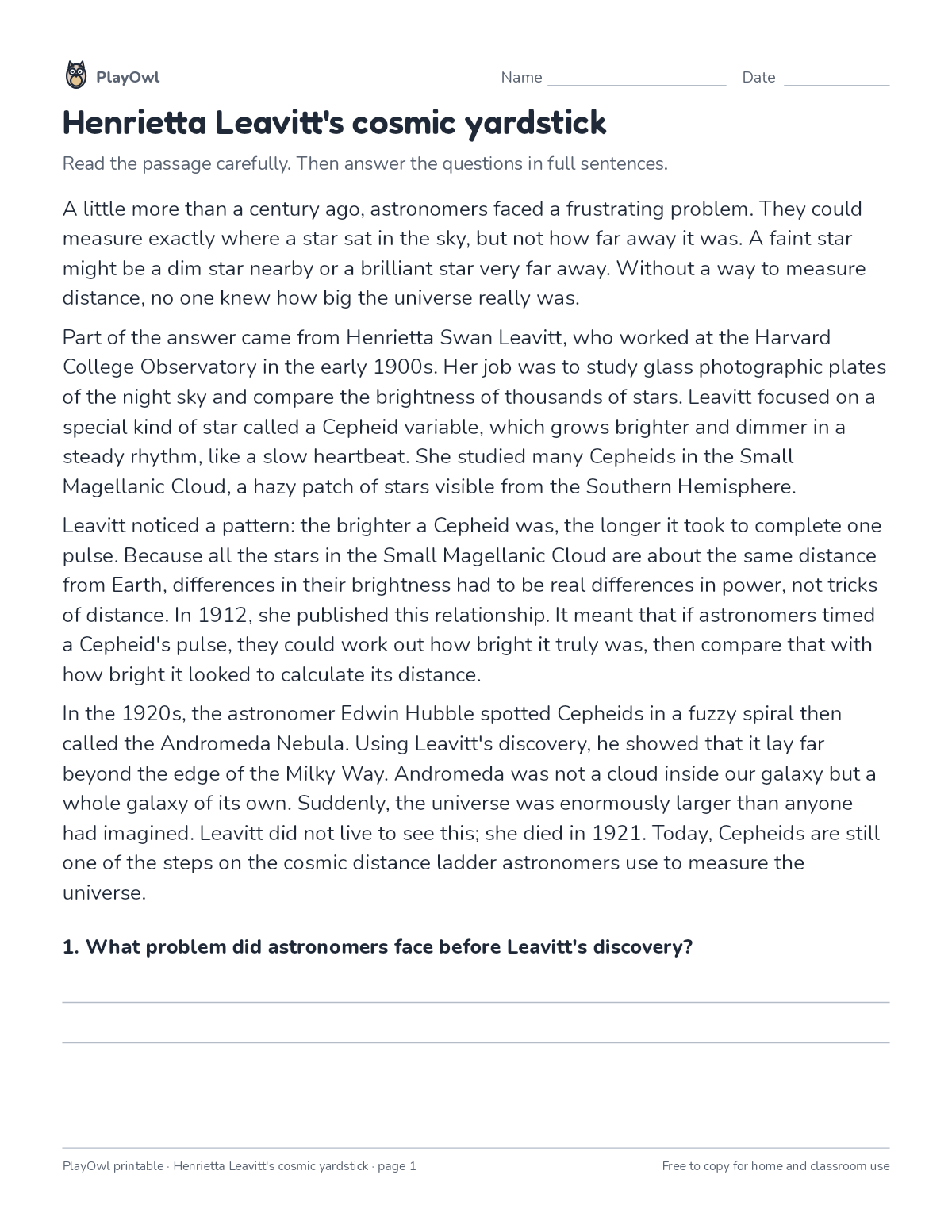
- A little more than a century ago, astronomers faced a frustrating problem. They could measure exactly where a star sat in the sky, but not how far away it was. A faint star might be a dim star nearby or a brilliant star very far away. Without a way to measure distance, no one knew how big the universe really was.
- Part of the answer came from Henrietta Swan Leavitt, who worked at the Harvard
- College Observatory in the early 1900s. Her job was to study glass photographic plates of the night sky and compare the brightness of thousands of stars. Leavitt focused on a special kind of star called a Cepheid variable, which grows brighter and dimmer in a steady rhythm, like a slow heartbeat. She studied many Cepheids in the Small
- Magellanic Cloud, a hazy patch of stars visible from the Southern Hemisphere.
- Leavitt noticed a pattern: the brighter a Cepheid was, the longer it took to complete one pulse. Because all the stars in the Small Magellanic Cloud are about the same distance from Earth, differences in their brightness had to be real differences in power, not tricks of distance. In 1912, she published this relationship. It meant that if astronomers timed a Cepheid's pulse, they could work out how bright it truly was, then compare that with how bright it looked to calculate its distance.
- In the 1920s, the astronomer Edwin Hubble spotted Cepheids in a fuzzy spiral then called the Andromeda Nebula. Using Leavitt's discovery, he showed that it lay far beyond the edge of the Milky Way. Andromeda was not a cloud inside our galaxy but a whole galaxy of its own. Suddenly, the universe was enormously larger than anyone had imagined. Leavitt did not live to see this; she died in 1921. Today, Cepheids are still one of the steps on the cosmic distance ladder astronomers use to measure the universe.
- 1. What problem did astronomers face before Leavitt's discovery?
- 2. Why did it matter that all the Cepheids Leavitt studied were in the Small
- Magellanic Cloud?
- 3. What does "variable" mean in the phrase "Cepheid variable"?
- 4. Copy the sentence that explains how Hubble's discovery changed the picture of the universe.
- 5. Explain, step by step, how timing a Cepheid's pulse helps astronomers find its distance.
- 6. How would the passage change if it were told from another point of view?
What your child practices
Your child practices the science skill “Sun, Moon, planets and stars”: describe the Sun, the Moon's phases, the planets and stars, day and night, years and Earth's movements.
- Grades and ages
- Grades 6–7, ages 11 to 13
- Time
- About 25 to 35 minutes
- Subject
- Science
- Level
- Medium for Grades 6–7
- Answer key
- Yes, for grown-ups who sign in
- Printing
- 2 pages, US Letter or A4, low-ink option
- Updated
How to use it
Read the passage once just for the story or the facts, then again with the questions in mind. Encourage underlining the words in the text that back up each answer. It is pitched at the expected level for Grades 6–7, for practice after the skill has been taught. Its 2 pages split well across two sittings.
An answer key comes with it as a separate page that grown-ups download after signing in.
Tip for grown-ups: Ask your child to point to the sentence that answers each question before writing it.
Done on paper? A grown-up can record it on the child's page in PlayOwl; downloading alone doesn't count as finished.
Science · Grades 6–7
More like this
 History of space exploration word scramble with a secret word
Science · Grade 6 · Puzzle · 1 page
History of space exploration word scramble with a secret word
Science · Grade 6 · Puzzle · 1 page
 History of space exploration word search
Science · Grade 7 · Puzzle · 1 page
History of space exploration word search
Science · Grade 7 · Puzzle · 1 page
 Label the weather instruments: tricky word bank
Science · Grade 6 · Worksheet · 1 page
Label the weather instruments: tricky word bank
Science · Grade 6 · Worksheet · 1 page
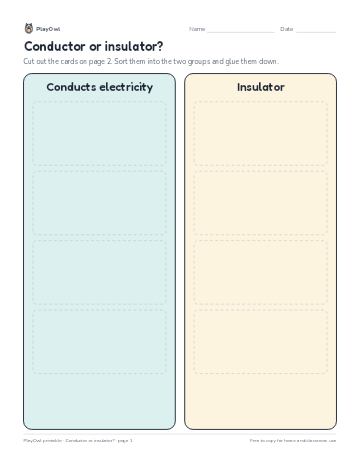 Conductor or insulator?
Science · 5–6 · Cut and sort · 2 pages
Conductor or insulator?
Science · 5–6 · Cut and sort · 2 pages
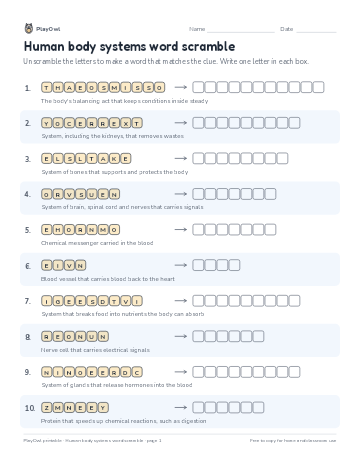 Human body systems word scramble
Science · Grade 7 · Puzzle · 1 page
Human body systems word scramble
Science · Grade 7 · Puzzle · 1 page
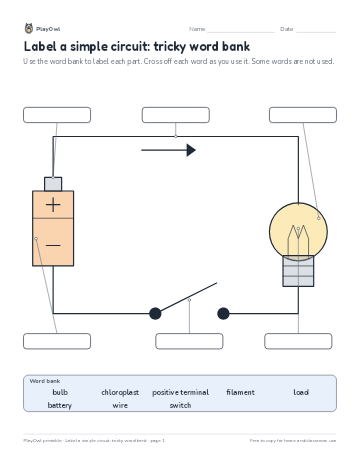 Label a simple circuit: tricky word bank
Science · Grade 6 · Worksheet · 1 page
Label a simple circuit: tricky word bank
Science · Grade 6 · Worksheet · 1 page
Printable generator
Make your own printables
Make brand-new sheets like this one, with answer keys, using the printable generator that comes with a PlayOwl plan. This sheet stays free.