How does Bluetooth connect nearby devices?
Bluetooth uses weak radio waves to join gadgets that are near each other, after they have paired.
The big idea: Bluetooth gadgets talk with weak radio waves. First they pair, which means they find each other and swap a secret key. Then they send data in tiny packets. The signal fades with distance and walls, so it only works nearby.
It's like two friends passing notes in class: first they agree on a secret code, then they pass many tiny notes, and it only works while they sit close together.
The interactive parts didn't load. The explanations below still work; try reloading the page.
How Bluetooth joins two gadgets
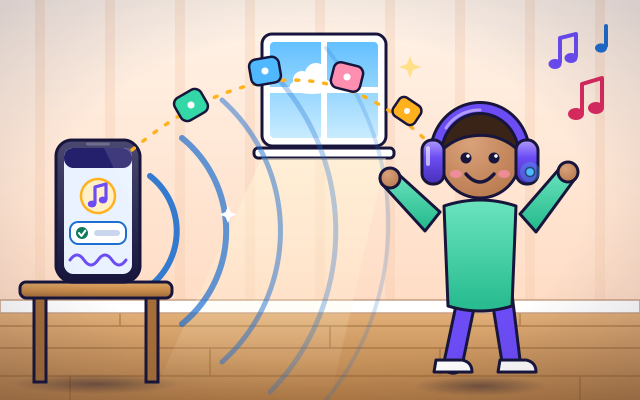
- Zara's music is stored on the phone on the table, but she hears it in her headphones across the room. No wire joins them. So how does the music travel?
- A tiny antenna in the phone sends out radio waves. They are invisible and very weak, like a whisper instead of a shout. That saves the battery, but the waves only reach about ten meters.
- First the gadgets must pair. The headphones call out, 'I am here!' The phone hears them and you tap to connect. Then they swap a secret key, so they can recognize each other next time.
- The phone does not send the song in one go. It cuts the music into tiny pieces called packets and sends them one after another. The headphones put the pieces back in order and play them.
- Other gadgets use the same kind of radio waves. So the pair keeps hopping between many channels, like lanes on a road, both jumping at the same moment. If a channel is busy, they stop using it.
- As Zara walks away, the signal gets weaker, and a wall soaks up even more. Some packets get lost, so the music stutters and then stops. When she comes back, the paired gadgets join up again by themselves.
Look inside a Bluetooth headphone
This ear cup is cut open. Tap each part to see what it does.
- Antenna. A tiny metal track, shorter than your finger. It catches the radio waves from the phone and sends waves back.
- Radio chip. A small chip that does all the Bluetooth work: listening, sending, hopping between channels and putting the packets in order.
- Secret key. When the gadgets pair, both save a secret key in their memory. That is how they know each other next time, without asking you again.
- Battery. A small rechargeable battery. Because Bluetooth signals are so weak, the battery can run the headphones for many hours.
- Speaker. The speaker turns the electrical music signal into sound by making a thin cone move back and forth very fast.
- Pairing button and light. Hold this button and the headphones start calling out so that a phone can find them. The blinking light shows they are ready to pair.
- Phone. The phone has its own antenna and Bluetooth chip. It holds the music and sends it as packets. It can stay paired with several gadgets.
Bluetooth lab: how far does it reach?
Pair the headphones with the phone: tap the headphones, then tap the phone. Then drag Zara farther away and watch the packets. Try a wall too.
Experiment: Zara walks farther and farther from the phone. What happens to her music?
- Tap the headphones, then the phone, to pair them. The music starts.
- Drag Zara slowly away. Watch the signal bars and the flying packets.
- Find the distance where the music starts to stutter, and where it stops.
- Switch on the wall and find those two distances again.
What we found: The music does not get quieter. It is sent as packets, and each packet either arrives or is lost. Nearby, they all arrive. Farther away some are lost and the music stutters. A little farther and the link breaks. A wall soaks up part of the signal, so all of this happens closer to the phone.
Turn on JavaScript to try it yourself.
Where should the phone go?
Three gadgets are waiting for music. Walls weaken the signal. Drag the phone to a spot where all three get a strong signal, then press Play music.
A radio whisper between gadgets
Bluetooth is a way for gadgets to talk using radio waves, the same kind of invisible waves that carry radio stations and wireless internet. The difference is strength. A Bluetooth signal is very weak, like a whisper instead of a shout. That is on purpose: a weak signal needs very little electricity, so tiny batteries in earbuds and watches can last a long time.
Two gadgets cannot just start talking. First they pair. One gadget calls out, 'I am here!' The other one listens and finds it. When you agree, they swap a secret key and save it. From then on they recognize each other and connect by themselves whenever they are close and switched on.
Once connected, they send information in tiny packets, thousands every second. Lots of other gadgets nearby use the same kind of radio waves, so a Bluetooth pair does a clever trick: both hop from channel to channel at exactly the same moments, many times a second. If a packet is spoiled on one channel, it is sent again on another.
The whisper fades quickly. Across a room it is fine. About ten meters away, or behind a couple of walls, packets start to get lost and the sound stutters. Then the link breaks. The sound does not fade like a voice does, because a packet either arrives or it does not. Our note-passing comparison breaks down a little: Bluetooth notes travel at the speed of light, and nobody has to get out of their seat.
Key words
- Radio waves
- Invisible waves that carry signals through the air at the speed of light.
- Pairing
- Introducing two gadgets so that they swap and save a secret key and can recognize each other later.
- Packet
- A tiny piece of data sent in one short radio burst.
- Channel
- One narrow slice of radio frequencies, like one lane on a road.
- Frequency hopping
- Jumping from channel to channel many times a second, both gadgets together, to dodge interference.
- Range
- How far apart two gadgets can be and still keep their link.
Check your thinking
-
You carry your headphones far from the phone. What happens to the music?
Show the answer
It stutters and then stops, because packets get lost. The signal gets too weak, so pieces of the music go missing. The pieces that do arrive are still full volume.
-
What happens when two gadgets pair?
Show the answer
They find each other and save a shared secret key. The saved key is why your headphones connect to your phone, and not to a stranger's, without asking each time.
-
Why is a Bluetooth signal made so weak?
Show the answer
A weak signal uses little battery, though it cannot reach far. It is a trade: low power means long battery life but a short reach.
-
Why do Bluetooth gadgets keep hopping between channels?
Show the answer
To dodge other signals that are using the same radio waves. If one channel is busy, only a tiny piece is spoiled, and it is sent again on another channel.
-
There is a thick wall between the phone and the speaker. What does it do to the Bluetooth signal?
Show the answer
It soaks up part of the signal, so the range is shorter. Walls absorb and scatter some of the radio energy. Less signal gets through, so the link fails at a shorter distance.
You're a Computers & communication expert!
You watched, looked inside, tried it, solved the challenge and went deeper. Pick another question below, or switch the age at the top to see this topic another way.
More about computers & communication
 #344
Computers & communication
How do walkie-talkies let people talk?
Select matching channels and follow voice signals between transmitters and receivers.
#344
Computers & communication
How do walkie-talkies let people talk?
Select matching channels and follow voice signals between transmitters and receivers.
 #345
Computers & communication
How do undersea cables carry information?
Trace light signals through a cutaway cable connecting distant coastlines.
#345
Computers & communication
How do undersea cables carry information?
Trace light signals through a cutaway cable connecting distant coastlines.
 #346
Computers & communication
How do phone towers pass along a moving call?
Move a phone between coverage areas and watch its connection transfer.
#346
Computers & communication
How do phone towers pass along a moving call?
Move a phone between coverage areas and watch its connection transfer.
 #347
Computers & communication
How do spam filters recognize unwanted messages?
Sort fictional messages using clues and compare correct detections with mistakes.
#347
Computers & communication
How do spam filters recognize unwanted messages?
Sort fictional messages using clues and compare correct detections with mistakes.
Keep exploring
Games to play next
- Robot RoutesSnap together arrow, repeat and dance blocks to guide Bolt the robot home.
- Bug DetectiveA robot program almost works. Run it, spot the buggy block, and fix it.
- Safe Message DetectiveRead made-up messages, pop-ups and posts, spot the clues, and choose the safe, kind thing to do.
Guide for grown-ups
- How to start homeschooling: a step-by-step guide for familiesA guide for parents · 7 min read
Coding games by grade
Computer skills worksheets by grade
- Preschool Computer Skills Worksheets
- Pre-K Computer Skills Worksheets
- Kindergarten Computer Skills Worksheets
- 1st Grade Computer Skills Worksheets
- 2nd Grade Computer Skills Worksheets
- 3rd Grade Computer Skills Worksheets
- 4th Grade Computer Skills Worksheets
- 5th Grade Computer Skills Worksheets
- 6th Grade Computer Skills Worksheets
- 7th Grade Computer Skills Worksheets
- 8th Grade Computer Skills Worksheets