How do undersea cables carry information?
Cables on the seabed carry messages between continents as flashes of light inside glass threads thinner than a hair.
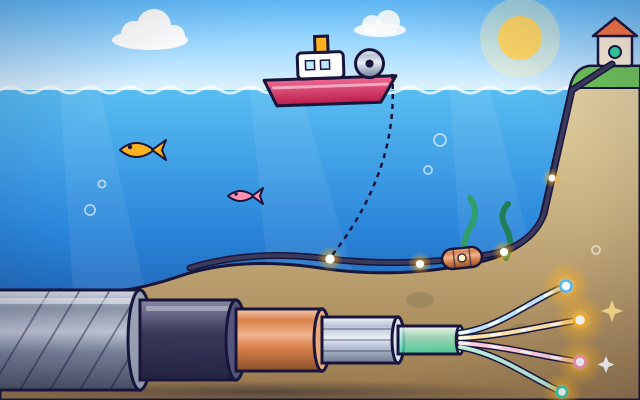
The big idea: Almost every message that crosses an ocean travels through a cable on the seabed. Inside are glass threads called optical fibers. A laser flashes light into a fiber, the light bounces along inside the glass, and boosters along the way keep it bright until it reaches the other shore.
It's like sending a message with a flashlight by blinking it on and off, except the light travels inside a glass thread thinner than a hair, all the way across the ocean.
The interactive parts didn't load. The explanations below still work; try reloading the page.
How a message crosses the ocean
- Noor sends a message to her grandma on the other side of the ocean, and it arrives in a moment. It does not fly through the sky. Almost every message between continents travels under the sea.
- A special ship lays the cable, slowly unreeling it onto the seabed from one coast to the other. In the deep ocean the cable is only about as thick as a garden hose.
- Peel back the cable's layers: tough plastic to keep water out, steel wires for strength, and a copper tube. Right in the middle sit a few glass threads, each thinner than a hair. They do all the work.
- At the shore, a laser flashes light into the glass thread: on for a one, off for a zero. The light cannot escape. It bounces off the inside of the glass again and again and races along the fiber.
- Even very clear glass soaks up a little light, so the flashes slowly get dimmer. Every so often along the cable, a booster called a repeater makes the light bright again. Electricity from the shore powers it.
- On the far shore, a sensor turns the flashes back into the message, and Grandma sees it. The trip across the ocean took less time than the blink of an eye.
Look inside an undersea cable
This cable has been peeled back layer by layer. Tap each part to see what it does.
- Glass fibers. The optical fibers: threads of very pure glass, each thinner than a hair. Flashes of light travel through them carrying the messages.
- Jelly tube. The fibers sit in a small tube filled with jelly. The jelly cushions them and stops any water from creeping along the cable.
- Steel wires. A ring of steel wires gives the cable its strength. They take the pull when the ship lowers the cable through kilometers of water.
- Copper tube. A copper tube carries electricity from the shore all the way along the cable. It powers the boosters far out at sea.
- Plastic coat. A thick coat of tough plastic keeps seawater away from the copper and everything inside, for 25 years or more.
- Armor. Near the coast, where ships drop anchors and boats drag fishing nets, the cable gets extra layers of steel armor and is buried in the seabed.
- Repeater. A repeater is a booster. Dim flashes go in at one end and bright flashes come out at the other, ready for the next stretch.
Fiber lab: keep the light bright
Tap the laser to send the message as flashes of light. Watch where the light fades. Then tap the rings on the cable to add boosters until the message arrives.
Experiment: The laser sends flashes into a very long fiber with no boosters. What happens?
- Tap the laser. Watch the flashes travel. Where do they fade out?
- Tap a ring just before that spot to add a booster. How far does the light get now?
- Add boosters until the message arrives on the far shore.
- Take one booster away again. Which ones does the light really need?
What we found: Glass soaks up a little light in every kilometer, so the flashes fade and finally become too dim to read. A booster must catch the light while it can still be read, and then it sends it on at full brightness. With boosters spaced along the cable, the message crosses the whole ocean.
Turn on JavaScript to try it yourself.
The fewest boosters
Get the message to the far shore using as few boosters as you can. Tap the rings to place boosters, then press Send.
Light in a thread of glass
When you watch a video made on another continent or call someone overseas, the signal almost always travels through a cable on the bottom of the sea. Hundreds of these cables cross the oceans. Laid end to end, they would stretch for more than a million kilometers.
The important part of each cable is tiny: a few threads of very pure glass called optical fibers, each thinner than a hair. A laser on the shore flashes light into a fiber, on for a one and off for a zero, billions of times every second. The light cannot get out through the sides of the glass. It bounces off the inside again and again, like a ball rolling down a tube, and follows the fiber wherever it goes.
Glass is not perfectly clear, so the flashes slowly fade. Every 50 to 100 kilometers a booster, called a repeater, makes the light bright again. Repeaters need electricity, so the cable has a copper tube that carries power out from the shore. Around that go steel wires for strength and thick plastic to keep the sea out. Near the coast the cable wears extra steel armor, because anchors and fishing nets are the biggest danger.
Light in glass covers about 200,000 kilometers each second, so a message crosses an ocean in a few hundredths of a second. If a cable breaks, a repair ship hooks it up from the seabed and joins it again. Our flashlight comparison is simplified: real fibers use invisible infrared light, and many colors of it at once, with each color carrying its own messages.
Key words
- Optical fiber
- A thread of very pure glass, thinner than a hair, that guides light along its length.
- Laser
- A device that makes a narrow beam of light of one pure color. It can be switched on and off extremely fast.
- Total internal reflection
- When light inside glass hits the edge at a shallow angle and bounces back in instead of escaping.
- Repeater
- A booster built into the cable that makes fading light signals strong again.
- Bit
- The smallest piece of data: a one or a zero. In a fiber, light on is a one and light off is a zero.
- Landing station
- The building on the coast where an undersea cable comes ashore and joins the land network.
Check your thinking
-
What travels through an undersea cable to carry your message?
Show the answer
Flashes of light inside glass threads. A laser flashes light into a glass fiber. The pattern of flashes is the message.
-
Why does an undersea cable need boosters along the way?
Show the answer
The glass soaks up a little light, so the flashes fade and must be made bright again. Even very clear glass is not perfect. Boosters keep the flashes strong enough to read at the far end.
-
Why does the light stay inside the glass fiber instead of leaking out of the sides?
Show the answer
It bounces off the inside of the glass again and again. Light that hits the inside wall of the glass at a shallow angle bounces back in, so it follows the fiber.
-
What is the copper tube inside the cable for?
Show the answer
It carries electricity to power the boosters. The messages travel as light in the glass. The copper only brings power from the shore to the boosters.
-
Why is the cable given extra steel armor near the coast?
Show the answer
Ship anchors and fishing nets could damage it in shallow water. Most cable damage comes from anchors and fishing gear, which only reach the seabed in shallow water. Armor and burial protect the cable there.
You're a Computers & communication expert!
You watched, looked inside, tried it, solved the challenge and went deeper. Pick another question below, or switch the age at the top to see this topic another way.
More about computers & communication
 #346
Computers & communication
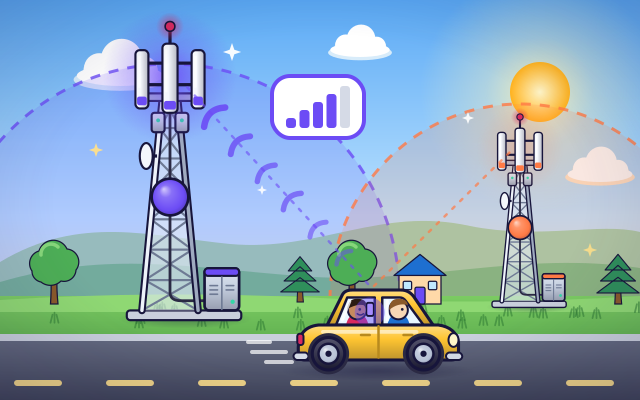
How do phone towers pass along a moving call?
Move a phone between coverage areas and watch its connection transfer.
#346
Computers & communication
How do phone towers pass along a moving call?
Move a phone between coverage areas and watch its connection transfer.
 #347
Computers & communication
How do spam filters recognize unwanted messages?
Sort fictional messages using clues and compare correct detections with mistakes.
#347
Computers & communication
How do spam filters recognize unwanted messages?
Sort fictional messages using clues and compare correct detections with mistakes.
 #348
Computers & communication
How do computers store letters and emojis?
Match characters to numerical codes and turn stored codes back into symbols.
#348
Computers & communication
How do computers store letters and emojis?
Match characters to numerical codes and turn stored codes back into symbols.
 #349
Computers & communication
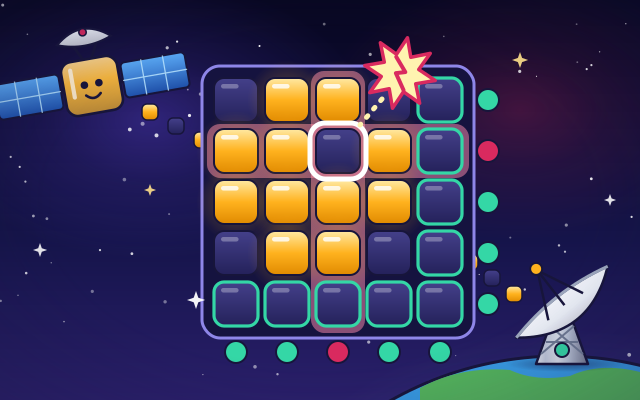
How can messages survive small transmission errors?
Damage an encoded message and use extra information to detect or repair errors.
#349
Computers & communication
How can messages survive small transmission errors?
Damage an encoded message and use extra information to detect or repair errors.
Keep exploring
Games to play next
- Safe Message DetectiveRead made-up messages, pop-ups and posts, spot the clues, and choose the safe, kind thing to do.
- Globe ExplorerSpin a real 3D globe, flip to the flat map, and find continents, oceans and countries.
- Robot RoutesSnap together arrow, repeat and dance blocks to guide Bolt the robot home.
Guide for grown-ups
- How to start homeschooling: a step-by-step guide for familiesA guide for parents · 7 min read
Coding games by grade
Computer skills worksheets by grade
- Preschool Computer Skills Worksheets
- Pre-K Computer Skills Worksheets
- Kindergarten Computer Skills Worksheets
- 1st Grade Computer Skills Worksheets
- 2nd Grade Computer Skills Worksheets
- 3rd Grade Computer Skills Worksheets
- 4th Grade Computer Skills Worksheets
- 5th Grade Computer Skills Worksheets
- 6th Grade Computer Skills Worksheets
- 7th Grade Computer Skills Worksheets
- 8th Grade Computer Skills Worksheets