How does delivery tracking know where a package is?
A tracking page is a list of scans. Scan a parcel along its trip and watch the list grow, then see what happens when a scan is missed.
The big idea: Most parcels carry no tracker. Each scan of the label sends the parcel's number, the place and the time to a computer. The tracking page shows that list, so it only knows the last scan.
It's like a relay race where someone calls out each handover: you know which runner had the baton last, but not exactly where they are now.
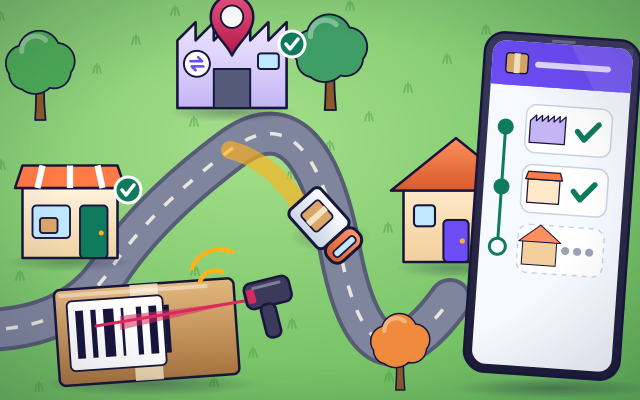
The interactive parts didn't load. The explanations below still work; try reloading the page.
How tracking knows
- Zoe is waiting for a parcel. A tracking page on the phone says where it has been. But the parcel has no phone of its own, and no map. So how does the page know?
- The answer starts with the label. Its barcode stands for a tracking number, and every parcel gets a different one. That number is the parcel's name for the whole trip.
- At each stop on the way, someone scans the barcode. Beep! The scanner sends a short message: this parcel number, at this place, at this time. A machine on a conveyor belt can do the same job.
- The messages go to a central computer, which keeps them in a list for each parcel. When you open the tracking page, your phone asks for the list with your number and shows it, newest first.
- While the parcel rides in a truck, nobody scans it. The page keeps showing the last place it was scanned. It is somewhere on the road, but the computer cannot tell exactly where until the next scan.
- At Zoe's door the driver scans the parcel one last time. The page changes to delivered. Every line on that page was one beep at one place, added by a person or a machine along the way.
Follow one scan to your screen
A map of a parcel's trip, with everything that tracking needs. Tap each part to see what it does.
- Tracking number. The barcode on the label stands for the tracking number. Every parcel has its own, so the computers never mix two parcels up.
- Scanner. A scanner reads the barcode. Some are held in the hand, and some are cameras above a conveyor belt. The scanner knows where it is and what time it is.
- Scan event. Each beep makes a short message: which parcel, which place, what time. It travels over the phone network or Wi-Fi to the carrier's computer.
- Central computer. The carrier's central computer keeps a list of scan messages for every parcel, in the order they happened.
- Tracking page. The tracking page asks the central computer for your parcel's list and shows it. It can only show what has been scanned.
- Last known place. The pin marks the last place the parcel was scanned. The parcel may have moved on since then.
- The van's position. On delivery day, some carriers show the van on a map. The van's own device uses satellites to find its place. The parcel is simply known to be on board, because it was scanned onto the van.
Scan it, or skip it
Tap a scanner when the truck is beside it, and watch the tracking page. Then drive past a stop without scanning. What does the page say now?
Experiment: The truck drives past the sorting center, but nobody scans the parcel there. What will the tracking page show?
- Scan the parcel at the shop. A line appears on the page.
- Drive past the sorting center without scanning. Compare the pin with the truck.
- Scan at the next stop and look at the list. What is missing?
What we found: The page showed the last place that was scanned, even after the truck had driven far beyond it. When the next scan came, the pin jumped forward, and the skipped stop never appeared in the list. Tracking only knows what scanners tell it.
Turn on JavaScript to try it yourself.
Find the parcel
Read the tracking page, then tap where the parcel must be now: a building if it arrived there, or the road if it has left. Find four parcels.
How a tracking page knows
A tracking page can look like magic: you type in a number and see where your parcel has been. But an ordinary parcel has no battery, no radio and no map. It cannot tell anyone where it is. All the information comes from people and machines that handle it along the way.
Every parcel has a label with a barcode. The barcode stands for a tracking number, and no two parcels share one. At each stop, the barcode is scanned: when the parcel is collected, when it reaches a sorting center, when it is loaded onto a van, and when it is handed over at the door. Each scan sends a short message: this number, this place, this time.
A central computer keeps these messages in a list for each parcel. When you open the tracking page, your phone asks for the list that belongs to your number and shows it. So the page is really a diary, written one line at a time, each time someone goes beep.
That explains the gaps. While the parcel rides in a truck for hours, nobody scans it, so the page keeps showing the last stop. The parcel is not stuck; the diary just has no new line yet. And if a scan is missed, that stop never appears in the list. When a page says "arriving tomorrow", that is a careful guess, based on the last scan and on how long the trip usually takes.
Key words
- Tracking number
- The number that belongs to one parcel only. It is printed on the label as digits and as a barcode.
- Scan
- Reading a barcode with a scanner or a camera.
- Scan event
- The short message made by one scan: which parcel, where and when.
- Database
- A computer's organized store of records, such as the list of scan events for every parcel.
- Estimate
- A careful guess worked out from what is known, such as the delivery day worked out from the last scan.
- Satellite positioning
- Finding your place on Earth from the signals of satellites. A delivery van's device can do this; a cardboard parcel cannot.
Check your thinking
-
Where does the information on a tracking page come from?
Show the answer
From scans of the label made along the way. Every line on the page is one scan: a place and a time, sent by a scanner.
-
A parcel has been in a truck for five hours with no scan. What does the tracking page show?
Show the answer
The last place it was scanned. Without a new scan, there is no new line. The page can only repeat the last one.
-
Why does every parcel need a tracking number that no other parcel has?
Show the answer
So that the scans of two different parcels never get mixed into one list. The number is how the computer knows which list a scan belongs to.
-
A parcel's page jumps from "Shop" straight to "Local depot". What most likely happened at the sorting center?
Show the answer
The parcel went through, but the scan there was missed. A list of scans has a hole wherever a scan did not happen. The parcel still made the trip.
-
On delivery day an app shows the van moving on a map. Where does that position come from?
Show the answer
From the driver's device, which uses satellite positioning; the parcel was scanned onto that van. The van's device knows its own position. The parcel's place is inferred from the scan that loaded it onto the van.
You're a Money, shops & services expert!
You watched, looked inside, tried it, solved the challenge and went deeper. Pick another question below, or switch the age at the top to see this topic another way.
More about money, shops & services
 #490
Money, shops & services
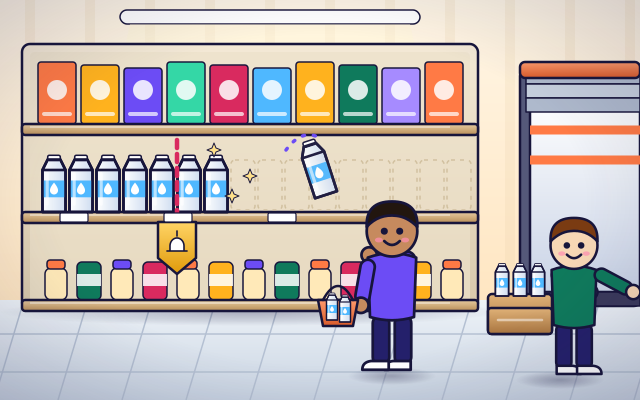
How do supermarkets keep shelves stocked?
Balance sales, inventory, reorder points, deliveries, and shelf space in a model store.
#490
Money, shops & services
How do supermarkets keep shelves stocked?
Balance sales, inventory, reorder points, deliveries, and shelf space in a model store.
 #491
Money, shops & services
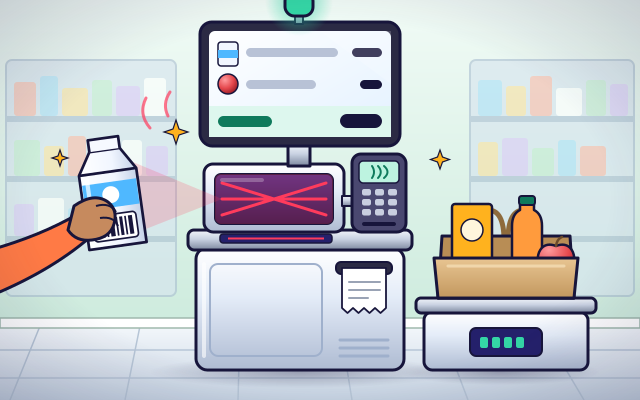
How does a self-checkout machine work?
Scan products, match prices, check a basket, and complete a pretend payment.
#491
Money, shops & services
How does a self-checkout machine work?
Scan products, match prices, check a basket, and complete a pretend payment.
 #492
Money, shops & services
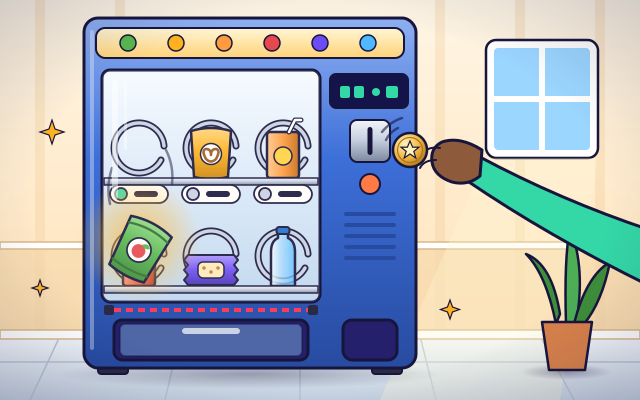
How does a vending machine deliver a snack?
Follow selection, payment, motor movement, and delivery through a transparent machine.
#492
Money, shops & services
How does a vending machine deliver a snack?
Follow selection, payment, motor movement, and delivery through a transparent machine.
 #493
Money, shops & services
How does a library track borrowed books?
Borrow and return virtual books while updating availability, borrower records, and due dates.
#493
Money, shops & services
How does a library track borrowed books?
Borrow and return virtual books while updating availability, borrower records, and due dates.
Keep exploring
Games to play next
- Coin MarketRun a pretend market stall: pay exactly, use the fewest coins, and give the right change.
- Festival PlannerPlace the stalls, book the acts and keep the budget — make every rule true.
- Supermarket StockerRoll out your cart and make every shelf ready for the day.
Guide for grown-ups
- How to start homeschooling: a step-by-step guide for familiesA guide for parents · 7 min read