How do supermarkets keep shelves stocked?
A supermarket counts every sale and orders more before the shelf runs out. Move the "order now" marker and keep a model shelf stocked.
The big idea: A delivery takes time. So a store orders more while there is still enough on the shelf to last until the truck arrives.
It's like a bathtub with the plug out: water drains away steadily, so you must turn on the tap in time, but not so much that it spills over.
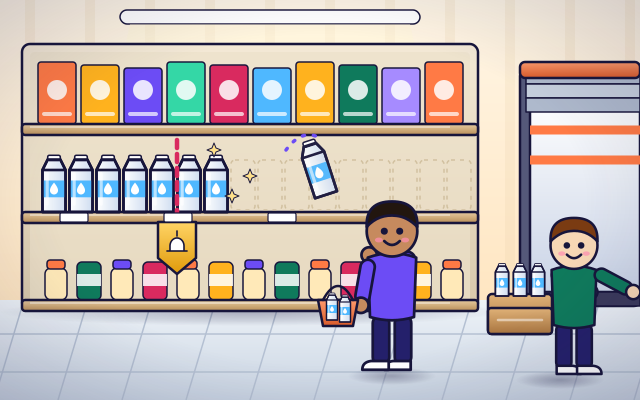
The interactive parts didn't load. The explanations below still work; try reloading the page.
How the shelf stays full
- In the morning, the milk shelf is full. All day long, shoppers take cartons. The row gets shorter, and nobody in the store has to count by hand. So how does the store know when to get more?
- The answer is at the checkout. Every carton is scanned, and each beep tells the store's computer that one carton has been sold. The computer keeps a running count of how many must be left.
- The computer does not wait until the count is zero. It has a marker called the reorder point. When the count drops to that number, it orders more by itself, while there is still milk to sell.
- The order goes to a big warehouse that serves many stores. Workers load a truck, and it drives through the night. From order to delivery takes a day or two. Shoppers keep buying milk the whole time.
- Early in the morning, the delivery arrives and workers fill the shelf. They slide the older cartons to the front and put the new ones behind, so the oldest milk is sold first and none goes bad.
- It is a balancing act. Order too late, and shoppers find an empty shelf. Order too much, and the milk does not fit, or it goes bad before it is sold. A good store keeps the shelf between the two.
What keeps the shelf stocked?
A small model store. Tap each part to see how it helps keep the milk shelf stocked.
- Shelf space. The shelf has room for a fixed number of cartons. If a delivery brings more than will fit, the rest has nowhere to go.
- Shelf label. The label on the shelf edge shows the product and has a barcode. A worker can scan it to check what should be here and how many the computer thinks are left.
- Reorder point. The reorder point is the "order now" marker. When the row of cartons shrinks back to it, the computer sends an order. It is set so that the milk left will last until the truck comes.
- Checkout scanner. The checkout scanner reads each barcode to find the price. The same beep tells the stock computer that one more has been sold.
- Stock computer. The stock computer keeps count: cartons delivered, minus cartons sold. When the count reaches the reorder point, it orders more.
- Delivery door. Deliveries arrive at the back door from a big warehouse that serves many stores. Each order brings a set number of cartons.
- Delivery time. A delivery does not come the moment it is ordered. The days in between are the delivery time, and the shelf has to last through them.
Move the "order now" marker
Drag the amber marker along the shelf, or use the slider. It tells the store when to order more milk. Look at the two weeks below: when is the shelf empty? When does a delivery not fit?
Experiment: The store waits until the shelf is completely empty before it orders more. What happens?
- Slide the marker all the way to the left, so the store orders only when the shelf is empty. Look for red days.
- Slide it far to the right, so the store orders almost at once. Does every delivery fit?
- Find a place for the marker with no red days and nothing left over.
What we found: A delivery takes two days, and three cartons are sold each day. If the store orders when fewer than six are left, there is nothing to sell before the truck comes. If it orders too soon, the new cartons arrive while the shelf is still nearly full, and they do not fit. The marker belongs in between.
Turn on JavaScript to try it yourself.
Two weeks, no empty shelf
This store sells two cartons a day, and its truck takes three days. Place the "order now" marker, then press Run. Get through two weeks with no empty shelf and no delivery that does not fit.
How a store keeps its shelves stocked
A supermarket sells thousands of different things, and shoppers expect to find every one of them. Nobody could walk around counting every shelf all day. Instead, the store lets its computer keep count. Every time a carton of milk is scanned at the checkout, the computer takes one away from its number. So it always knows roughly how many cartons are left.
Getting more milk takes time. The order goes to a big warehouse, a truck is loaded, and the truck drives to the store. That might take a day or two, and people keep buying milk the whole time. So the store must order before the shelf is empty. The computer has a number called the reorder point. When the count drops to that number, it orders more by itself.
Where should the reorder point be? If the store sells four cartons a day and the truck takes two days, eight cartons will be sold while waiting. So the store should order when at least eight are left. Order later, and the shelf will be empty before the truck arrives.
But ordering too early, or too much, is a mistake as well. A shelf has only so much room, and milk goes bad. So a store aims for the middle: enough that the shelf is never empty, and not so much that food is wasted. When the new cartons arrive, workers put them behind the older ones, so the oldest milk is always sold first. The store on this page is a simplified model.
Key words
- Stock
- The goods a store has ready to sell. It is also called inventory.
- Reorder point
- The number of items left at which the store orders more.
- Delivery time
- The time between ordering something and having it arrive.
- Capacity
- The most that something can hold, such as the number of cartons that fit on a shelf.
- Safety stock
- Extra stock kept in case more is sold than expected, or a delivery is late.
- Stock rotation
- Putting new items behind older ones, so that the oldest are sold first.
Check your thinking
-
Why does a store order more milk before the shelf is empty?
Show the answer
Because the delivery takes time, and shoppers keep buying while the truck is on its way. There is a gap between ordering and delivery. The milk still on the shelf has to last through that gap.
-
What goes wrong if a store orders far too much milk?
Show the answer
It does not fit on the shelf, and some may go bad before it is sold. A shelf holds only so much, and milk does not keep for long. Too much stock ends up wasted.
-
How does the store's computer know how many cartons are left on the shelf?
Show the answer
It subtracts one every time a carton is scanned at the checkout. The checkout scanner does two jobs: it finds the price, and it tells the computer what was sold.
-
Why do workers put the new cartons behind the older ones?
Show the answer
So that the oldest milk is bought first and does not go bad on the shelf. Shoppers usually take the carton at the front. Keeping the older ones there means they are sold in time.
-
A shelf holds 20 cartons. The store orders 12 whenever stock falls to 10, and sells 4 during the delivery time. How full is the shelf just after a delivery?
Show the answer
18 cartons: 10 minus 4, plus 12. Stock at arrival is the reorder point minus the sales during the delivery time: 10 minus 4 is 6. Adding the order of 12 gives 18, which fits under the capacity of 20.
You're a Money, shops & services expert!
You watched, looked inside, tried it, solved the challenge and went deeper. Pick another question below, or switch the age at the top to see this topic another way.
More about money, shops & services
 #491
Money, shops & services
How does a self-checkout machine work?
Scan products, match prices, check a basket, and complete a pretend payment.
#491
Money, shops & services
How does a self-checkout machine work?
Scan products, match prices, check a basket, and complete a pretend payment.
 #492
Money, shops & services
How does a vending machine deliver a snack?
Follow selection, payment, motor movement, and delivery through a transparent machine.
#492
Money, shops & services
How does a vending machine deliver a snack?
Follow selection, payment, motor movement, and delivery through a transparent machine.
 #493
Money, shops & services
How does a library track borrowed books?
Borrow and return virtual books while updating availability, borrower records, and due dates.
#493
Money, shops & services
How does a library track borrowed books?
Borrow and return virtual books while updating availability, borrower records, and due dates.
 #494
Money, shops & services
How does an emergency call reach the right help?
Follow location details, call assessment, dispatch, and responder updates in a fictional scenario.
#494
Money, shops & services
How does an emergency call reach the right help?
Follow location details, call assessment, dispatch, and responder updates in a fictional scenario.
Keep exploring
Games to play next
- Supermarket StockerRoll out your cart and make every shelf ready for the day.
- Shopping RushA list, a little planning and a supermarket full of possibilities.
- Coin MarketRun a pretend market stall: pay exactly, use the fewest coins, and give the right change.
Guide for grown-ups
- How to start homeschooling: a step-by-step guide for familiesA guide for parents · 7 min read