How are foam cushions made?
Two liquids are mixed, gas bubbles puff the mixture up like bread, and it sets into a springy foam full of tiny holes.
The big idea: A cushion is mostly air. When two liquids are mixed they make bubbles of gas and turn solid at the same time, so the bubbles are caught inside. When their thin walls pop open, the foam turns soft and springy.
It's like bread dough rising: gas bubbles puff it up, then it sets, and the bubbles stay behind as thousands of tiny holes.
The interactive parts didn't load. The explanations below still work; try reloading the page.
How foam is made
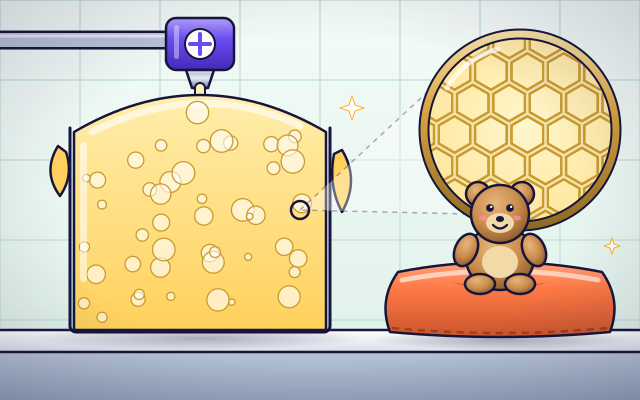
- Zoe drops onto a cushion. It squashes, then springs back. Inside is foam. Look very closely and you can see that it is full of tiny holes. How did they get there?
- At the foam factory, two liquids are pumped from big tanks into a mixing head. It whisks them together and pours the creamy mixture onto a moving belt.
- Zoom in. The liquids start to join together, and that makes a gas. Tiny bubbles appear all through the mixture. More gas keeps coming, so every bubble grows.
- As the bubbles grow, the mixture swells to many times its size and rises like a giant loaf of bread. A thin layer of liquid becomes a block of foam taller than a child.
- The bubbles press against each other. Just as the foam turns solid, their thin walls burst. Only the edges are left, like a net. Air can now move from hole to hole, and that makes the foam soft.
- After the foam has rested and cooled, saws slice the giant loaf into blocks and sheets. A piece is cut to shape, a cover is zipped on, and it is ready to be sat on.
Look inside a foam line
Tap each part of the foam line. Follow the foam from left to right!
- Tanks. Each tank holds one of the two liquids. They are kept apart until the very last moment, because they start to react as soon as they meet.
- Mixing head. The mixing head whisks the liquids together very fast, along with a little water, and pours the mixture out through a nozzle.
- Moving belt. The mixture is poured onto a moving belt lined with paper. The belt carries the foam away while it rises, so the machine can keep pouring without stopping.
- Rising foam. The foam rises as it rides along. It starts as a thin puddle near the nozzle and is a tall block a few steps later. The giant loaf of foam is called a bun.
- Foam cells. Under the magnifier you can see the cells: tiny bubbles packed together. In cushion foam their walls have popped open, so only a springy net is left.
- Saw. A long thin blade slices the bun into blocks. Later, other saws cut the blocks into sheets and cushion shapes.
Open bubbles or sealed bubbles?
Pour the mixture and watch both foams rise. One has bubbles that popped open, and one has sealed bubbles. Push each one down and compare.
Experiment: Two foams rise the same way. In one the bubble walls pop open. In the other they stay sealed. Which is squishier?
- Tap the mixer to pour, and watch both foams rise.
- Pull the handle down on the yellow foam with open bubbles.
- Now pull the handle down on the blue foam with sealed bubbles. Which went down further?
What we found: The foam with open bubbles is much squishier. When you push, the air rushes out through the open walls, and when you let go it rushes back in. Sealed bubbles keep their gas trapped, so they push back like thousands of tiny balloons.
Turn on JavaScript to try it yourself.
Fill the mould just right
Make a soft cushion that fills the mould up to the line, with no spilling over. Choose the bubbles and the amount of gas, then pour.
A solid full of bubbles
Squeeze a cushion and it squashes. Let go and it springs back. The secret is that foam is mostly air. It is a solid that is full of tiny bubbles, called cells, packed tightly together.
Cushion foam starts as two liquids. When they are mixed they begin to join into a rubbery solid, and at the same moment they make a gas. The gas forms bubbles everywhere in the mixture. The bubbles grow, and the whole thing puffs up to about thirty times its size, just as bread dough rises. Then the liquid sets and the bubbles are caught for good.
What happens to the thin walls between the bubbles matters a lot. In cushion foam the walls pop open as the foam sets, so only a net of springy edges is left. Air can flow out when you sit down and back in when you stand up. That is why it feels soft. In a camping mat or a pool noodle the bubbles stay sealed. The trapped gas pushes back, so the foam is firm, and it floats because water cannot get in.
Foam makers can change the recipe. More of the gas-making ingredient gives a lighter, softer foam. Less gives a heavier, firmer one. Our bread comparison is close, but bread needs an oven to set. Foam sets by itself, because the liquids make their own heat as they join.
Key words
- Foam
- A material full of gas bubbles. It can be a liquid, like soap suds, or a solid, like a cushion.
- Cell
- One of the tiny bubbles inside a foam.
- Open-cell foam
- Foam whose bubble walls have popped open, so air can flow through it. It is soft.
- Closed-cell foam
- Foam whose bubbles are sealed, so gas is trapped inside. It is firm, and it floats.
- Density
- How heavy something is for its size.
- Polymer
- A material made of very long molecules built from many small units joined together.
Check your thinking
-
What is a foam cushion mostly made of?
Show the answer
Air, in thousands of tiny holes. Foam is a solid full of tiny holes, so most of it is air.
-
Why is a foam with open bubbles softer than one with sealed bubbles?
Show the answer
Air can flow out when you squeeze it. With open walls the air can escape, so only the thin edges push back.
-
A foam maker adds more of the gas-making ingredient. What happens?
Show the answer
The foam rises higher and is lighter. More gas means bigger bubbles, so the same liquid makes more foam, and each piece weighs less.
-
A recipe is changed from 2 parts of water to 4 parts. What happens to the foam's density in our model?
Show the answer
It falls to about half. Twice the water makes about twice the gas, so the same mass fills about twice the volume: 1100 ÷ 19 ≈ 58, and 1100 ÷ 37 ≈ 30.
-
Which of these is a foam with sealed bubbles?
Show the answer
A pool noodle that floats. A pool noodle floats and does not soak up water, because its bubbles are sealed.
You're a Making everyday things expert!
You watched, looked inside, tried it, solved the challenge and went deeper. Pick another question below, or switch the age at the top to see this topic another way.
More about making everyday things
 #325
Making everyday things
How are coins made?
Prepare metal blanks, press designs onto both sides, and inspect the results.
#325
Making everyday things
How are coins made?
Prepare metal blanks, press designs onto both sides, and inspect the results.
 #11
Making everyday things
How is paper made?
Turn wood or recycled paper into pulp, spread it into a sheet, press out water, dry it, and cut it in a miniature paper mill.
#11
Making everyday things
How is paper made?
Turn wood or recycled paper into pulp, spread it into a sheet, press out water, dry it, and cut it in a miniature paper mill.
 #12
Making everyday things
How are books made?
Arrange words and pictures, print pages, fold sheets, bind them, and add a cover. Create a small digital book while exploring the manufacturing stages.
#12
Making everyday things
How are books made?
Arrange words and pictures, print pages, fold sheets, bind them, and add a cover. Create a small digital book while exploring the manufacturing stages.
 #13
Making everyday things
How are pencils made?
Follow the graphite mixture and wooden pieces through shaping, assembly, painting, and sharpening. Look inside a pencil and test different writing cores.
#13
Making everyday things
How are pencils made?
Follow the graphite mixture and wooden pieces through shaping, assembly, painting, and sharpening. Look inside a pencil and test different writing cores.
Keep exploring
Games to play next
- Machine RepairFix levers, pulleys, gears and ramps so every contraption works.
- Geometry Architect 3DCount, build and fold solids like a real architect.
- Sorting FactoryTurn a work order into if/else rules and watch the conveyor sort every item.
Guide for grown-ups
- How to start homeschooling: a step-by-step guide for familiesA guide for parents · 7 min read
Science games by grade
Science worksheets by grade
- Preschool Science Worksheets
- Pre-K Science Worksheets
- Kindergarten Science Worksheets
- 1st Grade Science Worksheets
- 2nd Grade Science Worksheets
- 3rd Grade Science Worksheets
- 4th Grade Science Worksheets
- 5th Grade Science Worksheets
- 6th Grade Science Worksheets
- 7th Grade Science Worksheets
- 8th Grade Science Worksheets