How is paper made?
Wood and recycled paper are mashed into pulp, spread on a screen, pressed, dried and cut into sheets.
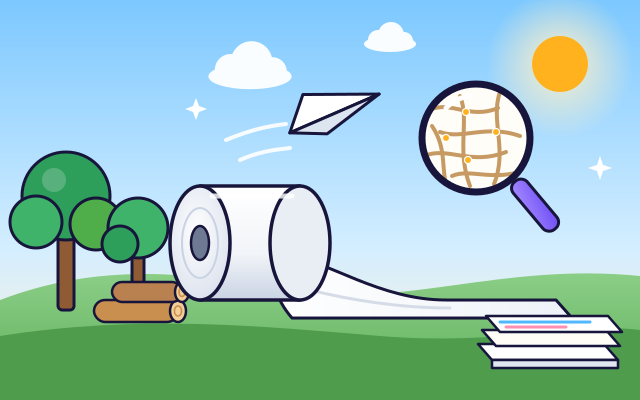
The big idea: Wood is full of tiny threads called fibers. Mix them with lots of water, spread them on a screen, then squeeze and dry them, and the fibers stick together into paper.
It's like
The interactive parts didn't load. The explanations below still work; try reloading the page.
A trip through a paper mill
- Most paper starts as wood. If you could zoom into wood, you would see millions of tiny, hollow threads called fibers, all glued together.
- At the mill, the bark is rubbed off the logs. Then a chipper slices them into small chips, about the size of a cracker.
- The chips are cooked and mashed with water until the fibers come apart. Old paper is mixed with water too. The gooey mix is called pulp.
- The watery pulp sprays onto a fast moving screen. Water drains through the tiny holes, and the fibers tangle together into a wet sheet.
- The wet sheet rides on soft felt blankets between heavy rollers. They squeeze out lots of water and press the fibers closer together.
- Next the sheet snakes over dozens of hot, steam heated rollers. The last water turns to steam, and the fibers stick tightly as they dry.
- The finished paper winds onto a giant roll. Then it is cut into neat sheets, stacked and packed, ready for your pencils and crayons.
Inside a paper mill, step by step
Step through the mill. Each machine changes the wood a little more until it becomes paper.
- Logs and debarker. Logs arrive by truck. They tumble inside a big spinning drum that knocks the bark off, because bark would make dark specks in the paper.
- Chipper. A chipper has a big spinning disk with sharp knives. It slices the logs into small chips so they can soak and cook evenly.
- Pulper. Chips are cooked to loosen the fibers, and old paper is stirred with water in a giant blender called a pulper. The result is pulp: fibers floating in water.
- Headbox and wire. The headbox sprays a thin, even sheet of pulp onto a moving screen called the wire. Water drips through the holes and the fibers stay on top, tangled into a mat.
- Press rollers. The wet sheet travels on soft felt blankets between heavy rollers. The squeeze pushes water into the felt and presses the fibers together.
- Drying cylinders. The paper snakes up and down over many hot rollers filled with steam. The last water turns into steam, and the fibers stick together as they dry.
- Reel and cutter. Smooth rollers polish the dry paper, then it winds onto a giant roll. Machines cut the roll into neat sheets and stack them.
Mini paper mill: pulp, spread, press, dry, cut
Run your mini paper mill. Choose how much pulp to spread and how hard to press. Watch the sheet and the close-up of the fibers change at every stage.
Experiment: What happens to a wet sheet when you press it hard?
- Make pulp, then spread some pulp on the screen.
- Set the press to light and press. Look at the sheet's edge and the water drops.
- Make another sheet and press it hard. Compare!
What we found: Pressing squeezes water out and pushes the fibers closer together, so the sheet gets thinner. Less water also means it dries much faster.
Turn on JavaScript to try it yourself.
Fill the paper order
A customer needs printer paper. Make a sheet whose thickness lands in the green zone, and make sure it is dry.
Why paper sticks together
Look closely at the torn edge of a piece of paper and you will see fuzzy little hairs. Those are fibers, the same tiny threads that made up the wood. A single sheet of printer paper contains millions of them, crossing over each other like a messy pile of spaghetti.
There is no glue holding most paper together. Instead, when the wet fibers dry, they pull close together and stick where they touch. That is why making paper needs so much water: the water lets the fibers float, spread out evenly and then hug each other as it leaves.
Pressing matters too. Squeezing the wet sheet pushes the fibers closer, so more of them touch and the paper gets thinner and stronger. Mills squeeze out as much water as they can, because drying with heat uses a lot of energy.
Recycling paper saves trees and energy. Old paper is soaked, stirred and cleaned, then made into new paper. Each time, the fibers get a little shorter, so after about five to seven trips they are too short to use and new fibers are added.
Key words
- Fiber
- A tiny thread from wood or plants. Paper is made of millions of them.
- Pulp
- Fibers separated from wood or old paper and mixed with lots of water.
- Grammage
- The mass of one square meter of paper, in grams per square meter (g/m²).
- Hydrogen bond
- A tiny sticky connection that forms where dry fibers touch.
- Refining (beating)
- Rubbing and squeezing the pulp so the fiber surfaces fray and can bond more.
Check your thinking
-
What are the tiny threads in paper called?
Show the answer
Fibers. Fibers are tiny threads from wood. Millions of them tangle together to make a sheet.
-
Why does a paper mill press the wet sheet before drying it?
Show the answer
Squeezing out water is cheaper and faster than drying it all with heat. Pressing removes water without using heat, and it pushes the fibers closer so the paper is stronger.
-
Two sheets both have a grammage of 80 g/m². Sheet A is 100 µm thick and sheet B is 160 µm thick. Which is denser?
Show the answer
Sheet A. Density = grammage ÷ thickness. The same mass squeezed into less thickness means higher density: A is 0.8 g/cm³ and B is 0.5 g/cm³.
-
Why can paper fibers only be recycled a few times?
Show the answer
Each time, the fibers get shorter. Pulping and drying break the fibers a little every time. After about five to seven trips, they are too short to hold a sheet together.
-
What happens to the water in the drying section?
Show the answer
It turns into steam and floats away. The hot cylinders heat the water until it evaporates, leaving dry paper behind.
You're a Making everyday things expert!
You watched, looked inside, tried it, solved the challenge and went deeper. Pick another question below, or switch the age at the top to see this topic another way.
More about making everyday things
 #12
Making everyday things
How are books made?
Arrange words and pictures, print pages, fold sheets, bind them, and add a cover. Create a small digital book while exploring the manufacturing stages.
#12
Making everyday things
How are books made?
Arrange words and pictures, print pages, fold sheets, bind them, and add a cover. Create a small digital book while exploring the manufacturing stages.
 #13
Making everyday things
How are pencils made?
Follow the graphite mixture and wooden pieces through shaping, assembly, painting, and sharpening. Look inside a pencil and test different writing cores.
#13
Making everyday things
How are pencils made?
Follow the graphite mixture and wooden pieces through shaping, assembly, painting, and sharpening. Look inside a pencil and test different writing cores.
 #14
Making everyday things
How are crayons made?
Mix virtual wax and pigments, fill molds, cool the crayons, and add wrappers. Use the finished colors to complete a drawing.
#14
Making everyday things
How are crayons made?
Mix virtual wax and pigments, fill molds, cool the crayons, and add wrappers. Use the finished colors to complete a drawing.
 #15
Making everyday things
How is glass made?
Follow raw materials through melting, shaping, and controlled cooling. Compare how a bottle, windowpane, and decorative glass object are formed.
#15
Making everyday things
How is glass made?
Follow raw materials through melting, shaping, and controlled cooling. Compare how a bottle, windowpane, and decorative glass object are formed.
Keep exploring
Games to play next
- Sorting FactoryTurn a work order into if/else rules and watch the conveyor sort every item.
- Machine RepairFix levers, pulleys, gears and ramps so every contraption works.
- Geometry Architect 3DCount, build and fold solids like a real architect.
Guide for grown-ups
- How to start homeschooling: a step-by-step guide for familiesA guide for parents · 7 min read
Science games by grade
Science worksheets by grade
- Preschool Science Worksheets
- Pre-K Science Worksheets
- Kindergarten Science Worksheets
- 1st Grade Science Worksheets
- 2nd Grade Science Worksheets
- 3rd Grade Science Worksheets
- 4th Grade Science Worksheets
- 5th Grade Science Worksheets
- 6th Grade Science Worksheets
- 7th Grade Science Worksheets
- 8th Grade Science Worksheets