How are books made?
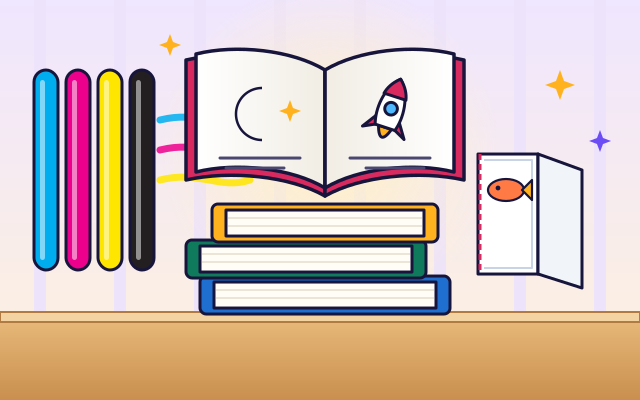
A book is laid out, printed on giant sheets, folded into page groups, bound together and covered.
The big idea: Printers don't print one page at a time. They print many pages on one huge sheet, fold it into a bundle called a signature, then join the bundles and add a cover.
It's like
The interactive parts didn't load. The explanations below still work; try reloading the page.
From story to bookshelf
- A book begins with an author, who writes the words, and an illustrator, who draws the pictures. Editors help check and polish the story.
- A designer arranges the words and pictures on each page with a computer. They choose fonts, sizes and margins so the pages are easy to read.
- A huge printing press prints many pages at once on one giant sheet. It uses just four inks: cyan, magenta, yellow and black. Tiny dots of them mix to make every color.
- A folding machine folds each big sheet in half again and again. Every fold doubles the pages, making a bundle called a signature.
- The signatures are stacked in the right order. Little black marks on their spines make a neat staircase when the order is right. Then they are sewn or glued together.
- The cover is glued around the sewn pages. Then a giant blade trims three edges. That cuts open the folded edges, so every page can turn.
- The finished books are packed into boxes and shipped to bookshops and libraries, where a reader like you can open one up.
Inside a hardcover book
This book has been cut through so you can see inside. Tap each part to find out what it does.
- Cover boards. A hardcover has two stiff boards made of thick cardboard, wrapped in cloth or printed paper. They protect the pages.
- Spine. The spine joins the front and back covers. It shows the title, so you can find the book on a shelf.
- Endpapers. Endpapers are strong sheets glued to the inside of the covers and to the first and last pages. They hold the pages inside the cover.
- Signatures. The pages are made from folded sheets called signatures. Each one is a big sheet folded until it makes 8, 16 or 32 pages.
- Sewing thread. A sewing machine pushes thread through the middle fold of each signature and links them together. Sewn books open flat and last a long time.
- Glue and spine cloth. Flexible glue is brushed on the back of the sewn pages, and a strip of thin cloth, called mull, is stuck on top. The cloth reaches onto the covers like a hinge.
- Headband. The headband is a small striped band at the top and bottom of the spine. Today it is mostly decoration, but it also helps protect the spine.
- Trimmed edges. After folding, the pages are still joined at their edges. A big blade trims the top, bottom and front edges to cut them open.
Book factory: lay out, print, fold, bind, cover
Choose a story, a page layout and a cover. Then make your book stage by stage. Count the pages each time the sheet is folded!
Experiment: If you fold a printed sheet in half two times, how many pages do you get?
- Lay out your pages and print the big sheet.
- Press Fold and count the pages after the first fold.
- Count again after the second fold.
What we found: One fold makes 2 leaves, which is 4 pages (front and back). A second fold doubles that to 8 pages. Every fold doubles the pages!
Turn on JavaScript to try it yourself.
Gather the signatures
Six signatures are waiting in the gathering machine. Tap them in the right order to stack the book. In the right order, the black marks on their spines make a neat staircase.
Why printers fold big sheets
Printing one page at a time would be very slow. Instead, a printing press prints many pages on one giant sheet. Then a machine folds the sheet again and again until it is the size of a book page. That folded bundle is called a signature.
Every time you fold a sheet in half, you double the number of pages. One fold gives 4 pages, two folds give 8 and three folds give 16. Because of this, the pages must be printed in a special order, and some are even upside down, so that they end up in the right order after folding.
The pictures in books use only four inks: cyan, magenta, yellow and black. The press prints tiny dots of each color, side by side and on top of each other. The dots are so small that your eyes blend them into thousands of colors.
Finally, the signatures are stacked in order and held together. Thin booklets are stapled through the fold, many paperbacks are glued, and sturdy books are sewn with thread. Then a sharp blade trims the edges so the pages can turn.
Key words
- Signature
- A printed sheet folded into a group of pages, such as 8, 16 or 32.
- Imposition
- Placing pages on the big sheet in a special order so they come out right after folding.
- CMYK
- Cyan, magenta, yellow and key (black): the four inks used for full color printing.
- Binding
- Holding the pages together with staples, glue or thread.
- Trimming
- Cutting the head, foot and front edge so the folded pages open and the edges are smooth.
Check your thinking
-
What is a signature?
Show the answer
A big printed sheet folded into a bundle of pages. Printers fold one big sheet into a bundle of pages called a signature.
-
Why are books trimmed after they are bound?
Show the answer
To cut open the folded edges so the pages can turn. Folding leaves the edges joined. Trimming cuts them open and makes them neat.
-
How many pages do you get from a sheet folded 3 times?
Show the answer
16. Each fold doubles the pages: 4, then 8, then 16.
-
Which four inks print full color pictures?
Show the answer
Cyan, magenta, yellow and black. Cyan, magenta, yellow and black dots blend in your eyes to make every color.
-
Why do printers print many pages on one big sheet instead of one page at a time?
Show the answer
It is much faster: one pass through the press prints many pages. One trip through the press prints 8, 16 or 32 pages at once, and folding turns them into a signature.
You're a Making everyday things expert!
You watched, looked inside, tried it, solved the challenge and went deeper. Pick another question below, or switch the age at the top to see this topic another way.
More about making everyday things
 #13
Making everyday things
How are pencils made?
Follow the graphite mixture and wooden pieces through shaping, assembly, painting, and sharpening. Look inside a pencil and test different writing cores.
#13
Making everyday things
How are pencils made?
Follow the graphite mixture and wooden pieces through shaping, assembly, painting, and sharpening. Look inside a pencil and test different writing cores.
 #14
Making everyday things
How are crayons made?
Mix virtual wax and pigments, fill molds, cool the crayons, and add wrappers. Use the finished colors to complete a drawing.
#14
Making everyday things
How are crayons made?
Mix virtual wax and pigments, fill molds, cool the crayons, and add wrappers. Use the finished colors to complete a drawing.
 #15
Making everyday things
How is glass made?
Follow raw materials through melting, shaping, and controlled cooling. Compare how a bottle, windowpane, and decorative glass object are formed.
#15
Making everyday things
How is glass made?
Follow raw materials through melting, shaping, and controlled cooling. Compare how a bottle, windowpane, and decorative glass object are formed.
 #16
Making everyday things
How does cotton become clothing?
Follow cotton from the plant through spinning, weaving or knitting, dyeing, cutting, and sewing. Design a shirt and inspect its fabric up close.
#16
Making everyday things
How does cotton become clothing?
Follow cotton from the plant through spinning, weaving or knitting, dyeing, cutting, and sewing. Design a shirt and inspect its fabric up close.
Keep exploring
Games to play next
- Machine RepairFix levers, pulleys, gears and ramps so every contraption works.
- Geometry Architect 3DCount, build and fold solids like a real architect.
- Sorting FactoryTurn a work order into if/else rules and watch the conveyor sort every item.
Guide for grown-ups
- How to start homeschooling: a step-by-step guide for familiesA guide for parents · 7 min read
Science games by grade
Science worksheets by grade
- Preschool Science Worksheets
- Pre-K Science Worksheets
- Kindergarten Science Worksheets
- 1st Grade Science Worksheets
- 2nd Grade Science Worksheets
- 3rd Grade Science Worksheets
- 4th Grade Science Worksheets
- 5th Grade Science Worksheets
- 6th Grade Science Worksheets
- 7th Grade Science Worksheets
- 8th Grade Science Worksheets