How do parcel centers sort packages?
In a parcel center, a scanner reads every label and a computer tells paddles when to push. Find out why the parcels need gaps between them.
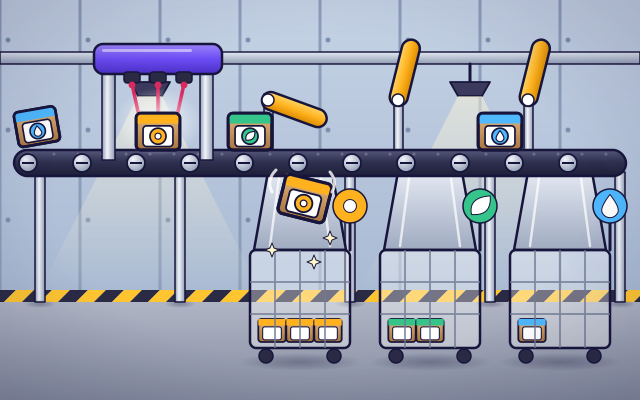
The big idea: Each parcel is scanned once. After that the computer follows it along the belt and pushes it off at the slide for its destination. Gaps between parcels give the paddles room to work.
It's like a marble run with trap doors: every marble rolls down the same track, and a door opens at just the right moment to drop it into its own cup.
The interactive parts didn't load. The explanations below still work; try reloading the page.
Inside a parcel center
- Every night, trucks bring thousands of parcels to a parcel center. They tumble onto a belt in a jumble. A faster belt pulls them apart, so they travel in a single line with a gap between each one.
- Every parcel has a label. People read the address. Machines read the barcode: black and white stripes that stand for a number. No other parcel has the same number.
- The belt carries each parcel through a scan tunnel. Cameras look from the top and the sides, because the label could be facing any way. In a blink, they find the barcode and read its number.
- A computer looks up the number in a list. The list says which town the parcel is going to, and which slide leads to that town's truck. Now the computer knows where to push this parcel off.
- The parcel rides on. Just as it reaches its slide, a paddle swings out and nudges it off the belt. Down it slides into the cart for its town. The paddle swings back before the next parcel comes.
- By morning, each cart holds parcels for one town. They are loaded onto that town's truck, and the trucks set off. A parcel that could not be read goes to a person, who sorts it by hand.
Look inside the sorting line
A sorting line from start to finish. Tap each part to see what it does to a parcel.
- Unloading belt. Parcels from the truck are put onto this belt. They arrive in a jumble, some side by side and some touching.
- Spacing belt. This short belt runs faster than the one before it. Each parcel speeds up as it rolls on, so it pulls ahead of the one behind. That makes a gap.
- Scan tunnel. Cameras all around the belt take pictures of each parcel as it passes. Software finds the barcode in the pictures and reads its number.
- Weigh and measure. A scale built into the belt weighs each parcel without stopping it. Light beams measure how long, wide and tall it is.
- Sorting computer. The computer looks up each parcel's number and chooses a slide. It knows how fast the belt moves, so it knows when the parcel will reach that slide.
- Diverter. A diverter moves a parcel off the main belt. This one is a paddle that swings out. Others use tilting trays or little wheels that pop up and steer the parcel sideways.
- Slide. A smooth slide, called a chute, lets the parcel glide down by gravity. Each chute leads to one town's cart.
- Roll cage. A cart with wire sides, called a roll cage, collects all the parcels for one town. When it is full, it is rolled onto that town's truck.
Mind the gap
Watch the parcels land in their carts. Then make the gap smaller and smaller. What goes wrong, and why?
Experiment: What happens when the parcels ride very close together?
- Start with a big gap. Check that every parcel lands in the cart with its own picture.
- Slide the gap down until the parcels almost touch.
- Watch the paddle after it pushes a parcel. What does it hit next?
What we found: With a good gap, each paddle pushes one parcel and swings back in time. When the parcels are too close, the paddle is still out when the next parcel arrives, so that one is pushed down the wrong slide.
Turn on JavaScript to try it yourself.
Set the switches
Each parcel must reach the truck with its picture. Tap the switches to set the path before the parcel gets there. Deliver five parcels.
How a parcel center sorts
A parcel center is a huge building where parcels change trucks. Trucks arrive in the evening from many places, and by morning every parcel must be on the right truck for the next part of its trip. People could never read that many labels in time, so machines do most of the sorting.
First, the parcels have to line up. They tumble out of the trucks in a jumble, so a faster belt pulls them apart into a single line with gaps between them. Then each parcel rides through a scan tunnel. Cameras look at it from all around, find the barcode on the label and read its number.
A computer looks that number up and learns where the parcel is going. Each town has its own slide, called a chute. The computer knows how fast the belt is moving, so it can work out exactly when the parcel will pass its chute. At that moment a paddle swings out and nudges the parcel off the belt, and it slides down into a cart.
The gaps matter. A paddle needs a moment to push and swing back. If the next parcel is too close, the paddle hits it as well and sends it to the wrong town. So a sorter is always balancing two wishes: pack the parcels close to sort more of them, but leave enough room for the paddles. The line on this page is a simplified model of a real one.
Key words
- Barcode
- A pattern of black and white stripes that stands for a number a machine can read.
- Conveyor
- A moving belt, or a row of rollers, that carries things along.
- Diverter
- The part of a sorter that moves a parcel off the main belt, such as a paddle, a tilting tray or pop-up wheels.
- Chute
- A smooth slide that lets parcels glide down to a cart or a bag.
- Gap
- The empty space between one parcel and the next on the belt.
- Throughput
- How many parcels a sorter handles in a given time, for example parcels per hour.
Check your thinking
-
How does the sorting computer find out where a parcel is going?
Show the answer
Cameras read the barcode, and the computer looks the number up. The barcode is a number. The computer keeps a list that matches numbers to towns and slides.
-
Why do parcels need a gap between them on a sorting belt?
Show the answer
So the paddle can swing back before the next parcel arrives. A paddle takes a moment to push and return. A parcel that arrives too soon gets pushed the wrong way.
-
Why does a scan tunnel have cameras on several sides?
Show the answer
The label could be on the top or on any side of the parcel. Parcels land on the belt any way up, so the cameras must be able to see every side.
-
A parcel's label is torn and cannot be read. What should the sorter do?
Show the answer
Send it to a person, who reads the label and sorts it by hand. A guess could send the parcel to the wrong town. A person can read what the cameras could not.
-
Parcels are 0.6 meters long with a 0.9 meter gap, and the belt runs at 1.5 meters per second. About how many parcels pass in one hour?
Show the answer
About 3,600. Front to front, each parcel takes up 0.6 + 0.9 = 1.5 meters. At 1.5 meters per second, one parcel passes every second, and there are 3,600 seconds in an hour.
You're a Money, shops & services expert!
You watched, looked inside, tried it, solved the challenge and went deeper. Pick another question below, or switch the age at the top to see this topic another way.
More about money, shops & services
 #489
Money, shops & services
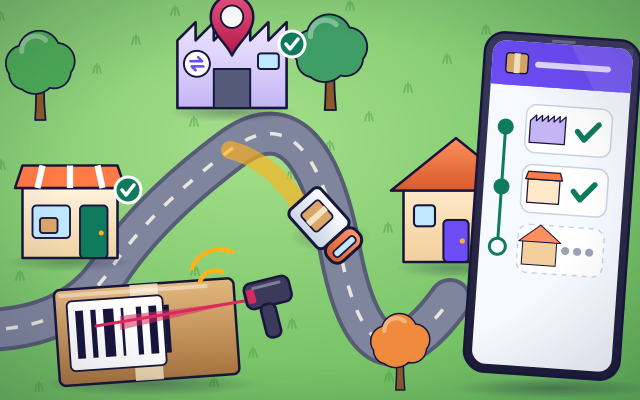
How does delivery tracking know where a package is?
Add scan events along a journey and watch the tracking history update.
#489
Money, shops & services
How does delivery tracking know where a package is?
Add scan events along a journey and watch the tracking history update.
 #490
Money, shops & services
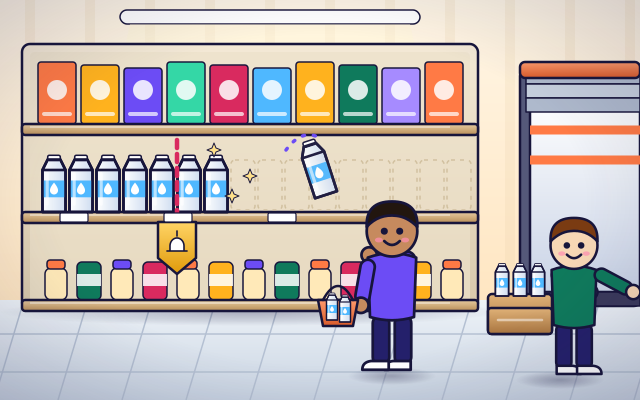
How do supermarkets keep shelves stocked?
Balance sales, inventory, reorder points, deliveries, and shelf space in a model store.
#490
Money, shops & services
How do supermarkets keep shelves stocked?
Balance sales, inventory, reorder points, deliveries, and shelf space in a model store.
 #491
Money, shops & services
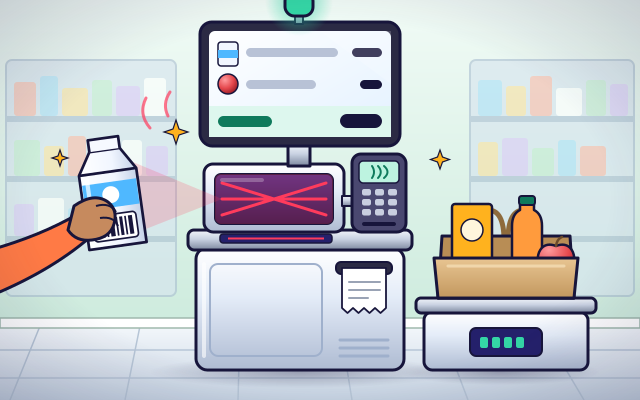
How does a self-checkout machine work?
Scan products, match prices, check a basket, and complete a pretend payment.
#491
Money, shops & services
How does a self-checkout machine work?
Scan products, match prices, check a basket, and complete a pretend payment.
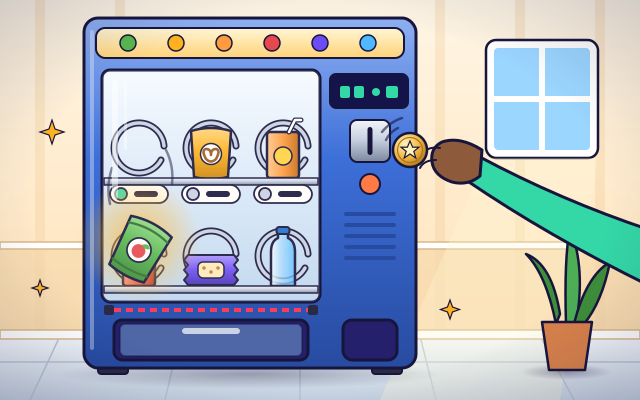 #492
Money, shops & services
How does a vending machine deliver a snack?
Follow selection, payment, motor movement, and delivery through a transparent machine.
#492
Money, shops & services
How does a vending machine deliver a snack?
Follow selection, payment, motor movement, and delivery through a transparent machine.
Keep exploring
Games to play next
- Coin MarketRun a pretend market stall: pay exactly, use the fewest coins, and give the right change.
- Festival PlannerPlace the stalls, book the acts and keep the budget — make every rule true.
- Supermarket StockerRoll out your cart and make every shelf ready for the day.
Guide for grown-ups
- How to start homeschooling: a step-by-step guide for familiesA guide for parents · 7 min read