How do QR codes store information?
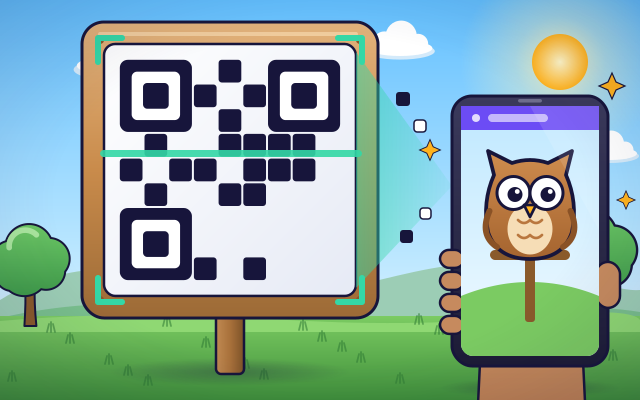
Dark and light squares spell out a message that a phone camera can read in a blink.
The big idea: Each little square is dark or light. A row of squares makes a number, each number stands for a letter, and a phone turns the pattern back into words.
It's like a row of light switches: each one is on or off, and the pattern of ons and offs is a message for anyone who knows the rule.
The interactive parts didn't load. The explanations below still work; try reloading the page.
How a square holds a message
- Mia finds a QR code on a sign in the park. It looks like a jumble of squares, but her phone can read it. How?
- Zoom in. Every little square is either dark or light. Computers call dark a one and light a zero. That one choice is the smallest piece of information there is.
- Each letter has a number: A is 1, B is 2 and O is 15. The number is written with five squares worth 16, 8, 4, 2 and 1. For 15, turn on 8, 4, 2 and 1.
- Three big corner squares help the phone find the code and tell which way is up. That is why you can scan a code sideways or even upside down.
- Extra check squares guard the message. If mud flips one square, a row check and a column check both complain. The square where they cross is the mistake. Flip it back!
- The camera snaps the squares, finds the corners, reads every row and fixes any mistakes. In a blink the pattern turns back into words, often a web address.
Look inside a QR code
Tap each part of the code and the phone. Every part has its own job.
- Corner squares. These three big squares are easy for a camera to spot. They show where the code is and which way is up. The fourth corner has none, so the phone can tell if the code is turned.
- Timing dots. These squares always go dark, light, dark, light. They work like the marks on a ruler, so the phone can count the rows and columns even if the code is bent or tilted.
- Message squares. These squares hold the message. In our little code each row is one letter, written as a number with five squares worth 16, 8, 4, 2 and 1.
- Check squares. Each check square makes the number of dark squares in its row or column even. If a square gets smudged, one row and one column turn odd, and that points straight at the mistake.
- Quiet border. The empty white edge is called the quiet zone. It keeps the code separate from pictures and words nearby, so the phone can see where the code ends.
- Phone camera. The camera takes a picture. An app finds the corner squares, checks every little square to see if it is dark or light, and turns the pattern back into letters.
Code maker and scanner
Pick a word or tap the message squares to flip them. Watch the phone read the code. Then smudge a square and see what happens.
Experiment: What happens if one square of the code gets smudged?
- Pick a word and watch the phone scan it.
- Press Smudge a square. Look for the red lights.
- See what the phone reads now.
What we found: One smudge is no problem. A row light and a column light both turn red, and the square where they cross is the mistake. The phone flips it back and reads the right word.
Turn on JavaScript to try it yourself.
Code doctor
One square in each code is wrong. Use the red lights to find it, then tap it to flip it back. Fix 3 codes.
How a QR code stores a message
A QR code is a way to write a message with squares instead of letters. Each little square can only be dark or light. That sounds too simple to say much, but lots of simple choices add up. With five squares you can make 32 different patterns, enough for every letter of the alphabet.
To make a code, a computer turns each letter into a number and each number into a row of dark and light squares. Then it adds three big corner squares, so a camera can find the code and tell which way is up, and a white border to keep it apart from everything around it.
The clever part is the spare squares. They are worked out from the message squares, like a secret sum. If mud, a scratch or a fold spoils a few squares, the sum no longer adds up. The phone can tell which squares are wrong and repair them. That is why a QR code still works when it is crumpled or has a picture printed in the middle.
The little code on this page is a simplified model. A real QR code has at least 21 squares along each side and uses stronger math. A code can lead to any website, so ask a grown-up before you scan one you find on the street.
Key words
- Module
- One little square of a QR code. It is either dark or light.
- Bit
- The smallest piece of information: one of two choices, such as dark or light, 1 or 0.
- Finder pattern
- One of the three big corner squares that help a camera find the code.
- Error correction
- Spare squares that let a phone repair a code that is dirty or torn.
- Parity
- Whether a count is even or odd. A parity check adds one square to make the count of dark squares even.
- Quiet zone
- The empty light border around a QR code.
Check your thinking
-
What does each little square in a QR code store?
Show the answer
One choice: dark or light. A square can only be dark or light. Many squares together make numbers and letters.
-
Why can a phone read a QR code that is upside down?
Show the answer
Three corner squares show which way is up. Only three corners have big squares, so the phone can work out how the code is turned and rotate it.
-
A code has a muddy smudge on one square, but the phone still reads it. Why?
Show the answer
Spare check squares let the phone fix the mistake. The check squares are worked out from the message, so the phone can tell which square is wrong and flip it back.
-
In our little code, a row shows light, dark, dark, dark, dark. The squares are worth 16, 8, 4, 2 and 1. Which letter number is it?
Show the answer
15, the letter O. Add up the dark squares: 8 + 4 + 2 + 1 = 15, and the 15th letter is O.
-
With parity checks on every row and column, two modules in different rows and columns are flipped. What can the decoder do?
Show the answer
Notice that something is wrong, but not tell which modules to fix. Two rows and two columns turn odd. They cross at four modules, and the decoder cannot tell which two of the four were flipped.
-
You find a QR code on a lamp post and do not know who put it there. What should you do?
Show the answer
Ask a grown-up before you scan it. A QR code can open any website. A grown-up can help you check that it is a safe one.
You're a Computers & communication expert!
You watched, looked inside, tried it, solved the challenge and went deeper. Pick another question below, or switch the age at the top to see this topic another way.
More about computers & communication
 #327
Computers & communication
How does a search engine find websites?
Build a miniature index and compare which pages match different searches.
#327
Computers & communication
How does a search engine find websites?
Build a miniature index and compare which pages match different searches.
 #328
Computers & communication
How do passwords protect accounts?
Explore how a system checks fictional passwords without displaying stored secrets.
#328
Computers & communication
How do passwords protect accounts?
Explore how a system checks fictional passwords without displaying stored secrets.
 #329
Computers & communication
How does two-step verification protect accounts?
Unlock a pretend account using two proofs and explore their separate roles.
#329
Computers & communication
How does two-step verification protect accounts?
Unlock a pretend account using two proofs and explore their separate roles.
 #330
Computers & communication
How does encryption keep messages private?
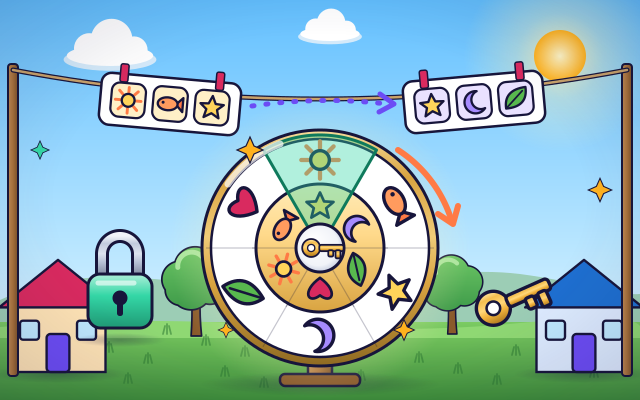
Scramble a message in a simple model and restore it using the appropriate key.
#330
Computers & communication
How does encryption keep messages private?
Scramble a message in a simple model and restore it using the appropriate key.
Keep exploring
Games to play next
- Robot RoutesSnap together arrow, repeat and dance blocks to guide Bolt the robot home.
- Bug DetectiveA robot program almost works. Run it, spot the buggy block, and fix it.
- Safe Message DetectiveRead made-up messages, pop-ups and posts, spot the clues, and choose the safe, kind thing to do.
Guide for grown-ups
- How to start homeschooling: a step-by-step guide for familiesA guide for parents · 7 min read
Coding games by grade
Computer skills worksheets by grade
- Preschool Computer Skills Worksheets
- Pre-K Computer Skills Worksheets
- Kindergarten Computer Skills Worksheets
- 1st Grade Computer Skills Worksheets
- 2nd Grade Computer Skills Worksheets
- 3rd Grade Computer Skills Worksheets
- 4th Grade Computer Skills Worksheets
- 5th Grade Computer Skills Worksheets
- 6th Grade Computer Skills Worksheets
- 7th Grade Computer Skills Worksheets
- 8th Grade Computer Skills Worksheets