How does an emergency call reach the right help?
An emergency call travels to a call center, where trained people find out where you are and what happened, then send the nearest helper.
The big idea: The call-taker needs two things: where you are and what happened. A computer then shows which helper is closest and free, and that helper is sent.
It's like the school office: you say what happened and where, and the office sends the right person, the nurse or the caretaker, whoever is closest.
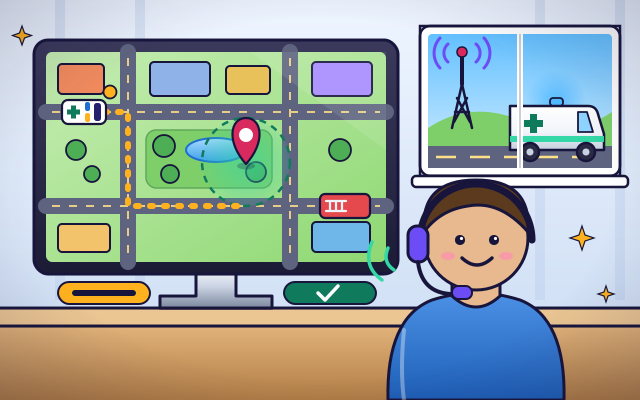
The interactive parts didn't load. The explanations below still work; try reloading the page.
How a call reaches the right help
- In our made-up town, Grandpa Leo has twisted his ankle at Maple Park and cannot stand up. He is awake and talking. Aunt Rosa calls the emergency number while Mina stays beside him.
- The phone's signal goes to the nearest cell tower. The network sees it is an emergency call and passes it straight to the emergency call center for that area.
- First question: where are you? The phone sends a rough location, shown as a circle on the map. Mina reads the park sign aloud, and now the call-taker knows the exact spot.
- Next: what happened? The call-taker asks a set list of questions. Is he awake? Is he breathing normally? Is there any danger nearby? The answers show what kind of help is needed, and how fast.
- A dispatcher sees every ambulance and fire truck on a map. The computer picks the closest one that is free, and the crew gets the address and details on a screen.
- The crew taps a button: on the way. Then: arrived. The call-taker stays on the line with Aunt Rosa until help is there. Grandpa Leo gets his ankle looked after.
Inside an emergency call center
Tap each part of the chain, from the caller's phone to the ambulance.
- The caller's phone. The call starts here. A phone can call the emergency number even when it is locked, and it sends its location along with the call.
- Cell tower. The nearest tower picks up the phone's radio signal and passes the call into the phone network.
- Call-taker. A trained person answers within seconds. They stay calm, ask clear questions and type what you say.
- Location map. This screen shows the caller's position as a circle on a map. The smaller the circle, the surer the system is.
- Question list. The questions are written down in order so nothing is forgotten: Where? What happened? Is the person awake? Is anything dangerous nearby?
- Dispatch board. The board lists every ambulance and fire truck: free, on the way, or busy. The dispatcher sends the closest free one.
- Radio link. Radio and data links carry the address and details to the crew, and carry their updates back.
- Responders. The crew gets the job on a screen in the cab, drives to the address and reports when they arrive.
Which ambulance should go?
The pin shows Grandpa Leo at Maple Park. Tap one ambulance, then the other, and compare how long each takes.
Experiment: Two ambulances are free. Which one should the dispatcher send?
- Tap ambulance A1 and watch the minutes count up until it arrives.
- Tap ambulance A2 and compare.
- Try the fire truck. What does the dispatcher say?
What we found: The closest free ambulance arrives first, because it has less road to cover. That is why the dispatch map shows where every vehicle is. And the helper must fit the problem: a hurt ankle needs an ambulance crew, not a fire truck.
Turn on JavaScript to try it yourself.
Be the dispatcher
For each call, decide what kind of help is needed, then send the closest free helper of that kind.
From your call to the right help
When someone is hurt or in danger, one phone call sets a whole team in motion. The call goes to the nearest cell tower, and the phone network passes it straight to the emergency call center for that area. A trained call-taker answers within seconds.
The call-taker needs to know two things: where you are and what happened. Where comes first. The phone sends a rough location, but saying the address or a landmark, like the name of a park, makes it exact. Then come short questions about what happened. The answers tell the call-taker what kind of help to send and how quickly.
A dispatcher looks at a map that shows every ambulance and fire truck and whether each one is free. The closest free helper of the right kind gets the job on a screen, and reports back: on the way, then arrived. The call-taker often stays on the line until help is there.
How to call for help: get a grown-up if you can. Call the emergency number (911 in the United States and Canada, 112 in much of Europe; other countries use other numbers, so ask a grown-up which number is yours). Say where you are. Say what happened. Answer the questions and stay on the line until you are told you can hang up. The emergency number is only for real emergencies, when someone is hurt or in danger. Our town and our call are made up, and the school-office comparison is not perfect: a real call center covers a whole region and never closes.
Key words
- Emergency number
- The short phone number that reaches police, fire and ambulance services: 911 in the United States and Canada, 112 in much of Europe. Other countries use other numbers.
- Call-taker
- The trained person who answers an emergency call and asks where you are and what happened.
- Dispatcher
- The person who chooses which helpers to send and keeps track of them.
- Triage
- Sorting calls so that the most urgent ones get help first.
- Location uncertainty
- How far the true position might be from the estimate, often drawn as a circle on a map.
- Responder
- A trained helper who comes to the scene, such as a paramedic or a firefighter.
Check your thinking
-
What is the first thing an emergency call-taker needs to know?
Show the answer
Where you are. Help cannot be sent until the call-taker knows where to send it.
-
Which of these is a reason to call the emergency number?
Show the answer
Someone is hurt and cannot get up. The emergency number is for when someone is hurt or in danger. Other problems can wait for other helpers.
-
Two ambulances are free. Why does the dispatcher send the closer one?
Show the answer
It can reach the person sooner. Less road to cover means help arrives faster.
-
Why does the call-taker ask everyone the same set of questions?
Show the answer
So nothing important is forgotten and the right help is chosen. A set list means every caller gets the same careful check, even on a very busy day.
-
A phone's location estimate has an uncertainty of 300 meters. What best reduces the time to find the caller?
Show the answer
The caller names the address or a landmark. A named place removes the search area, so the crew can go straight to the right spot.
You're a Money, shops & services expert!
You watched, looked inside, tried it, solved the challenge and went deeper. Pick another question below, or switch the age at the top to see this topic another way.
More about money, shops & services
 #495
Money, shops & services
How do restaurant orders reach the kitchen?
Send an order through preparation stations and coordinate its completion and collection.
#495
Money, shops & services
How do restaurant orders reach the kitchen?
Send an order through preparation stations and coordinate its completion and collection.
 #496
Money, shops & services
How do hotel key cards open the correct door?
Match a card's permission with a model lock and explore how access expires.
#496
Money, shops & services
How do hotel key cards open the correct door?
Match a card's permission with a model lock and explore how access expires.
 #497
Money, shops & services
How do garbage trucks collect and compact waste?
Operate lifting equipment and follow waste through loading and compaction inside a cutaway truck.
#497
Money, shops & services
How do garbage trucks collect and compact waste?
Operate lifting equipment and follow waste through loading and compaction inside a cutaway truck.
 #498
Money, shops & services
How do water meters measure household use?
Run virtual taps and follow measured flow into a household usage total.
#498
Money, shops & services
How do water meters measure household use?
Run virtual taps and follow measured flow into a household usage total.
Keep exploring
Games to play next
- Coin MarketRun a pretend market stall: pay exactly, use the fewest coins, and give the right change.
- Festival PlannerPlace the stalls, book the acts and keep the budget — make every rule true.
- Supermarket StockerRoll out your cart and make every shelf ready for the day.
Draw it or make it
- How to draw a fire truckDrawing lesson
Guide for grown-ups
- How to start homeschooling: a step-by-step guide for familiesA guide for parents · 7 min read