Reading passage · Science
The friar who counted peas · Grade 8
An original passage about genes and heredity with 6 questions that check details, inference and vocabulary.
- Grade 8 · ages 13 to 14
- Medium
- 25 to 35 minutes
- 2 pages
- Free
The answer key is a separate page for grown-ups. Sign in to download it.
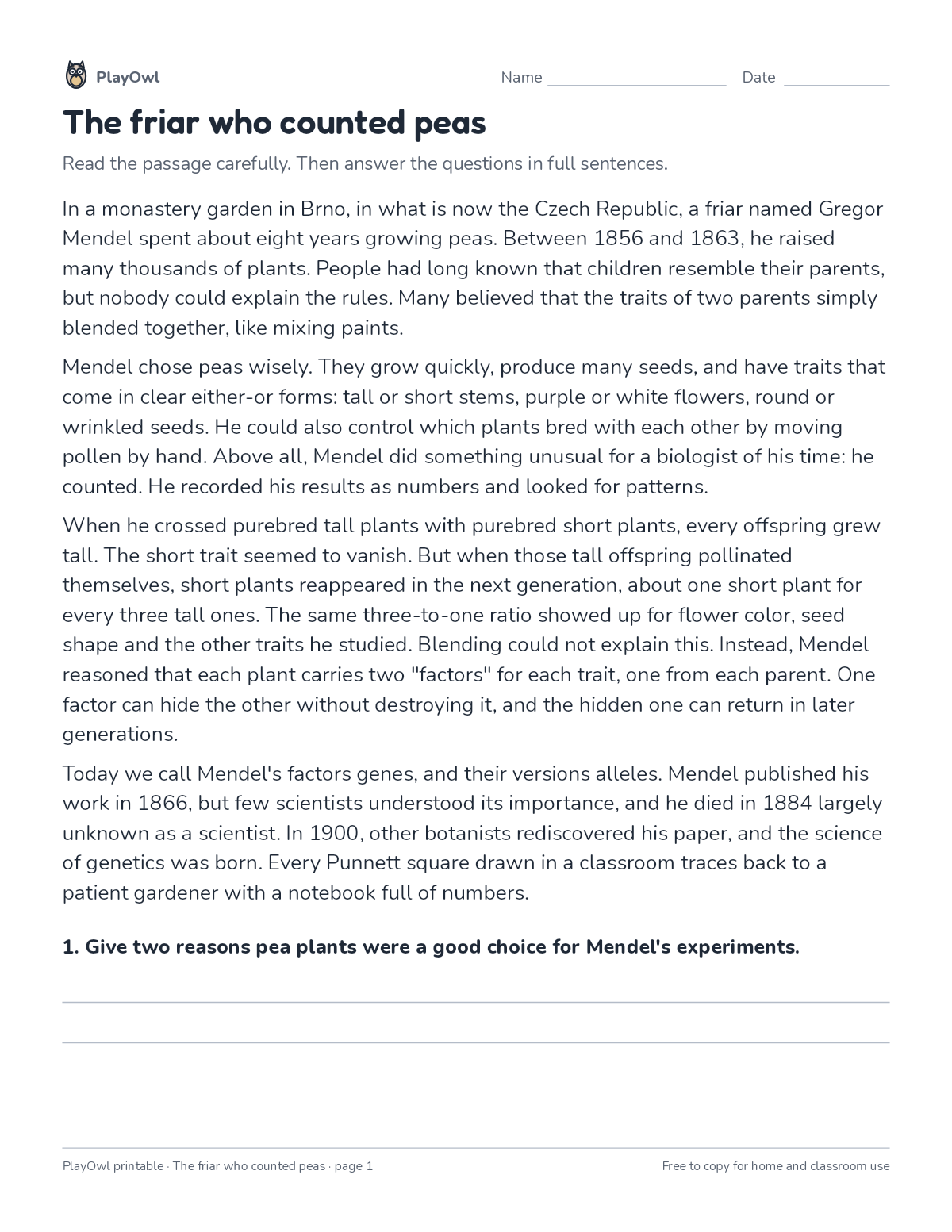
The passage and its 6 questions
Directions: Read the passage carefully. Then answer the questions in full sentences.
- In a monastery garden in Brno, in what is now the Czech Republic, a friar named Gregor
- Mendel spent about eight years growing peas. Between 1856 and 1863, he raised many thousands of plants. People had long known that children resemble their parents, but nobody could explain the rules. Many believed that the traits of two parents simply blended together, like mixing paints.
- Mendel chose peas wisely. They grow quickly, produce many seeds, and have traits that come in clear either-or forms: tall or short stems, purple or white flowers, round or wrinkled seeds. He could also control which plants bred with each other by moving pollen by hand. Above all, Mendel did something unusual for a biologist of his time: he counted. He recorded his results as numbers and looked for patterns.
- When he crossed purebred tall plants with purebred short plants, every offspring grew tall. The short trait seemed to vanish. But when those tall offspring pollinated themselves, short plants reappeared in the next generation, about one short plant for every three tall ones. The same three-to-one ratio showed up for flower color, seed shape and the other traits he studied. Blending could not explain this. Instead, Mendel reasoned that each plant carries two "factors" for each trait, one from each parent. One factor can hide the other without destroying it, and the hidden one can return in later generations.
- Today we call Mendel's factors genes, and their versions alleles. Mendel published his work in 1866, but few scientists understood its importance, and he died in 1884 largely unknown as a scientist. In 1900, other botanists rediscovered his paper, and the science of genetics was born. Every Punnett square drawn in a classroom traces back to a patient gardener with a notebook full of numbers.
- 1. Give two reasons pea plants were a good choice for Mendel's experiments.
- 2. What did many people believe about heredity before Mendel, and how did his results challenge it?
- 3. What does the word "purebred" most likely mean in paragraph 3?
- 4. Copy the sentence that explains Mendel's idea of "factors."
- 5. If Mendel grew 400 plants in the second generation, about how many would you expect to be short? Show your reasoning.
- 6. How would the passage change if it were told from another point of view?
What your child practices
Your child practices science for Grade 8 with this reading passage.
- Grades and ages
- Grade 8, ages 13 to 14
- Time
- About 25 to 35 minutes
- Subject
- Science
- Level
- Medium for Grade 8
- Answer key
- Yes, for grown-ups who sign in
- Printing
- 2 pages, US Letter or A4, low-ink option
- Updated
How to use it
Read the passage once just for the story or the facts, then again with the questions in mind. Encourage underlining the words in the text that back up each answer. It is pitched at the expected level for Grade 8, for practice after the topic has been taught. Its 2 pages split well across two sittings.
An answer key comes with it as a separate page that grown-ups download after signing in.
Tip for grown-ups: Ask your child to point to the sentence that answers each question before writing it.
Done on paper? A grown-up can record it on the child's page in PlayOwl; downloading alone doesn't count as finished.
Science · Grade 8
More like this
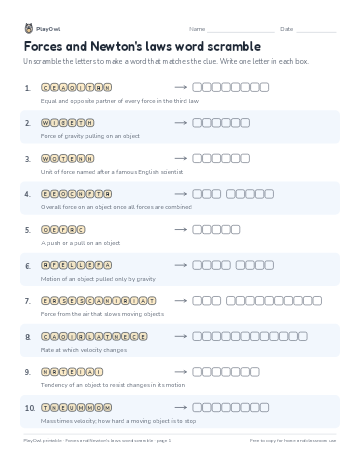 Forces and Newton's laws word scramble
Science · Grade 8 · Puzzle · 1 page
Forces and Newton's laws word scramble
Science · Grade 8 · Puzzle · 1 page
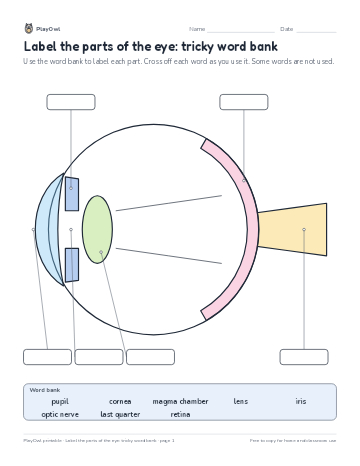 Label the parts of the eye: tricky word bank
Science · 5–10 · Worksheet · 1 page
Label the parts of the eye: tricky word bank
Science · 5–10 · Worksheet · 1 page
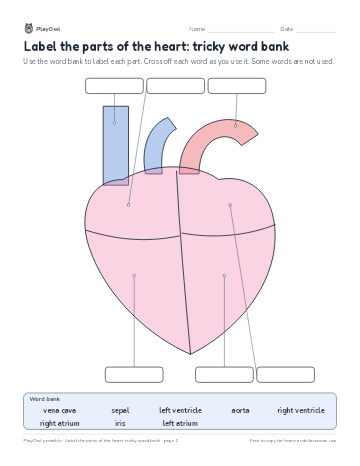 Label the parts of the heart: tricky word bank
Science · 5–8 · Worksheet · 1 page
Label the parts of the heart: tricky word bank
Science · 5–8 · Worksheet · 1 page
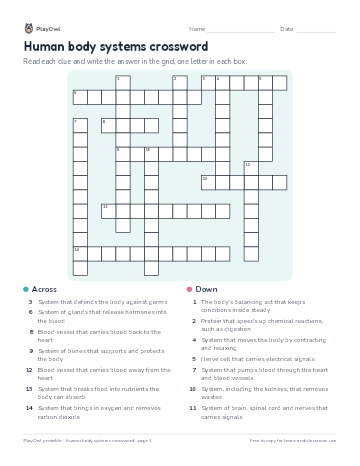 Human body systems crossword
Science · Grade 8 · Puzzle · 1 page
Human body systems crossword
Science · Grade 8 · Puzzle · 1 page
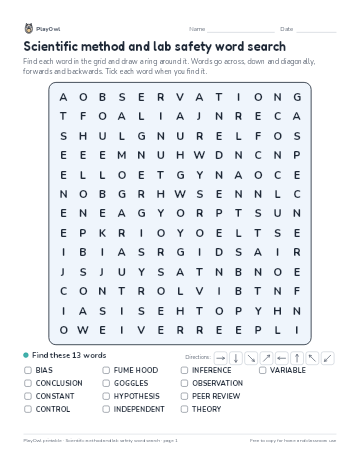 Scientific method and lab safety word search
Science · Grade 8 · Puzzle · 1 page
Scientific method and lab safety word search
Science · Grade 8 · Puzzle · 1 page
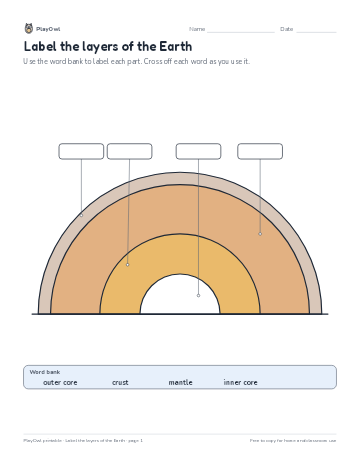 Label the layers of the Earth
Science · 8–9 · Worksheet · 1 page
Label the layers of the Earth
Science · 8–9 · Worksheet · 1 page
Printable generator
Make your own printables
Make brand-new sheets like this one, with answer keys, using the printable generator that comes with a PlayOwl plan. This sheet stays free.