How do acids and bases behave?
Acids and bases are chemical opposites. Indicators change color to tell them apart, and mixing the two can cancel them out.
The big idea: Acids fill water with one kind of tiny particle and bases fill it with the opposite kind. When they meet, the particles pair up and make plain water.
It's like a tug of war: acid particles pull one way and base particles pull the other. The pH scale shows which team is winning, and 7 is a tie.
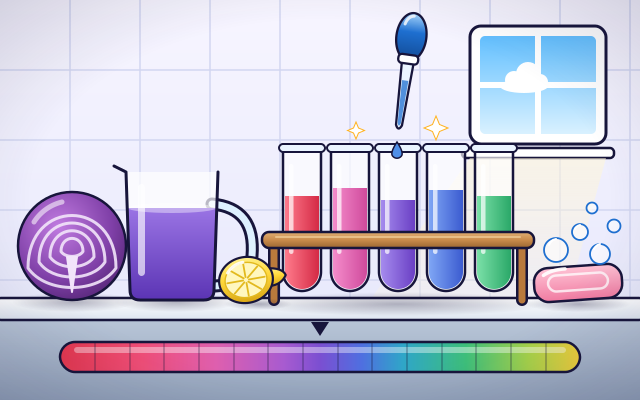
The interactive parts didn't load. The explanations below still work; try reloading the page.
Sour, soapy and in between
- Juice from a red cabbage is purple. In lemon juice it turns pink. In soapy water it turns green. In plain water it stays purple. Why?
- Lemon juice and vinegar are acids. Zoom in and the water is crowded with extra tiny particles called hydrogen ions. The more of them there are, the stronger the acid.
- Soap and baking soda are bases, the chemical opposites of acids. In water they make a different particle, called a hydroxide ion. Bases often feel slippery.
- Scientists line everything up on the pH scale, from 0 to 14. Acids are below 7 and bases are above 7. Pure water sits at 7, right in the middle. That middle is called neutral.
- An indicator is a dye that changes color with pH. Cabbage juice goes red or pink in acids, stays purple at neutral, and turns blue, then green, in bases. A few drops tell you which side a sample is on.
- Mix an acid with a base and their particles join in pairs. One hydrogen ion and one hydroxide ion make one molecule of water. When every one has a partner, the mixture is neutral. That is called neutralization.
Look inside an indicator test
Tap the jug, each test tube and the color scale. Then tap the tiny particles in the magnifying glass.
- Cabbage juice indicator. Red cabbage juice is a natural indicator: a dye that changes color in acids and bases. The same purple color is in blueberries and red grapes.
- Acid sample. A few drops of lemon juice turned the indicator pink. Pink or red means acid. Acids taste sour, but scientists never taste to test.
- Neutral sample. Pure water is neutral: not an acid and not a base. The indicator keeps its own purple color.
- Base sample. Soapy water turned the indicator blue-green. Blue or green means base. Baking soda and toothpaste are bases too.
- pH scale. The pH scale runs from 0 to 14. Low numbers are strong acids, 7 is neutral and high numbers are strong bases. Match a tube's color to the scale to read its pH.
- Hydrogen ion. The particle that makes an acid an acid. It is the smallest piece of a hydrogen atom, with a positive electric charge. Lots of these mean a strong acid.
- Hydroxide ion. The particle found in bases. It is one oxygen atom and one hydrogen atom stuck together, with a negative electric charge.
- Water molecule. When a hydrogen ion meets a hydroxide ion, they join to make a water molecule. That is how an acid and a base cancel each other out.
The pretend pantry test
These pretend products need sorting. Tap each bottle to test it with the indicator, and find the acids, the bases and the neutral one.
Experiment: Cabbage juice turns pink in lemon juice. What will it do in soapy water?
- Tap Lemon Zing and watch the tube below it.
- Tap Bubble Suds, the soapy water. Compare the two colors.
- Test the rest, and find each one's place on the color scale.
What we found: Soapy water turned the juice blue-green, the opposite side of the scale from lemon juice. Acids push the indicator toward red and pink, bases push it toward blue and green, and neutral water leaves it purple.
Turn on JavaScript to try it yourself.
Cancel it out
Make each beaker neutral. Look at the color, pick the right dropper, and stop when the indicator is purple.
What acids and bases really are
Lemon juice, vinegar and fizzy drinks are acids. Soap, baking soda and toothpaste are bases. They are chemical opposites, a bit like hot and cold. Most acids we eat taste sour, and bases often feel slippery, but tasting and touching are not safe ways to test. Scientists use indicators instead.
The difference is in tiny particles. When an acid dissolves in water, it fills the water with hydrogen ions. A base fills it with a different particle, the hydroxide ion. The pH scale tells you which kind is winning. It runs from 0 to 14: below 7 is an acid, above 7 is a base and exactly 7 is neutral, like pure water.
An indicator is a dye that changes color with pH. Red cabbage juice turns pink in acids and green in bases. When you mix an acid and a base, each hydrogen ion grabs a hydroxide ion and the pair becomes a molecule of water. If the numbers match, nothing is left to pull either way, and the mixture is neutral.
The tug of war comparison is not perfect. In a real tug of war the teams keep pulling. Here the two kinds of particle join up and stop pulling at all. Remember too that strong acids and strong bases, such as some cleaners, can harm skin and eyes. Never mix cleaners, and leave them to grown-ups.
Key words
- Acid
- A substance that fills water with hydrogen ions. Its pH is below 7.
- Base
- The chemical opposite of an acid. Its pH is above 7.
- pH
- A number from 0 to 14 that says how acidic or basic something is. 7 is neutral.
- Indicator
- A dye that changes color depending on pH.
- Neutral
- Neither acid nor base: pH 7, like pure water.
- Neutralization
- When an acid and a base cancel each other out and make water.
- Ion
- An atom or a small group of atoms with an electric charge.
Check your thinking
-
A sample turns cabbage juice pink. What is it?
Show the answer
An acid. Pink and red are the acid side of the cabbage color scale.
-
What happens when the right amounts of an acid and a base are mixed?
Show the answer
They cancel out and make water. Hydrogen ions and hydroxide ions pair up into water molecules. That is neutralization.
-
Which number on the pH scale is neutral?
Show the answer
7. 7 is the middle of the scale. Below it are acids and above it are bases.
-
A drink has pH 3 and rainwater has pH 5. How do their hydrogen ion concentrations compare?
Show the answer
The drink has 100 times more. Each pH step is a factor of ten, and a lower pH means more hydrogen ions. Two steps is 10 times 10.
-
Why should you never taste a liquid to find out if it is an acid?
Show the answer
Some acids and bases can hurt you, so we use indicators. Strong acids and bases can burn. Indicators and pH meters let scientists test safely.
-
In the challenge, the pH barely moved for many drops and then leapt from about 4 to 7. Why?
Show the answer
Near the balance point so few ions are left that one drop changes their number by a huge factor. Going from 100 units of acid to 10 is one pH step, and so is going from 10 to 1. The final unit takes the count all the way down to the tiny level in pure water.
You're a Everyday chemistry & materials expert!
You watched, looked inside, tried it, solved the challenge and went deeper. Pick another question below, or switch the age at the top to see this topic another way.
More about everyday chemistry & materials
 #423
Everyday chemistry & materials
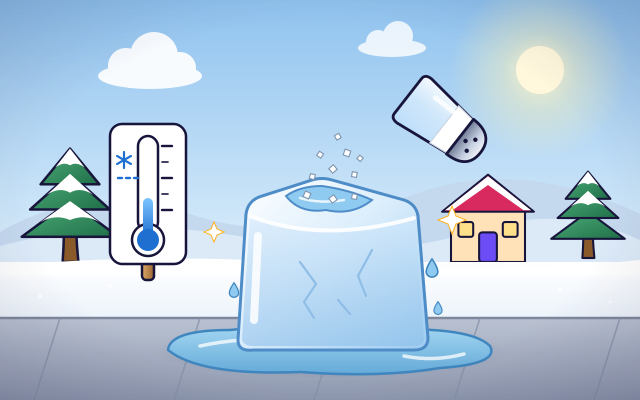
Why does salt change how ice melts?
Compare pure water and saltwater as temperature changes in a virtual freezing experiment.
#423
Everyday chemistry & materials
Why does salt change how ice melts?
Compare pure water and saltwater as temperature changes in a virtual freezing experiment.
 #424
Everyday chemistry & materials
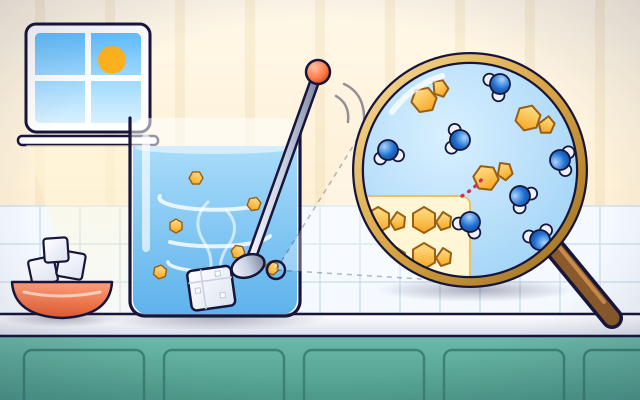
How does sugar dissolve in water?
Follow particles spreading through water and compare stirring and temperature.
#424
Everyday chemistry & materials
How does sugar dissolve in water?
Follow particles spreading through water and compare stirring and temperature.
 #425
Everyday chemistry & materials
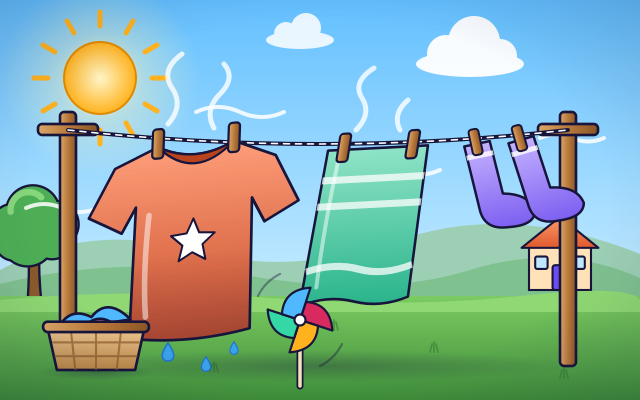
How do wet clothes dry?
Change airflow, temperature, and humidity and follow water leaving fabric.
#425
Everyday chemistry & materials
How do wet clothes dry?
Change airflow, temperature, and humidity and follow water leaving fabric.
 #401
Everyday chemistry & materials
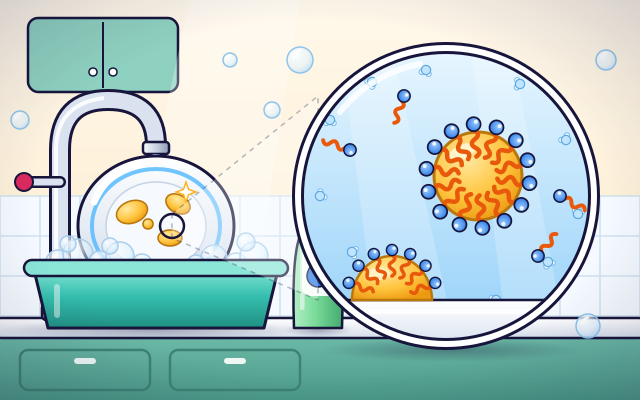
How does soap remove grease?
Follow soap molecules surrounding oily dirt so it can be carried away in water.
#401
Everyday chemistry & materials
How does soap remove grease?
Follow soap molecules surrounding oily dirt so it can be carried away in water.
Keep exploring
Games to play next
- Weather LabPredict the weather in a box, then run a fair test to find out why.
- Science QuizzesOlly's Science Quiz Show: plants, animals, the body, weather, space and more, for every grade.
- Ratio KitchenScale recipes, fill ratio tables and find the better buy.
Guide for grown-ups
- How to start homeschooling: a step-by-step guide for familiesA guide for parents · 7 min read
Science games by grade
Science worksheets by grade
- Preschool Science Worksheets
- Pre-K Science Worksheets
- Kindergarten Science Worksheets
- 1st Grade Science Worksheets
- 2nd Grade Science Worksheets
- 3rd Grade Science Worksheets
- 4th Grade Science Worksheets
- 5th Grade Science Worksheets
- 6th Grade Science Worksheets
- 7th Grade Science Worksheets
- 8th Grade Science Worksheets