Why does salt change how ice melts?
Salty water has to get colder than plain water before it will freeze. That is why salt melts the ice on winter paths.
The big idea: Salt dissolved in water gets in the way of ice forming. So salty water stays liquid below zero degrees Celsius, and salt on ice makes it melt.
It's like a crowded dance floor: dancers keep leaving the floor and coming back. Put strangers in the doorway and fewer get back in, so the floor empties.
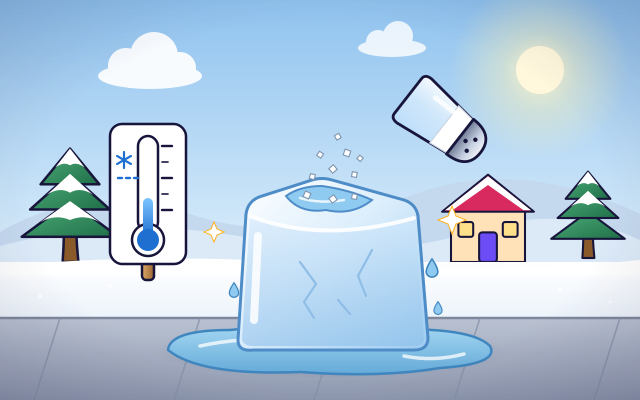
The interactive parts didn't load. The explanations below still work; try reloading the page.
Why salt melts ice
- It is below freezing, and the path is covered in ice. Sprinkle salt on it and the ice turns to slush and water, even though the air is still freezing cold. How?
- Water is made of tiny particles called molecules. In liquid water they slide past each other. Cool it to zero degrees Celsius and they lock together in a neat pattern: an ice crystal.
- The surface of ice is a busy place. Some molecules break free and join the liquid. Others settle back onto the ice. At exactly zero degrees, the two happen equally fast.
- Salt dissolves in the thin film of water on the ice and breaks into tiny pieces called ions. They crowd the surface, so fewer water molecules get back onto the ice. Leaving wins, and the ice melts.
- Put plain water and salty water in a freezer. The plain water freezes at zero. The salty water stays liquid until it is several degrees colder. Salt has lowered its freezing point.
- Salt has a limit. On a very cold day even salty water freezes, so the salt cannot melt the ice. Then road crews spread sand or grit instead. It does not melt ice, but it gives grip.
Look inside melting, salty ice
Tap the parts of the salted ice cube, then the tiny particles in the magnifying glass.
- Ice cube. Ice is water in its solid form. Without salt it would stay frozen at any temperature below zero degrees Celsius.
- Salt grains. Each grain is a tiny cube-shaped crystal of salt. It does nothing while it is dry. It has to dissolve in a little water before it can work.
- Salty meltwater. Very salty water is called brine. This puddle is colder than zero, but it stays liquid and keeps spreading, melting more ice as it goes.
- Thermometer. Surprise: a mix of ice and salt gets colder than plain ice. Melting takes heat, and the salt makes the ice melt, so the mixture cools down.
- Ice crystal. Inside the ice, every water molecule is locked in place in a repeating six-sided pattern. That pattern is why snowflakes have six arms.
- Liquid water. In the liquid, water molecules are free to slide and tumble. They keep bumping into the ice, and some of them stick to it.
- Salt ions. In water, salt comes apart into two kinds of tiny charged particles, called ions. They wander among the water molecules and get in their way.
- The ice surface. Here melting and freezing happen at the same time. With salt in the water, fewer molecules make it back onto the ice, so the edge creeps backward: the ice melts.
Plain water against salty water
Two glasses sit in the freezer: plain water and salty water. Drag the thermometer down, degree by degree, and watch when each one freezes.
Experiment: The freezer gets colder and colder. Which glass freezes first?
- Drag the thermometer down to just below zero and wait.
- Look at both glasses. Tap a glass to see it close up.
- Keep going colder until the salty water freezes too.
What we found: The plain water froze first, at zero degrees. The salty water stayed liquid until it was about seven degrees colder. Salt ions in the water get in the way of ice forming, so salty water has a lower freezing point.
Turn on JavaScript to try it yourself.
Three winter mornings
Make the path safe on three winter mornings. Check the thermometer, then choose a little salt, a lot of salt or sand.
How salt beats the ice
Pure water freezes at zero degrees Celsius. Its molecules, which slide around freely in the liquid, slow down and lock together into a neat crystal pattern. That solid pattern is ice.
But the surface of ice is never still. Molecules are always breaking away into the liquid, and others are always settling back onto the ice. At zero degrees these two things happen equally fast, so the ice neither grows nor shrinks. If it gets colder, more molecules join the ice. If it gets warmer, more break away.
When salt dissolves in water it splits into tiny charged pieces called ions. The ions spread through the water and crowd the surface of the ice. Now fewer water molecules can get back on, while just as many break away. So the ice melts. It only stops melting when it is cold enough for the two to match again, and that happens below zero. We say salt lowers the freezing point.
This has limits. Salt needs a little liquid water to dissolve in, and below about minus 21 degrees Celsius even the saltiest water freezes. On days like that, crews spread sand for grip. The dance floor comparison is not perfect, either: salt does not really block a door. Its ions are simply mixed in among the water, taking up room at the ice surface.
Key words
- Freezing point
- The temperature at which a liquid turns solid. For pure water it is zero degrees Celsius.
- Dissolve
- To mix into a liquid so completely that the pieces are too small to see.
- Ion
- A tiny particle with an electric charge. Salt splits into ions in water.
- Brine
- Very salty water.
- Freezing point depression
- The lowering of a liquid's freezing point when something is dissolved in it.
- Equilibrium
- A balance in which two opposite changes happen equally fast.
Check your thinking
-
Why does salt make the ice on a path melt?
Show the answer
Salty water has a lower freezing point. Salt is not warm. It dissolves and gets in the way of ice forming, so the water stays liquid below zero.
-
Plain water and salty water cool down together. Which freezes first?
Show the answer
The plain water, at zero degrees. Plain water freezes at zero. Salty water must get several degrees colder.
-
It is minus 30 degrees Celsius outside. Will salt melt the ice on the path?
Show the answer
No. It is too cold: even very salty water freezes. Salt can only lower the freezing point so far. Below about minus 21, sand for grip is the better choice.
-
The same mass of sugar lowers the freezing point much less than salt does. Why?
Show the answer
It gives far fewer dissolved particles. Freezing point depression counts particles. A sugar molecule is heavy and stays whole, while salt is light and splits into two ions.
-
You mix ice cubes with lots of salt in a bowl. What happens to the temperature?
Show the answer
It drops below zero. Melting takes in heat. Salt makes the ice melt, so the mixture gets colder.
-
Seawater is about 3.5 percent salt. At about what temperature does it begin to freeze?
Show the answer
About minus 2 degrees Celsius. A few percent of salt lowers the freezing point by about 2 degrees. Minus 21 needs the strongest brine possible.
You're a Everyday chemistry & materials expert!
You watched, looked inside, tried it, solved the challenge and went deeper. Pick another question below, or switch the age at the top to see this topic another way.
More about everyday chemistry & materials
 #424
Everyday chemistry & materials
How does sugar dissolve in water?
Follow particles spreading through water and compare stirring and temperature.
#424
Everyday chemistry & materials
How does sugar dissolve in water?
Follow particles spreading through water and compare stirring and temperature.
 #425
Everyday chemistry & materials
How do wet clothes dry?
Change airflow, temperature, and humidity and follow water leaving fabric.
#425
Everyday chemistry & materials
How do wet clothes dry?
Change airflow, temperature, and humidity and follow water leaving fabric.
 #401
Everyday chemistry & materials
How does soap remove grease?
Follow soap molecules surrounding oily dirt so it can be carried away in water.
#401
Everyday chemistry & materials
How does soap remove grease?
Follow soap molecules surrounding oily dirt so it can be carried away in water.
 #402
Everyday chemistry & materials
How do laundry detergents remove different stains?
Match cleaning ingredients to model grease, protein, and other stain types.
#402
Everyday chemistry & materials
How do laundry detergents remove different stains?
Match cleaning ingredients to model grease, protein, and other stain types.
Keep exploring
Games to play next
- Weather LabPredict the weather in a box, then run a fair test to find out why.
- Science QuizzesOlly's Science Quiz Show: plants, animals, the body, weather, space and more, for every grade.
- Ratio KitchenScale recipes, fill ratio tables and find the better buy.
Guide for grown-ups
- How to start homeschooling: a step-by-step guide for familiesA guide for parents · 7 min read
Science games by grade
Science worksheets by grade
- Preschool Science Worksheets
- Pre-K Science Worksheets
- Kindergarten Science Worksheets
- 1st Grade Science Worksheets
- 2nd Grade Science Worksheets
- 3rd Grade Science Worksheets
- 4th Grade Science Worksheets
- 5th Grade Science Worksheets
- 6th Grade Science Worksheets
- 7th Grade Science Worksheets
- 8th Grade Science Worksheets