How are crayons made?
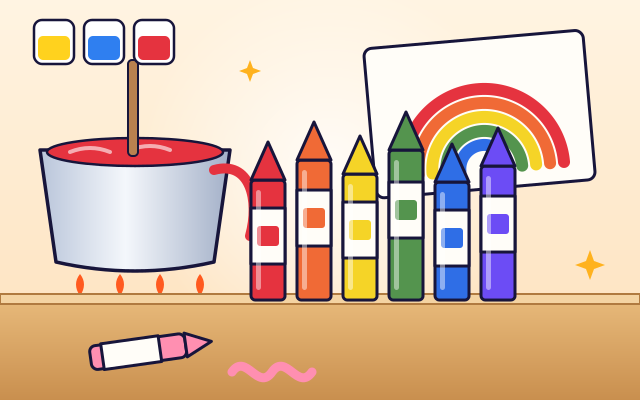
Crayons are melted wax mixed with color powders, poured into molds, cooled until hard and wrapped in paper.
The big idea: Wax melts into a liquid when it is hot and turns solid again when it cools. Crayon makers stir color powders into hot, runny wax, pour it into crayon-shaped molds and cool it until it is hard.
It's like
The interactive parts didn't load. The explanations below still work; try reloading the page.
A trip to the crayon factory
- Crayons are made mostly of wax, the same kind used in many candles. The factory heats it in big tanks until the hard wax melts into a clear, runny liquid.
- Color comes from pigments, which are very fine colored powders. Workers measure them carefully and stir them into the hot wax until the color is even.
- The colored wax is poured over a mold table. It has hundreds of crayon-shaped holes, so it makes hundreds of crayons at once.
- Cold water flows through pipes under the mold table and carries the heat away. In a few minutes the runny wax turns into hard crayons.
- Extra wax on top is scraped off and melted again. Then pins push the crayons up out of their holes. Any broken ones go back to be melted too.
- A labeling machine wraps each crayon in a paper label with a little glue. The wrapper keeps your hands clean and helps stop the crayon from breaking.
- Machines sort the crayons into boxes so each box gets one of every color. Then they travel to shops, schools and your table.
The crayon factory, step by step
Step through the factory. The magnifier shows what the wax is doing up close.
- Melting the wax. When wax gets hot, its tiny pieces wiggle and slide past each other, so the solid wax turns into a runny liquid.
- Mixing in pigment. Pigment is a fine colored powder. Stirring spreads the tiny grains evenly through the wax, so the whole crayon is the same color.
- Pouring into molds. The hot wax is poured over the mold table and flows into every crayon-shaped hole, called a cavity.
- Cooling. Cold water flows under the mold. The wax cools down, its tiny pieces stop sliding and lock together, and it becomes a hard crayon.
- Scraping and popping out. Extra wax is scraped off the table to be melted again. Then pins rise under each hole and push the crayons out.
- Checking quality. Every batch is checked. Broken or bumpy crayons are not thrown away: they go back to the melting tank.
- Wrapping and boxing. A machine wraps each crayon in a paper label with its color name. Then the crayons are sorted into boxes of many colors.
Crayon factory: melt, color, mold, cool, wrap
Melt the wax, tap the pigment jars to mix a color, then pour, cool, pop out and wrap. What happens if you pop the crayons out before they are cool?
Experiment: What happens if you pop the crayons out of the mold before they have cooled?
- Make a batch and press Pop out right after pouring, without cooling.
- Make another batch and cool it first.
- Compare the two batches of crayons.
What we found: Warm wax is still soft inside, so crayons popped out too early droop and bend. Cooling lets the wax harden all the way through.
Turn on JavaScript to try it yourself.
Make the colors, finish the picture
This picture needs an orange sun, green grass and a purple flower. Mix the pigments, make each crayon and color the picture.
Wax, pigment and color mixing
Wax is a solid at room temperature, but it melts when it gets warm. That makes it perfect for crayons: hot wax is runny, so it can be poured into molds, and cool wax is hard, so the crayon keeps its shape in your hand.
The color comes from pigments, which are very fine powders. Pigments do not dissolve in wax the way sugar dissolves in water. Instead, the tiny grains spread out evenly, and each grain gives a little bit of color.
Crayon makers can make hundreds of colors from a smaller set of pigments. Mixing red and yellow pigment makes orange, yellow and blue make green, and red and blue make purple. Adding white makes a lighter color, called a tint.
When you draw, the crayon rubs against the bumpy paper and leaves a thin layer of soft wax with pigment stuck in the paper fibers. That is why crayon pictures look waxy and shiny.
Key words
- Wax
- A soft solid that melts when warm. Most crayons use paraffin wax.
- Pigment
- Tiny colored particles that give a crayon its color without dissolving.
- Mold
- A shape with hollows that liquid wax fills and hardens in.
- Tint
- A lighter version of a color, made by adding white.
- Melting point
- The temperature where a solid turns into a liquid.
Check your thinking
-
What makes a crayon colorful?
Show the answer
Pigment powder mixed into the wax. Tiny pigment grains are spread through the whole crayon, so it is colorful inside and out.
-
Which two pigments mix to make purple?
Show the answer
Red and blue. Red and blue pigments together make purple.
-
Why does the factory run cold water under the molds?
Show the answer
To cool the wax so it hardens faster. The water carries heat away, so the wax turns solid sooner.
-
What happens to the extra wax scraped off the mold table?
Show the answer
It is melted again and reused. Wax melts again when heated, so scraps and broken crayons are recycled into new ones.
-
Why do crayons slide out of their molds more easily once they have cooled?
Show the answer
The wax crystallizes and shrinks slightly. Packing into crystals takes less space, so the wax pulls away from the mold walls.
You're a Making everyday things expert!
You watched, looked inside, tried it, solved the challenge and went deeper. Pick another question below, or switch the age at the top to see this topic another way.
More about making everyday things
 #15
Making everyday things
How is glass made?
Follow raw materials through melting, shaping, and controlled cooling. Compare how a bottle, windowpane, and decorative glass object are formed.
#15
Making everyday things
How is glass made?
Follow raw materials through melting, shaping, and controlled cooling. Compare how a bottle, windowpane, and decorative glass object are formed.
 #16
Making everyday things
How does cotton become clothing?
Follow cotton from the plant through spinning, weaving or knitting, dyeing, cutting, and sewing. Design a shirt and inspect its fabric up close.
#16
Making everyday things
How does cotton become clothing?
Follow cotton from the plant through spinning, weaving or knitting, dyeing, cutting, and sewing. Design a shirt and inspect its fabric up close.
 #17
Making everyday things
How are plastic toys made?
Design a simple toy, explore an injection mold, and watch the material fill its shape. Cool, assemble, and decorate the finished pieces.
#17
Making everyday things
How are plastic toys made?
Design a simple toy, explore an injection mold, and watch the material fill its shape. Cool, assemble, and decorate the finished pieces.
 #18
Making everyday things
How are bricks made?
Prepare virtual clay, shape bricks, dry them, and fire them in a kiln. Compare brick shapes and arrange them into different wall patterns.
#18
Making everyday things
How are bricks made?
Prepare virtual clay, shape bricks, dry them, and fire them in a kiln. Compare brick shapes and arrange them into different wall patterns.
Keep exploring
Games to play next
- Paint StudioBrushes, stamps, shapes and a paint bucket for any picture you can imagine.
- Machine RepairFix levers, pulleys, gears and ramps so every contraption works.
- Geometry Architect 3DCount, build and fold solids like a real architect.
Guide for grown-ups
- How to start homeschooling: a step-by-step guide for familiesA guide for parents · 7 min read
Science games by grade
Science worksheets by grade
- Preschool Science Worksheets
- Pre-K Science Worksheets
- Kindergarten Science Worksheets
- 1st Grade Science Worksheets
- 2nd Grade Science Worksheets
- 3rd Grade Science Worksheets
- 4th Grade Science Worksheets
- 5th Grade Science Worksheets
- 6th Grade Science Worksheets
- 7th Grade Science Worksheets
- 8th Grade Science Worksheets