How do computer-controlled machines carve precise parts?
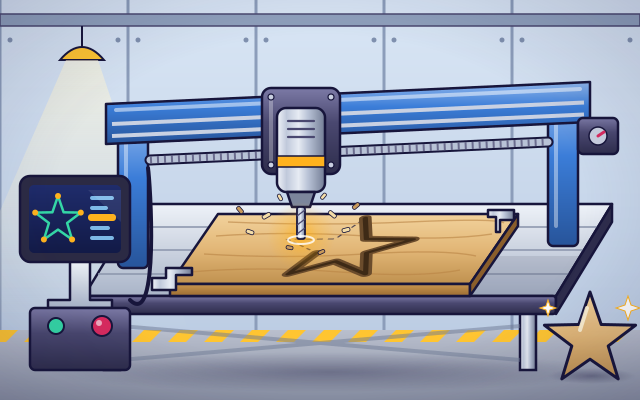
A computer turns a drawing into a path, and motors steer a spinning cutter along it to carve the part.
The big idea: A CNC machine follows a list of positions. Motors move a spinning cutter along that planned path, and the cutter removes a little material at a time until only the part is left.
It's like a dot-to-dot picture: the computer lists the dots, and the machine joins them in order with a spinning cutter instead of a pencil.
The interactive parts didn't load. The explanations below still work; try reloading the page.
From drawing to finished part
- Mia drew a star on the computer. She wants a real one, cut from this block of wood. A machine called a CNC router can carve it for her.
- The computer marks points around the star. Each point gets two numbers: how far across and how far up. The list of points, in order, is the path for the cutter.
- The machine has a motor for each direction. One slides the cutter left and right, one moves it forward and back, and one moves it up and down. Together they can reach any point.
- The cutter spins thousands of times a minute. Its sharp edges slice off tiny chips as the motors push it along the path. The chips fly out and a groove is left behind.
- The cutter does not dig all the way down in one go. That would break it. It goes around the path again and again, a little deeper on every pass.
- The star comes free, just like the drawing. Run the same program again and the machine makes another one exactly the same. That is why factories use CNC machines.
Look inside a CNC router
Tap each part of the machine. Watch it move when you find it!
- Controller. The controller is the machine's brain. It reads the program one line at a time and sends signals to the motors.
- Stepper motor. A stepper motor turns in tiny, equal steps. The controller counts the steps, so it knows exactly how far the motor has turned.
- Lead screw. The motor spins this long screw. A nut on the screw cannot spin, so it slides along instead and takes the cutter with it.
- Gantry. The gantry is a strong bridge over the table. The cutter's carriage rides along it on smooth rails, side to side.
- Spindle. The spindle is a powerful motor that holds the cutter and spins it very fast, often more than 200 times every second.
- Cutter. The cutter has sharp twisted edges. As it spins, it shaves off chips and lifts them out of the groove. A thin cutter makes fine details. A fat one works faster.
- Clamps. Clamps squeeze the block tight against the table. If the block slipped even a little, the shape would come out wrong.
- Table. The flat table supports the block. A spare board sits on top, so the cutter can go right through the block without hurting the table.
Run the program: thin cutter or fat cutter?
Pick a shape, a cutter and a speed, then press Go. Look in the magnifier at an inside corner. What does a fatter cutter do to it?
Experiment: What happens to the inside corners when you carve the same shape with a fatter cutter?
- Carve a shape with the thin cutter. Look at the corner in the magnifier.
- Now choose the fat cutter and press Go again.
- Compare the orange leftover in the corner.
What we found: A cutter is round, so it cannot reach into a sharp inside corner. It leaves a rounded bit behind, and a fatter cutter leaves more. But a fat cutter is strong, so it can cut deeper and finish sooner.
Turn on JavaScript to try it yourself.
Carve it to order
The order needs neat inside corners and a quick job. Choose a cutter and a speed, then press Go. Do not break the cutter or scorch the wood!
How a computer carves a part
CNC is short for computer numerical control. That is a long way of saying that a computer steers the machine with numbers. First someone draws the part on a computer. Then software works out a path for the cutter to follow, and saves it as a long list of positions.
The machine has one motor for each direction: left and right, forward and back, up and down. Each motor turns a long screw, and the screw pushes the cutter along. The motors turn in tiny, counted steps, so the machine always knows where the cutter is, because it counted how it got there.
The cutter itself spins very fast. Its sharp edges shave off small chips of wood, plastic or metal. It does not dig the whole way down at once. It goes around the path several times, a little deeper each time, until the part is cut free.
A cutter is round, so it cannot reach into a sharp inside corner. A thin cutter gets closer, but it is weaker and must work slowly. Machinists pick the cutter that is thin enough for the detail and strong enough to finish the job in good time. Our dot-to-dot comparison is not perfect: a real machine also controls how fast it moves between the dots.
Key words
- CNC
- Computer numerical control: a computer steers the machine using numbers.
- Toolpath
- The planned route the center of the cutter follows.
- Axis
- One direction the machine can move: X, Y or Z.
- Feed rate
- How fast the cutter travels along the path, in millimeters per minute.
- Chip load
- How big a bite each sharp edge takes.
- Tolerance
- How far a finished size is allowed to be from the size in the design.
Check your thinking
-
How does a CNC machine know where to move the cutter?
Show the answer
It follows a list of positions from the computer. The program is a list of positions. The motors move the cutter from one to the next.
-
Why can't a cutter make a perfectly sharp inside corner?
Show the answer
The cutter is round, so it cannot reach into the point. A round cutter always leaves a curve the size of itself in an inside corner.
-
Why does the cutter go around the path several times?
Show the answer
Cutting a little deeper each time keeps the cutter from breaking. Taking it all in one go would push too hard on the cutter. Small layers are gentle.
-
A 2-flute cutter spins at 10,000 rpm and feeds at 2,000 millimeters a minute. What is the chip load?
Show the answer
0.1 millimeters per tooth. Chip load = feed ÷ (speed × flutes) = 2,000 ÷ (10,000 × 2) = 0.1 millimeters.
-
You run the same program ten times. What do you get?
Show the answer
Ten parts that match each other. The program never changes, so the machine repeats the same moves and makes matching parts.
-
What do the clamps do?
Show the answer
Hold the block still so the shape comes out right. If the block slips, the cutter still follows its path, and the cut lands in the wrong place.
You're a Making everyday things expert!
You watched, looked inside, tried it, solved the challenge and went deeper. Pick another question below, or switch the age at the top to see this topic another way.
More about making everyday things
 #322
Making everyday things
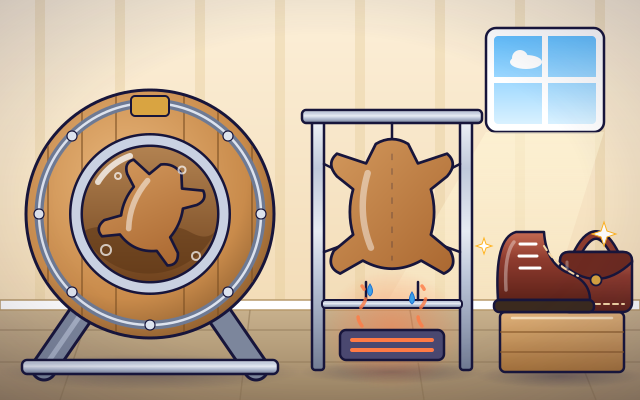
How is leather made?
Follow prepared hides through tanning, drying, softening, and finishing.
#322
Making everyday things
How is leather made?
Follow prepared hides through tanning, drying, softening, and finishing.
 #323
Making everyday things
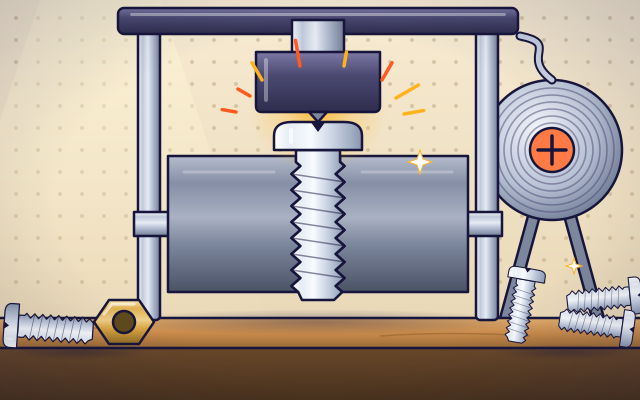
How are screws manufactured?
Shape a head, roll threads into the shaft, and inspect the fastener.
#323
Making everyday things
How are screws manufactured?
Shape a head, roll threads into the shaft, and inspect the fastener.
 #324
Making everyday things
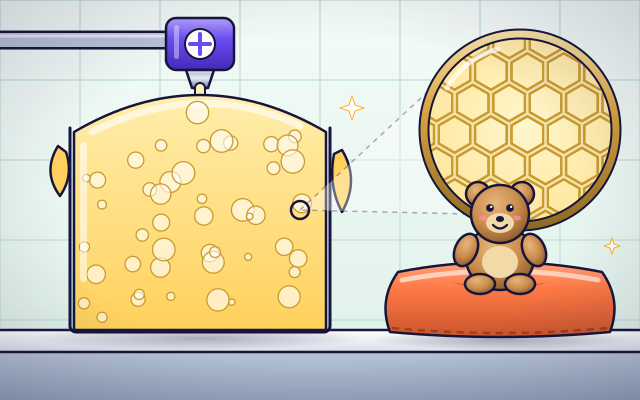
How are foam cushions made?
Watch bubbles form inside material and compare different foam structures.
#324
Making everyday things
How are foam cushions made?
Watch bubbles form inside material and compare different foam structures.
 #325
Making everyday things
How are coins made?
Prepare metal blanks, press designs onto both sides, and inspect the results.
#325
Making everyday things
How are coins made?
Prepare metal blanks, press designs onto both sides, and inspect the results.
Keep exploring
Games to play next
- Machine RepairFix levers, pulleys, gears and ramps so every contraption works.
- Geometry Architect 3DCount, build and fold solids like a real architect.
- Sorting FactoryTurn a work order into if/else rules and watch the conveyor sort every item.
Guide for grown-ups
- How to start homeschooling: a step-by-step guide for familiesA guide for parents · 7 min read
Science games by grade
Science worksheets by grade
- Preschool Science Worksheets
- Pre-K Science Worksheets
- Kindergarten Science Worksheets
- 1st Grade Science Worksheets
- 2nd Grade Science Worksheets
- 3rd Grade Science Worksheets
- 4th Grade Science Worksheets
- 5th Grade Science Worksheets
- 6th Grade Science Worksheets
- 7th Grade Science Worksheets
- 8th Grade Science Worksheets