How do drums make different sounds?
A drum's stretched skin wobbles when you hit it. Its size and its tightness decide how high or low it sounds.
The big idea: Hitting a drum makes its stretched skin spring up and down. A tight or small skin springs back quickly and sounds high. A loose or big skin moves slowly and sounds low.
It's like a trampoline: a small, tight one flicks you back quickly, and a big, saggy one swings you slowly. A drum skin does the same, hundreds of times a second.
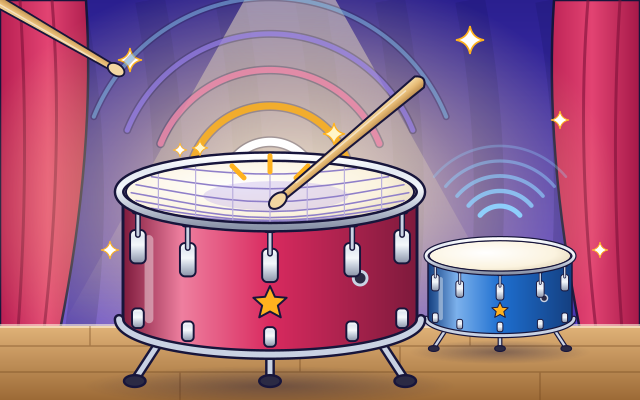
The interactive parts didn't load. The explanations below still work; try reloading the page.
Why drums sound different
- Mia has two drums. The big one makes a deep boom and the small one makes a bright tap. Why do two drums sound so different?
- The top of a drum is a thin skin, stretched tight, called the drumhead. The stick pushes it down, and it springs back up, again and again. That is a vibration.
- Each time the drumhead moves up it pushes the air, and each time it drops it pulls the air back. Those pushes travel out as a sound wave to your ears.
- Bolts around the edge pull the drumhead tighter. A tight drumhead snaps back faster, so it wobbles more times each second, and the sound is higher.
- A big drumhead has farther to travel and more skin to move, so it wobbles slowly and sounds low. A small drumhead wobbles quickly and sounds high.
- A drumhead can wobble in different patterns. Hit the middle and the whole head moves together. Hit near the edge and the two halves take turns, like a seesaw. Sand gathers where the head stays still.
Look inside a drum
Part of the drum has been cut away. Tap each part to see how it helps make the sound.
- Drumhead. The drumhead is a thin, strong sheet stretched over the top. It is the part you hit, and its wobbling makes the sound.
- Hoop. The metal hoop presses down on the edge of the drumhead, all the way around, and keeps it stretched.
- Tension bolts. These bolts pull the hoop down. A drummer turns them with a little key to tighten the drumhead, which makes the sound higher.
- Shell. The shell is the round body of the drum, usually made of wood or metal. It holds the heads apart and helps shape the sound.
- Air inside. When the top head moves, it squeezes the air inside. The air pushes on the bottom head, and that head starts to wobble too.
- Bottom head. Many drums have a second skin underneath. It wobbles along with the top one and makes the drum ring longer.
- Drumstick. The stick gives the drumhead a quick push. Hitting harder makes a bigger wobble and a louder sound, but not a higher one.
Drum lab: size and tightness
Tap the drumhead to hit it. Change how tight it is and how big the drum is, and compare the wobble patterns for a hit in the middle and a hit near the edge.
Experiment: What happens to the sound when you make the drumhead tighter?
- Tap the drumhead and watch how fast it wobbles.
- Slide the drumhead to Tight and tap again.
- Now try the small drum and the big drum.
What we found: A tighter drumhead pulls itself back faster, so it wobbles more times each second and sounds higher. A bigger drumhead wobbles more slowly and sounds lower.
Turn on JavaScript to try it yourself.
Tune the drum
Each band member asks for a sound. Choose a drum size and tightness, then hit the drum to land in the green zone.
Why drums sound the way they do
A drum is a skin stretched over a hollow body. When you hit the skin, called the drumhead, it dips down. Because it is stretched tight, it pulls itself back up, shoots past the middle, and pulls back down again. This fast wobble is called a vibration.
The wobbling drumhead pushes and pulls the air, and those pushes spread out as a sound wave. If the drumhead wobbles many times each second, you hear a high sound. If it wobbles fewer times each second, you hear a low sound.
Two things change the speed of the wobble most. A tighter drumhead pulls back harder, so it wobbles faster and sounds higher. A bigger drumhead is wider and heavier, so it wobbles more slowly and sounds lower. That is why a huge bass drum booms and a little bongo taps. Hitting harder only makes the sound louder.
A drumhead can also wobble in patterns. Hit the middle and the whole head moves up and down together. Hit near the edge and other patterns join in, where one half goes up while the other goes down. The mix of patterns is why a drum sounds like a thump rather than a clear note. A trampoline works in a similar way, but it bounces only a few times a second, and a drumhead bounces hundreds of times.
Key words
- Drumhead
- The thin skin stretched over a drum that you hit.
- Vibration
- A fast back-and-forth movement.
- Pitch
- How high or low a sound is.
- Frequency
- The number of vibrations each second, measured in hertz (Hz).
- Tension
- How tightly something is stretched.
- Mode
- One of the wobble patterns a drumhead can make.
Check your thinking
-
Which drum will make the lowest sound?
Show the answer
A big drum with a loose drumhead. Big and loose both make the drumhead wobble more slowly, so the sound is the lowest.
-
What makes the sound when you hit a drum?
Show the answer
The drumhead vibrates and pushes the air. The stretched drumhead springs up and down and pushes the air, which carries the sound to you.
-
A drummer tightens the bolts around a drum. What happens to its sound?
Show the answer
It gets higher. A tighter drumhead snaps back faster, so it vibrates more times each second.
-
You hit the same drum harder. What changes?
Show the answer
It gets louder, but not higher. A harder hit makes a bigger wobble, which is louder. The speed of the wobble stays about the same.
-
Why does a drum sound like a thump instead of a clear note like a guitar string?
Show the answer
Its overtones are not whole-number multiples of the lowest frequency. A membrane's higher modes sit at about 1.59, 2.14 and 2.30 times the lowest, so they do not line up into one clear pitch.
-
Sand on a ringing drumhead gathers in a line. What is special about that line?
Show the answer
The drumhead stays still there. The moving parts shake the sand away. It comes to rest where the head is still.
You're a Light & sound expert!
You watched, looked inside, tried it, solved the challenge and went deeper. Pick another question below, or switch the age at the top to see this topic another way.
More about light & sound
 #442
Light & sound
How does soundproofing reduce noise?
Compare absorption, barriers, and gaps around a model noisy room.
#442
Light & sound
How does soundproofing reduce noise?
Compare absorption, barriers, and gaps around a model noisy room.
 #443
Light & sound
How do noise-canceling headphones work?
Combine a noise waveform with an opposing signal in a simplified model.
#443
Light & sound
How do noise-canceling headphones work?
Combine a noise waveform with an opposing signal in a simplified model.
 #444
Light & sound
Why does a passing siren change pitch?
Move a virtual sound source past a listener and inspect wave spacing.
#444
Light & sound
Why does a passing siren change pitch?
Move a virtual sound source past a listener and inspect wave spacing.
 #445
Light & sound
How does resonance make vibrations stronger?
Drive a model oscillator at different rhythms and compare its response.
#445
Light & sound
How does resonance make vibrations stronger?
Drive a model oscillator at different rhythms and compare its response.
Keep exploring
Games to play next
- Listen and FindOlly whispers a clue or plays a sound. Can you find it in the picture?
- Mirror MazeBend a beam of light with mirrors to light up every crystal — in the right order.
- Shadow SculptorStack cubes under three lamps until every shadow matches the outline.
Guide for grown-ups
- How to start homeschooling: a step-by-step guide for familiesA guide for parents · 7 min read
Science games by grade
Science worksheets by grade
- Preschool Science Worksheets
- Pre-K Science Worksheets
- Kindergarten Science Worksheets
- 1st Grade Science Worksheets
- 2nd Grade Science Worksheets
- 3rd Grade Science Worksheets
- 4th Grade Science Worksheets
- 5th Grade Science Worksheets
- 6th Grade Science Worksheets
- 7th Grade Science Worksheets
- 8th Grade Science Worksheets