How does resonance make vibrations stronger?
Everything that swings or shakes has its own beat. Push in time with that beat, and small pushes add up to a big motion.
The big idea: A swing always takes the same time to go back and forth. If your pushes arrive in step with that rhythm, each one adds a little more energy, and the swing grows. Out of step, the pushes cancel each other.
It's like pushing a swing: tiny pushes at just the right moments add up to a huge swing, but the same pushes at the wrong moments do almost nothing.
The interactive parts didn't load. The explanations below still work; try reloading the page.
The secret of the swing
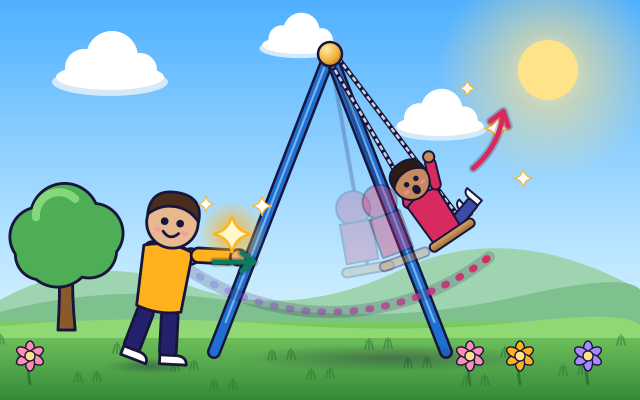
- Ben pushes Ana on the swing. Each push is small, but soon she is flying high. How can a few gentle pushes make such a big swing?
- Left alone, a swing goes back and forth in its own steady rhythm. A long swing has a slow beat and a short swing has a quick one. It keeps that beat whether it swings high or low.
- Ben pushes each time the swing is just starting forward. His pushes are in step with the swing's own beat, so every push adds a little more energy. The swing grows and grows.
- Now Ben pushes at a different rhythm. Some pushes help, but others hit the swing while it is coming back and slow it down. The pushes cancel out, and the swing stays small.
- It works with sound as well. Strike one tuning fork, and its sound waves gently push a matching fork again and again on its own beat, until that fork hums too. A fork with a different beat stays still.
- Bridges and tall towers have their own beats too. So engineers add dampers, such as a huge weight that swings the opposite way, to soak up the motion before wind or footsteps can build it up.
What makes a swing resonate?
Tap each part of the swing to see what it has to do with resonance.
- Pivot. The swing hangs from this bar and turns freely around it. A smooth, low-friction pivot lets the swing keep going for a long time.
- Chains. The length of the chains sets the swing's beat. A long swing takes more time for each back-and-forth, and a short one takes less.
- Rider. The rider is the weight that swings. Surprisingly, a heavier rider does not change the beat. Only the length of the chains does.
- Push. Each push adds a little energy, as long as it pushes the same way the swing is moving. The best moment is just as the swing starts forward.
- Air and friction. Air and friction steal a little energy on every swing. That is why a swing slowly stops if nobody pushes, and why it cannot grow forever.
- Natural beat. This is the swing's own rhythm: the time for one full back-and-forth. It stays the same for big swings and small swings.
Find the swing's beat
Change the rhythm of the helper's pushes and watch how high the swing gets. You can also push by hand. When do the pushes add up?
Experiment: The helper pushes just as hard every time. Which rhythm makes the swing go highest?
- Set the rhythm faster than the swing and watch for a while.
- Slide slowly toward the middle and watch the two beat lamps.
- When the lamps flash together, look at how high the swing goes.
What we found: The swing goes highest when the pushes are in step with its own beat. Then every push arrives at a helpful moment and adds energy. Faster or slower pushes get out of step, so some of them work against the swing.
Turn on JavaScript to try it yourself.
Which pendulum?
Three pendulums hang from one shaking bar. Set the shake rhythm so that only the pendulum with the star swings wide, then press Lock in. Three rounds.
Why timing matters
Sit on a swing and let it go. It moves back and forth in a steady rhythm, and that rhythm is always the same for that swing. It is called the natural beat. A long swing has a slow beat. A short swing has a quick one. Many things have a natural beat: a ruler twanged on a desk, a guitar string, a bridge, even a glass of water.
Now add pushes. If you push the swing just as it starts to move away from you, your push adds a little energy and it goes a bit higher. Do that every time, in step with the natural beat, and the small pushes pile up into a big swing. This piling up is called resonance.
Push at any other rhythm and it does not work. Some pushes help, but others hit the swing while it is still coming toward you, which slows it down. The helpful pushes and the unhelpful ones cancel each other, and the swing stays small.
Resonance is everywhere. The hollow body of a guitar resonates with its strings and makes them louder. A radio picks one station by resonating with that station's signal and ignoring the rest. Sometimes resonance is not wanted: a footbridge can start to sway if many people walk in step with its beat. So engineers add dampers, which soak up the energy, and marching soldiers break step when they cross a bridge.
Key words
- Natural frequency
- The beat that something swings or shakes at when it is left alone.
- Resonance
- A big motion that builds up when pushes arrive in step with the natural beat.
- Amplitude
- How far something swings from its resting position.
- Period
- The time for one complete back-and-forth.
- Damping
- Anything, like friction or air, that takes energy out of a swinging motion.
Check your thinking
-
What is the best moment to push someone on a swing?
Show the answer
Just as it starts to move away from you. A push that goes the same way as the swing adds energy. A push against it takes energy away.
-
You make the chains of a swing longer. What happens to its beat?
Show the answer
It gets slower. A longer pendulum takes more time for each back-and-forth, so its natural beat is slower.
-
A helper pushes a swing much faster than the swing's own beat. What happens?
Show the answer
The swing stays small, because some pushes work against it. Out of step, some pushes help and others slow the swing down, so they mostly cancel.
-
A heavier child sits on the same swing. What happens to its beat?
Show the answer
It stays the same. The beat depends on the length of the chains, not on the weight of the rider.
-
What does adding more damping do to a resonance curve?
Show the answer
It makes the peak lower and broader. More damping removes more energy each cycle, so the build-up at resonance is smaller and the response is spread over a wider range of frequencies.
You're a Light & sound expert!
You watched, looked inside, tried it, solved the challenge and went deeper. Pick another question below, or switch the age at the top to see this topic another way.
More about light & sound
 #426
Light & sound
How do mirrors form reflections?
Trace light rays and compare flat and curved mirrors.
#426
Light & sound
How do mirrors form reflections?
Trace light rays and compare flat and curved mirrors.
 #427
Light & sound
How does a magnifying glass enlarge things?
Move an object and lens and compare image size and focus.
#427
Light & sound
How does a magnifying glass enlarge things?
Move an object and lens and compare image size and focus.
 #428
Light & sound
How does a prism separate colors?
Guide white light through a prism and follow different colors' paths.
#428
Light & sound
How does a prism separate colors?
Guide white light through a prism and follow different colors' paths.
 #429
Light & sound
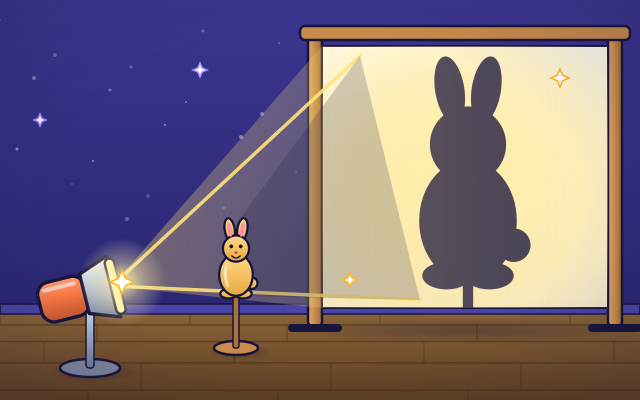
How do shadows change size and shape?
Move a light and object and compare the resulting shadow.
#429
Light & sound
How do shadows change size and shape?
Move a light and object and compare the resulting shadow.
Keep exploring
Games to play next
- Mirror MazeBend a beam of light with mirrors to light up every crystal — in the right order.
- Shadow SculptorStack cubes under three lamps until every shadow matches the outline.
- Listen and FindOlly whispers a clue or plays a sound. Can you find it in the picture?
Guide for grown-ups
- How to start homeschooling: a step-by-step guide for familiesA guide for parents · 7 min read
Science games by grade
Science worksheets by grade
- Preschool Science Worksheets
- Pre-K Science Worksheets
- Kindergarten Science Worksheets
- 1st Grade Science Worksheets
- 2nd Grade Science Worksheets
- 3rd Grade Science Worksheets
- 4th Grade Science Worksheets
- 5th Grade Science Worksheets
- 6th Grade Science Worksheets
- 7th Grade Science Worksheets
- 8th Grade Science Worksheets