How do garbage trucks collect and compact waste?
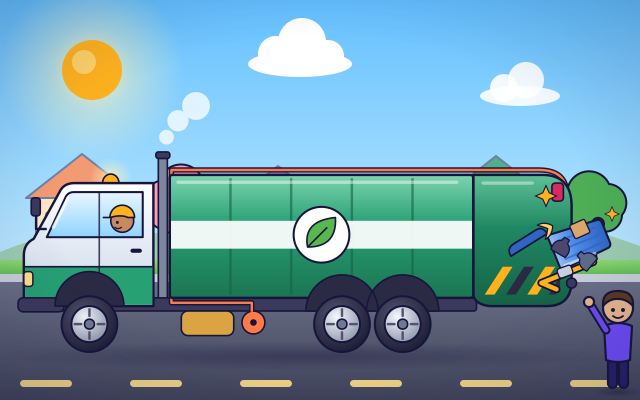
A lifter tips each bin into the hopper. Then a blade pushed by oil squeezes the trash so a whole street fits inside.
The big idea: Loose trash is mostly air gaps. A garbage truck uses oil-powered pushers to squeeze out the gaps, so it can carry many more bins before it is full.
It's like packing a suitcase: you push the clothes down to squeeze out the air, and suddenly there is room for more.
The interactive parts didn't load. The explanations below still work; try reloading the page.
From the curb into the truck
- It is trash day. The garbage truck stops at every house on the street. How can one truck swallow the bins of a whole neighborhood?
- At the back, a lifter hooks the front of the bin. It raises the bin and tips it upside down, so the trash falls out and the lid swings open.
- Now look through the side of the truck. The trash lands in a bowl at the back called the hopper. It is loose and full of air gaps, so the hopper fills up fast.
- A steel packer blade swings down behind the trash and pushes it into the body. Oil under pressure drives the blade, so it squeezes with enormous force. The trash ends up much smaller.
- Bin after bin gets tipped and squeezed. Inside the body, a wall called the ejector panel slowly slides toward the cab to make room. The packed trash takes about a quarter of the space it did before.
- When the truck is full, it drives to a depot. The whole back end lifts up, and the ejector panel pushes the packed trash out in one long block. Then the truck goes back for more.
Inside a garbage truck
Tap each part of the truck. Watch it move when you find it.
- Cab. The driver sits in the cab. Mirrors and cameras help the driver see the back of the truck, and a flashing light warns people that the truck stops often.
- Oil pump and tank. The engine turns a pump. The pump pushes oil from a tank through strong hoses to the truck's pushers. Oil cannot be squashed, so it passes the push along.
- Bin lifter. The lifter has a row of teeth that hook under the bin's front rim. It lifts the bin and tips it over the edge of the hopper.
- Hopper. The hopper is the bowl at the back where the trash lands. It holds only a few bins of loose trash, so it must be swept out again and again.
- Packer blade. The packer blade is a strong steel plate. It swings down behind the trash, sweeps it out of the hopper and squeezes it into the body.
- Hydraulic cylinder. A cylinder is a tube with a sliding rod. When oil is pumped in, the rod is pushed out with a huge force, enough to crush boxes and bags.
- Body. The body is the big steel box that carries the squeezed trash. Its walls are thick and strong so they do not bulge when the trash pushes back.
- Ejector panel. The ejector panel is a sliding wall inside the body. The trash is squeezed against it, and it slowly slides forward to make room. At the depot it pushes everything out.
Work the lifter and the packer
Tap the bin, or drag it up, to tip it into the hopper. Press Pack to sweep and squeeze. Watch how much room the trash takes before and after.
Experiment: A bin of loose trash takes up a lot of room. What happens to that trash when the blade squeezes it?
- Tip two bins into the hopper and look at the pile.
- Press Pack and watch the blade.
- Compare the pile in the hopper with the slab in the body.
What we found: The loose pile was mostly air gaps. The blade squeezed the gaps out, so the same trash became a thin slab that takes about a quarter of the room.
Turn on JavaScript to try it yourself.
Collect the whole street
Collect all 8 bins. The hopper holds only 2 bins of loose trash, so pack before it overflows.
Oil power and squeezed trash
Look into a trash bin and you will see more air than trash. Bags are puffed up, boxes are hollow and bottles are empty. If a truck carried trash loose like that, it would be full after a few houses and would have to drive to the depot all day long.
So a garbage truck squeezes. A steel blade sweeps the trash out of the hopper and presses it into the body. The air gaps are pushed out, and the trash ends up taking roughly a quarter of the space. That means the truck can collect about four times as many bins on one trip.
The blade gets its strength from oil. The engine turns a pump, and the pump pushes oil through hoses into tubes called cylinders. Oil cannot be squashed, so when it is pushed in, a rod has to slide out. That rod pushes with a force of many tonnes. Machines that work this way are called hydraulic machines.
Squeezing has a limit. Once the air is gone, you are pressing on the solid stuff itself, and that hardly shrinks at all. Stay safe around these trucks, too: they are heavy, the driver cannot see everything behind, and the blade is very strong. Always watch from well back with a grown-up.
Key words
- Hopper
- The bowl at the back of the truck where the trash lands first.
- Compaction
- Squeezing something so that it takes up less room.
- Hydraulics
- Using oil pushed through hoses to make a very strong push.
- Cylinder
- A tube with a sliding rod that is pushed out when oil is pumped in.
- Ejector panel
- The sliding wall inside the body that the trash is squeezed against, and that pushes the load out at the depot.
- Density
- How much stuff is packed into a certain amount of space.
Check your thinking
-
Why does a garbage truck squeeze the trash?
Show the answer
So it can carry many more bins before it is full. Squeezing pushes out the air gaps. The trash takes less room, so more bins fit.
-
The hopper is full of loose trash. What should happen before the next bin is tipped?
Show the answer
The packer blade sweeps the hopper and squeezes the trash into the body. The hopper is small. The blade must clear it, or the next bin would spill.
-
Where does the packer blade get its huge pushing force?
Show the answer
From oil that a pump pushes into a cylinder. The engine drives a pump. The oil it pushes cannot be squashed, so it forces the rod out.
-
Which trash gets the most smaller when it is squeezed?
Show the answer
Empty cardboard boxes. A box is nearly all air inside. Bricks and sand have very little air to squeeze out.
-
Raising the pressure from 50 to 100 bar improved the squeeze ratio a lot. Why does going from 150 to 200 bar add so little?
Show the answer
Most air gaps are already closed, and the solid material resists. This is diminishing returns: easy gains come first, and each extra step of pressure buys less density.
You're a Money, shops & services expert!
You watched, looked inside, tried it, solved the challenge and went deeper. Pick another question below, or switch the age at the top to see this topic another way.
More about money, shops & services
 #498
Money, shops & services
How do water meters measure household use?
Run virtual taps and follow measured flow into a household usage total.
#498
Money, shops & services
How do water meters measure household use?
Run virtual taps and follow measured flow into a household usage total.
 #499
Money, shops & services
How do digital tickets open entry gates?
Scan a fictional ticket, verify its permission, and update its entry status.
#499
Money, shops & services
How do digital tickets open entry gates?
Scan a fictional ticket, verify its permission, and update its entry status.
 #500
Money, shops & services
How does the cold chain keep food chilled during delivery?
Follow food through storage, refrigerated transport, shops, and temperature checks along its journey.
#500
Money, shops & services
How does the cold chain keep food chilled during delivery?
Follow food through storage, refrigerated transport, shops, and temperature checks along its journey.
 #481
Money, shops & services
How does an ATM dispense money?
Follow card verification, account checks, note counting, and dispensing inside a transparent machine.
#481
Money, shops & services
How does an ATM dispense money?
Follow card verification, account checks, note counting, and dispensing inside a transparent machine.
Keep exploring
Games to play next
- Coin MarketRun a pretend market stall: pay exactly, use the fewest coins, and give the right change.
- Festival PlannerPlace the stalls, book the acts and keep the budget — make every rule true.
- Supermarket StockerRoll out your cart and make every shelf ready for the day.
Guide for grown-ups
- How to start homeschooling: a step-by-step guide for familiesA guide for parents · 7 min read