How do water meters measure household use?
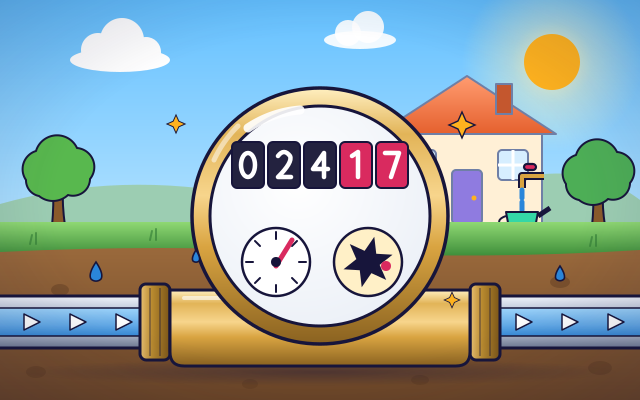
All the water for your home flows through one meter. A spinning wheel inside turns number wheels that count every liter.
The big idea: Every tap in the house gets its water through the meter. The water spins a wheel, and the wheel turns numbers that add up all the water used.
It's like a pinwheel with a counter: the harder you blow, the faster it spins, and a counter keeps track of every turn.
The interactive parts didn't load. The explanations below still work; try reloading the page.
How the house counts its water
- Turn on a tap and water comes out. It travels to your home through one pipe under the ground. But how does anyone know how much water you used?
- Right where the pipe reaches the house, there is a small box with a lid. Inside sits the water meter. Every drop for the house must flow through it.
- Inside the meter is a small wheel with paddles. Flowing water pushes the paddles and spins the wheel. A trickle turns it slowly. A rush of water makes it whirl.
- The wheel spins far too fast to count. So gears slow the turning down and roll a row of number wheels, like the ones that count distance on a bike. The numbers show liters.
- The kitchen tap, the shower, the washing machine and the hose all get their water through the same meter. When more of them run, the wheel spins faster and the total climbs faster.
- The numbers only ever go up. This month's number minus last month's number is the water you used. And if the tiny star still turns when every tap is off, there is a leak somewhere.
Inside a water meter
Tap each part of the meter. Watch what happens to the water and the numbers.
- Strainer. A small sieve sits where the water comes in. It catches grit and sand, so nothing can jam the wheel.
- Paddle wheel. The paddle wheel is the heart of the meter. Water pushes on its paddles, so it spins whenever water flows. Faster flow means faster spinning.
- Gears. A small gear on the wheel turns a bigger gear, which turns a bigger one still. Each gear turns more slowly than the one before.
- Number wheels. The number wheels show the total water used since the meter was new. When one wheel rolls from 9 to 0, it nudges the next wheel on by one.
- Leak star. The tiny star turns for even the smallest trickle. If it moves when all the taps are off, water is leaking somewhere in the house.
- Shutoff valve. Next to the meter is a valve with a handle. A grown-up can turn it to shut off all the water to the house, for example to fix a pipe.
- Radio sender. Many newer meters have a small radio. It sends the reading to the water company, so nobody has to lift the lid and look.
Run the taps and watch the meter
Tap the things in the house to turn the water on and off. Watch the pipes, the wheel in the meter and the total.
Experiment: The kitchen tap is running. Now you turn on the shower as well. What does the meter do?
- Turn on only the kitchen tap. How fast does the total climb?
- Now turn on the shower too.
- Turn everything off. What does the wheel do?
What we found: The meter adds up everything that flows. Two things running at once make the wheel spin faster and the total climb faster. With everything off, the wheel stops and the number stays put.
Turn on JavaScript to try it yourself.
Find the hidden leak
Everything is off, but the star on the meter still turns. Close the small red valves one at a time to find what is leaking. Then tap that thing and press Fix it.
Counting water by the liter
All the water your home uses comes in through one pipe, and the water meter sits right on that pipe. It does not matter whether you fill a glass, take a shower or water the garden. Every drop has to pass through the meter first.
Inside the meter is a little wheel with paddles. Flowing water pushes the paddles, the same way your breath spins a pinwheel. When a lot of water flows, the wheel whirls. When only a trickle flows, it creeps. When every tap is off, it stands still.
The wheel spins too quickly to count, so it turns a set of gears. Each gear turns more slowly than the last, until the final ones roll a row of number wheels. Those numbers are the total: all the water that has ever gone through. They never run backward.
To find out how much you used this month, someone reads the number now and takes away the number from last month. The meter can also catch leaks. A tiny star on the dial turns for even a few drops. If it moves when everything is turned off, water is escaping somewhere, and a grown-up should look for a dripping tap or a toilet that keeps running.
Key words
- Impeller
- The little paddle wheel inside the meter that water spins.
- Register
- The row of number wheels that shows the total water used.
- Flow rate
- How much water flows in a certain time, such as liters each minute.
- Reading
- The number on the meter at one moment. Usage is the new reading minus the old reading.
- Cubic meter
- A box of water one meter long, wide and high: 1,000 liters.
Check your thinking
-
What makes the paddle wheel inside the meter spin?
Show the answer
Water flowing through the meter. Flowing water pushes the paddles. No flow, no spin.
-
Every tap is off, but the little star on the meter is still turning. What does that tell you?
Show the answer
Water is flowing somewhere: there is a leak. The star only turns when water passes through the meter. With the taps off, that water must be leaking.
-
The meter showed 2,417 liters last week and 2,917 liters today. How much water was used?
Show the answer
500 liters. Take the old number away from the new number: 2,917 minus 2,417 is 500.
-
A tap gives 6 liters each minute and a shower gives 9. Both are running. How much passes the meter each minute?
Show the answer
15 liters. The flows add up: 6 plus 9 is 15 liters every minute.
-
A hidden leak lets 10 liters escape every hour. About how much is wasted in a week?
Show the answer
About 1,700 liters. 10 liters an hour is 240 liters a day, and 240 times 7 is 1,680 liters: more than ten full bathtubs.
You're a Money, shops & services expert!
You watched, looked inside, tried it, solved the challenge and went deeper. Pick another question below, or switch the age at the top to see this topic another way.
More about money, shops & services
 #499
Money, shops & services
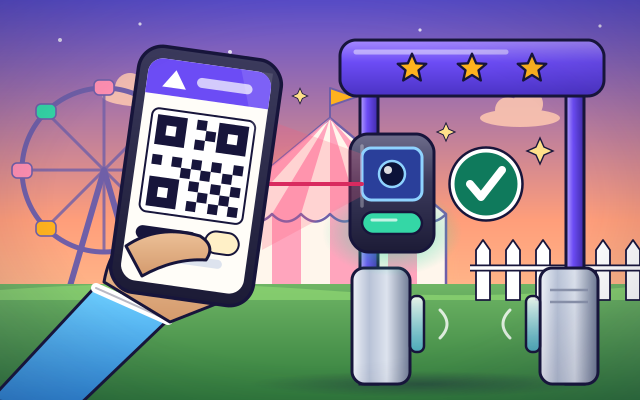
How do digital tickets open entry gates?
Scan a fictional ticket, verify its permission, and update its entry status.
#499
Money, shops & services
How do digital tickets open entry gates?
Scan a fictional ticket, verify its permission, and update its entry status.
 #500
Money, shops & services
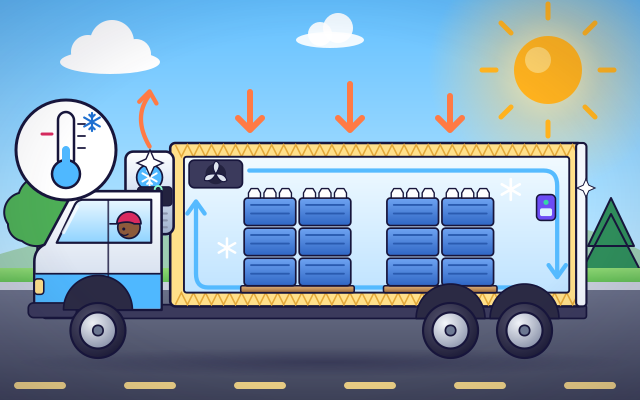
How does the cold chain keep food chilled during delivery?
Follow food through storage, refrigerated transport, shops, and temperature checks along its journey.
#500
Money, shops & services
How does the cold chain keep food chilled during delivery?
Follow food through storage, refrigerated transport, shops, and temperature checks along its journey.
 #481
Money, shops & services
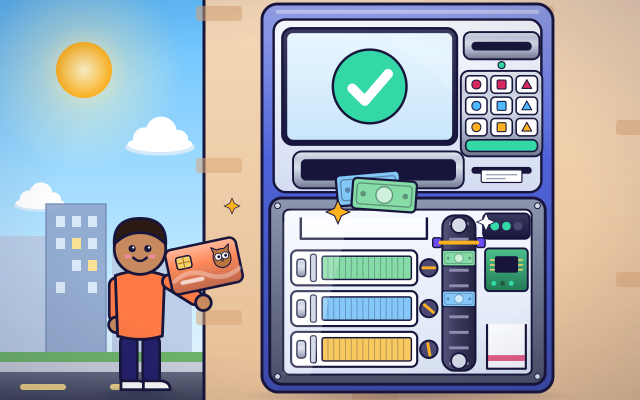
How does an ATM dispense money?
Follow card verification, account checks, note counting, and dispensing inside a transparent machine.
#481
Money, shops & services
How does an ATM dispense money?
Follow card verification, account checks, note counting, and dispensing inside a transparent machine.
 #482
Money, shops & services
How does a debit-card payment work?
Trace a purchase through merchant, payment network, and bank using pretend account balances.
#482
Money, shops & services
How does a debit-card payment work?
Trace a purchase through merchant, payment network, and bank using pretend account balances.
Keep exploring
Games to play next
- Coin MarketRun a pretend market stall: pay exactly, use the fewest coins, and give the right change.
- Festival PlannerPlace the stalls, book the acts and keep the budget — make every rule true.
- Supermarket StockerRoll out your cart and make every shelf ready for the day.
Guide for grown-ups
- How to start homeschooling: a step-by-step guide for familiesA guide for parents · 7 min read