How do flutes produce different notes?
A flute is a tube of singing air. Open and close its holes to make the air column longer or shorter, and hear the note change.
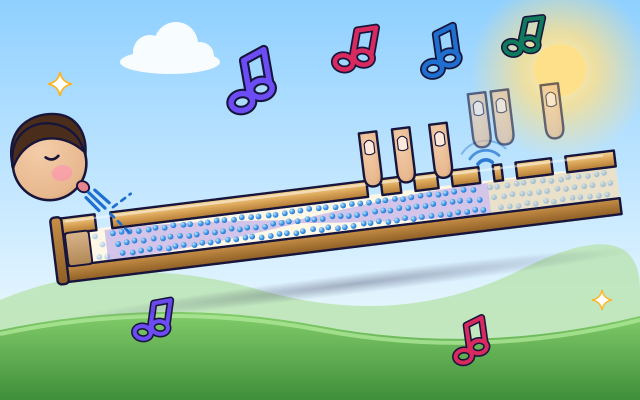
The big idea: Blowing across the mouth hole makes the air inside the flute shake back and forth. The shaking air reaches from the mouth hole to the first open hole. Open a hole nearer the mouth and that column of air gets shorter, so the note gets higher.
It's like blowing across the tops of bottles. A bottle with little air inside toots high, and one with lots of air hoots low. A flute's holes change how much air sings.
The interactive parts didn't load. The explanations below still work; try reloading the page.
A tube of singing air
- Ana plays her flute. It has no strings to pluck and no skin to hit. It is only a hollow tube with a row of holes. So what is shaking to make the sound?
- Ana does not blow into the flute. She blows across the mouth hole, so that her stream of air hits its far edge. The stream flips into the hole, then out of it, again and again, very quickly.
- Those flips push and pull on the air inside the tube. The whole column of air starts to slosh back and forth. It moves most at the open ends and hardly at all in the middle. That shaking air is the note.
- With every hole covered, the shaking air reaches all the way from the mouth hole to the far end. A long column of air takes a long time to slosh back and forth, so the note is low.
- Lift a finger and the air can escape through that hole. The shaking column now ends there, not at the far end. A shorter column sloshes faster, so the note is higher. The holes farther along hardly matter any more.
- Lift the fingers one at a time, starting from the far end, and the air column gets shorter step by step. Each step is the next note of a scale. Blow harder, and the same fingers can play higher notes still.
Look inside a flute
This flute is cut open so you can see the air inside. Tap each part.
- Air from the lips. The player squeezes the lips into a small gap and blows a thin, flat stream of air across the mouth hole, not down into it.
- The edge. The far side of the mouth hole is a sharp edge. The stream of air splits on it and flips in and out of the tube, pushing the air inside each time.
- The air column. The air inside the tube is what really makes the sound. It sloshes back and forth, moving most at the open ends and least in the middle.
- Finger holes. Each hole is a little door. Cover it and the air column carries on past it. Open it and the air column ends there, so the note is higher.
- The open end. The far end of the flute is open. When every hole is covered, the shaking air reaches right to this end and the flute plays its lowest note.
- Stopper. A cork plugs the tube just beyond the mouth hole. It closes that end, so the mouth hole itself is the open top of the air column.
Flute lab: open and close the holes
Tap the holes to cover and uncover them, then blow. Watch where the shaking air ends, and how long the air column is. What happens when you open a hole in the middle?
Experiment: All six holes are covered. You may open just one. Which hole gives the highest note?
- Cover all six holes and blow. Listen to the low note.
- Open only the hole at the far end, and blow. Then cover it again.
- Now open only the hole nearest the mouth, and blow. Which note is higher?
What we found: The hole nearest the mouth gives the highest note, because the shaking air column ends at the first open hole, and that makes it shortest. A short column of air sloshes back and forth quickly. Once a hole is open, the holes beyond it hardly change the note.
Turn on JavaScript to try it yourself.
Play the tune
Play a five-note tune. For each star on the note line, set your fingers so the air column is just the right length, then blow.
How a flute makes notes
A guitar has strings that shake, and a drum has a skin. In a flute, the thing that shakes is the air inside the tube. You cannot see it, but that column of air is the real instrument. The tube just holds it in shape.
To start the air shaking, the player blows a thin stream of air across the mouth hole so that it hits the far edge. The stream flips quickly in and out of the hole. Each flip gives the air in the tube a push, like pushing a friend on a swing. Soon the whole column of air is sloshing back and forth.
The note depends on how long the column of shaking air is. A long column sloshes slowly and makes a low note. A short column sloshes quickly and makes a high note. The column reaches from the mouth hole to the first open hole. So lifting fingers, one after another, makes the column shorter and the notes higher.
Recorders, tin whistles, pan pipes and the big pipes of an organ all work in a similar way. Blowing across a bottle does too, though the bottle comparison is not perfect: the air in a bottle bounces in and out of the neck like a spring, while the air in a flute sloshes along the whole tube.
Key words
- Air column
- The air inside a tube. In a flute, the air column vibrates to make the sound.
- Mouth hole
- The hole the player blows across. The stream of air splits on its far edge.
- Pitch
- How high or low a note sounds.
- Standing wave
- A wave that shakes in one place, like the air sloshing back and forth in a flute.
- Harmonic
- A higher note that the same tube can play when you blow harder.
- Frequency
- How many times something shakes each second.
Check your thinking
-
What vibrates to make the sound of a flute?
Show the answer
The air inside the tube. A flute has no strings or reeds. The column of air inside shakes back and forth.
-
Why does opening a hole make the note higher?
Show the answer
The shaking column of air ends at the open hole, so it is shorter. A shorter column of air sloshes back and forth more quickly, and faster shaking means a higher note.
-
How does a flute player start the air shaking?
Show the answer
By blowing a thin stream of air across the mouth hole onto its edge. The stream of air flips in and out of the hole, and each flip pushes the air inside.
-
All the holes are covered except the one nearest the mouth. Does it matter whether the other holes are open or closed?
Show the answer
Hardly at all: the air column already ends at the first open hole. The shaking air stops at the first open hole it meets. Holes beyond that point have very little effect.
-
Which pipe plays the lowest note?
Show the answer
The longest pipe. The longest column of air shakes the most slowly. That is why big organ pipes rumble and small ones whistle.
You're a Light & sound expert!
You watched, looked inside, tried it, solved the challenge and went deeper. Pick another question below, or switch the age at the top to see this topic another way.
More about light & sound
 #441
Light & sound
How do drums make different sounds?
Change membrane tension and drum size and compare vibration patterns.
#441
Light & sound
How do drums make different sounds?
Change membrane tension and drum size and compare vibration patterns.
 #442
Light & sound
How does soundproofing reduce noise?
Compare absorption, barriers, and gaps around a model noisy room.
#442
Light & sound
How does soundproofing reduce noise?
Compare absorption, barriers, and gaps around a model noisy room.
 #443
Light & sound
How do noise-canceling headphones work?
Combine a noise waveform with an opposing signal in a simplified model.
#443
Light & sound
How do noise-canceling headphones work?
Combine a noise waveform with an opposing signal in a simplified model.
 #444
Light & sound
Why does a passing siren change pitch?
Move a virtual sound source past a listener and inspect wave spacing.
#444
Light & sound
Why does a passing siren change pitch?
Move a virtual sound source past a listener and inspect wave spacing.
Keep exploring
Games to play next
- Listen and FindOlly whispers a clue or plays a sound. Can you find it in the picture?
- Mirror MazeBend a beam of light with mirrors to light up every crystal — in the right order.
- Shadow SculptorStack cubes under three lamps until every shadow matches the outline.
Guide for grown-ups
- How to start homeschooling: a step-by-step guide for familiesA guide for parents · 7 min read
Science games by grade
Science worksheets by grade
- Preschool Science Worksheets
- Pre-K Science Worksheets
- Kindergarten Science Worksheets
- 1st Grade Science Worksheets
- 2nd Grade Science Worksheets
- 3rd Grade Science Worksheets
- 4th Grade Science Worksheets
- 5th Grade Science Worksheets
- 6th Grade Science Worksheets
- 7th Grade Science Worksheets
- 8th Grade Science Worksheets