How does GPS know where you are?
Your phone listens to signals from satellites and uses how long they take to arrive to work out where you are.
The big idea: Each GPS satellite sends out the exact time. The signal takes a tiny moment to reach your phone. That delay tells the phone how far away each satellite is, and with three or more distances it can work out exactly where it is.
It's like
The interactive parts didn't load. The explanations below still work; try reloading the page.
Finding your way with satellites
- Mia is exploring a big island. Her phone's map shows a dot right where she is standing. How does the phone know?
- About thirty GPS satellites circle the Earth, about 20,000 kilometers up. Each one carries an incredibly accurate atomic clock.
- Each satellite keeps sending a radio message: who it is, where it is and the exact time. The phone checks when the message arrives.
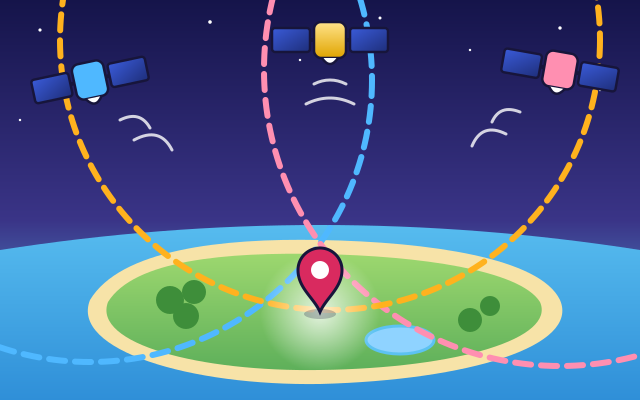
- Radio signals travel at the speed of light. If the phone knows how long the trip took, it knows how far away the satellite is. Mia must be somewhere on this circle.
- A second satellite gives another circle. They cross in two places. A third circle crosses at just one of them: that's where Mia is!
- As Mia walks, the travel times change a tiny bit, so the circles shift and the dot moves with her. The phone does this sum again every second.
The parts of the GPS system
GPS needs satellites, a ground station and a receiver. Tap each part to see what it does.
- GPS satellite. A GPS satellite is about the size of a car with its solar panels open. It circles the Earth twice a day, sending signals down to us.
- Atomic clock. Inside each satellite are atomic clocks. They are so accurate they would lose less than a second in hundreds of thousands of years.
- Solar panels. Big solar panels turn sunlight into electricity for the satellite. Batteries keep it running when it passes through Earth's shadow.
- Satellite antenna. The antenna points at the Earth and sends radio signals down to everyone below, all at once.
- Radio signal. The signal travels at the speed of light. It reaches the ground in less than a tenth of a second.
- Ground control station. Ground stations track every satellite. They check where each one is and send up corrections to keep the clocks and positions perfect.
- Receiver in the phone. A small GPS chip in the phone listens for satellites, times their signals and works out where you are. It only listens; it never sends anything to space.
- Map app. The GPS chip gives a position as numbers, called latitude and longitude. The map app puts a dot on the map at that spot.
Circles from signal times
Turn on satellites and drag Mia around. Each signal's travel time makes a circle. How many satellites do you need to find just one spot?
Experiment: How many satellites does the receiver need to find one exact spot on a flat map?
- Turn on satellite A only. Where could Mia be?
- Turn on satellite B. How many places could she be now?
- Turn on satellite C. Watch the pin drop!
What we found: One satellite tells you that you're somewhere on a circle. Two circles cross in two places. A third circle meets only one of those places, so three satellites find one exact spot on a flat map. (On the round Earth, receivers use four.)
Turn on JavaScript to try it yourself.
Track the robot dog
Bolt is running around the island with a GPS collar. Turn on enough satellites to find one spot, move the net there and press Catch!
Timing is everything
GPS stands for Global Positioning System. It is a group of about thirty satellites, high above the Earth, that keep sending out radio signals. Each signal says which satellite sent it, where that satellite is, and the exact time it was sent.
Radio signals travel at the speed of light, about 300,000 kilometers every second. That is so fast that the signal from a satellite reaches you in less than a tenth of a second. Your phone measures that tiny delay very carefully.
If the phone knows how long a signal took, it knows how far away that satellite is. That means you are somewhere on a circle around it. With circles from three satellites there is only one place they all meet, and that is where you are.
Timing has to be amazingly accurate. If the phone's clock were wrong by just one millionth of a second, its answer would be off by 300 meters! That's why GPS satellites carry atomic clocks, and why phones use an extra satellite to check their own clock.
Key words
- Satellite
- An object that orbits the Earth. GPS satellites orbit about 20,200 km up.
- Trilateration
- Finding a place from its distances to three or more known points.
- Atomic clock
- A clock that keeps time by counting the vibrations of atoms; extremely accurate.
- Speed of light
- About 300,000 kilometers every second. Radio signals travel this fast.
- Receiver
- The GPS chip in a phone or car that listens to satellites and calculates position.
Check your thinking
-
Where do GPS signals come from?
Show the answer
Satellites circling the Earth. About thirty GPS satellites send signals down to the whole Earth.
-
A signal from satellite A took longer to arrive than one from satellite B. What does that tell you?
Show the answer
Satellite A is farther away. Signals travel at the same speed, so a longer trip means a longer distance.
-
On a flat map, how many satellite circles do you need to find one exact spot?
Show the answer
Three. One circle gives a ring of places, two circles cross twice, and the third picks one spot.
-
A signal takes 0.07 seconds to arrive. About how far away is the satellite?
Show the answer
21,000 km. 300,000 km/s × 0.07 s = 21,000 km, about the height of the GPS orbits.
-
Why do GPS satellites need such accurate clocks?
Show the answer
A tiny timing mistake makes a big distance mistake. Signals go 300 meters in a millionth of a second, so clocks must be incredibly precise.
You're a Computers & communication expert!
You watched, looked inside, tried it, solved the challenge and went deeper. Pick another question below, or switch the age at the top to see this topic another way.
More about computers & communication
 #57
Computers & communication
How does a printer make colorful pictures?
Look inside an inkjet printer and build a picture from tiny cyan, magenta, yellow, and black dots. Switch colors on and off to compare results.
#57
Computers & communication
How does a printer make colorful pictures?
Look inside an inkjet printer and build a picture from tiny cyan, magenta, yellow, and black dots. Switch colors on and off to compare results.
 #58
Computers & communication
How do microphones and speakers work?
Watch sound vibrations become an electrical signal and turn back into vibrations. Compare quiet, loud, low-pitched, and high-pitched sounds.
#58
Computers & communication
How do microphones and speakers work?
Watch sound vibrations become an electrical signal and turn back into vibrations. Compare quiet, loud, low-pitched, and high-pitched sounds.
 #326
Computers & communication
How do QR codes store information?
Encode a short message into a square pattern and decode it onscreen.
#326
Computers & communication
How do QR codes store information?
Encode a short message into a square pattern and decode it onscreen.
 #327
Computers & communication
How does a search engine find websites?
Build a miniature index and compare which pages match different searches.
#327
Computers & communication
How does a search engine find websites?
Build a miniature index and compare which pages match different searches.
Keep exploring
Games to play next
- Route PlannerFind the shortest way around town, dodge closed roads, and measure trips with a scale bar.
- Globe ExplorerSpin a real 3D globe, flip to the flat map, and find continents, oceans and countries.
- Robot RoutesSnap together arrow, repeat and dance blocks to guide Bolt the robot home.
Guide for grown-ups
- How to start homeschooling: a step-by-step guide for familiesA guide for parents · 7 min read
Coding games by grade
Computer skills worksheets by grade
- Preschool Computer Skills Worksheets
- Pre-K Computer Skills Worksheets
- Kindergarten Computer Skills Worksheets
- 1st Grade Computer Skills Worksheets
- 2nd Grade Computer Skills Worksheets
- 3rd Grade Computer Skills Worksheets
- 4th Grade Computer Skills Worksheets
- 5th Grade Computer Skills Worksheets
- 6th Grade Computer Skills Worksheets
- 7th Grade Computer Skills Worksheets
- 8th Grade Computer Skills Worksheets