How do microscopes reveal tiny details?
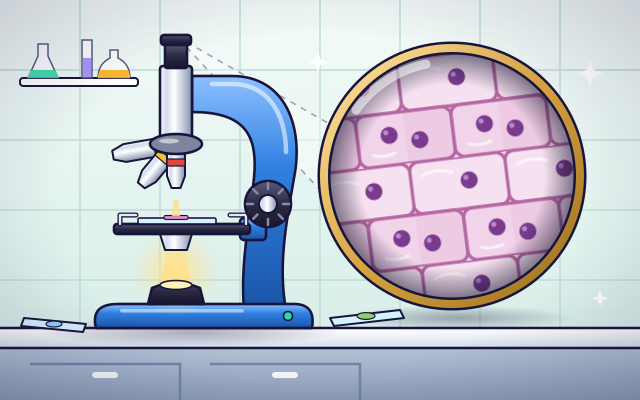
A microscope shines light through a thin sample and uses two lenses, one after the other, to make tiny details big enough to see.
The big idea: A lens bends the light coming from a sample so it spreads out and looks bigger. A microscope uses two lenses in a row, so the picture is made bigger twice.
It's like using a magnifying glass to look at a picture that another magnifying glass has already made bigger.
The interactive parts didn't load. The explanations below still work; try reloading the page.
How a microscope makes tiny things big
- Nia peels a thin, see-through skin from an onion. To her eyes it looks plain and smooth. Its parts are far too small to see. She needs a microscope.
- The skin goes on a glass slide, on the flat stage. A lamp underneath shines light straight up through the thin sample and into the lens above it.
- Just above the slide sits a small, strongly curved lens called the objective. It bends the light from each point of the sample so the rays spread into a bigger picture inside the tube.
- At the top of the tube is a second lens, the eyepiece. It works like a magnifying glass on the picture the first lens made, so the picture gets bigger again.
- At first the picture is a blur. Nia turns the focus knob, which moves the stage up and down a tiny bit. When the sample is exactly the right distance from the lens, the picture snaps sharp.
- Now Nia can see it: the onion skin is built from tiny boxes packed like bricks. They are cells, and the dark dot in each one is its control center, the nucleus.
The parts of a microscope
Tap each part. Follow the light from the lamp at the bottom all the way up to your eye.
- Lamp. The lamp in the base shines light upward through the hole in the stage. Without it the thin sample would be too dark to see.
- Diaphragm. Under the stage is a ring with a hole that can open wide or close small. It controls how much light reaches the sample.
- Slide and stage. The sample sits on a strip of glass called a slide. The slide rests on the flat stage, over a hole that lets the light through, and clips hold it still.
- Objective lenses. Three objective lenses sit on a wheel that turns. The short one makes things a little bigger. The long one makes them much bigger. You click the one you want into place.
- Body tube. The tube holds the two lenses exactly the right distance apart and keeps stray light out. Inside it, the first lens makes its bigger picture.
- Eyepiece. You look into the eyepiece at the top. It is a magnifying lens that makes the picture from the first lens about ten times bigger again.
- Focus knobs. The big knob moves the stage up and down quickly to find the picture. The small knob moves it very slowly to make the picture perfectly sharp.
Focus, move and zoom
Turn the focus knob until the picture is sharp. Move the slide to look around. Then switch to a stronger lens. What changes?
Experiment: You switch from the weakest lens to the strongest lens. What happens to the picture?
- Use the weakest lens and turn the focus knob until the picture is sharp.
- Move the slide so something interesting is in the middle.
- Switch to the strongest lens and focus again. Compare what you see.
What we found: A stronger lens shows a smaller part of the sample, made much bigger. That is why you find things with the weak lens first and then zoom in. The strong lens also needs more exact focus.
Turn on JavaScript to try it yourself.
Photograph the water bear
Find the water bear, get it in the middle, then zoom in and take a sharp photo. The stronger the lens, the more stars.
How two lenses make tiny things big
A lens is a piece of glass that is thicker in the middle than at the edges. When light passes through it, the light bends. Light from one tiny point of a sample spreads out, goes through the lens and is bent so that it seems to come from a much bigger picture. A magnifying glass is one lens. It can make things look about two to ten times bigger.
A microscope uses two lenses, one after the other. The first one, the objective, sits very close to the sample and makes a bigger picture inside the tube. The second one, the eyepiece, magnifies that picture again. To find the total, you multiply: a 40 times objective and a 10 times eyepiece make things look 400 times bigger. A hair would look as wide as a tree trunk.
There is a price for zooming in. A stronger lens shows a smaller patch of the sample, so it is easy to lose what you were looking at. The picture gets dimmer, because the same light is spread over a bigger picture. And the focus must be more exact. That is why scientists start with the weakest lens, find the thing, put it in the middle and only then switch up.
Our comparison with two magnifying glasses is not perfect. In a real microscope the first lens flips the picture upside down and back to front. If you push the slide to the left, the picture moves to the right!
Key words
- Lens
- A curved piece of glass or plastic that bends light.
- Objective
- The lens closest to the sample. It makes the first, enlarged image inside the tube.
- Eyepiece
- The lens you look into. It magnifies the image made by the objective.
- Magnification
- How many times bigger something looks.
- Field of view
- The width of the patch of sample you can see at one time.
- Resolution
- How close two tiny dots can be and still look like two dots, not one.
- Cell
- The tiny building block that all living things are made of.
Check your thinking
-
What does a lens do to light to make things look bigger?
Show the answer
It bends the light. A lens bends light so the rays spread out and seem to come from a bigger picture.
-
The picture is blurry. Which part do you turn?
Show the answer
The focus knob. The focus knob moves the stage until the sample is exactly the right distance from the lens.
-
A microscope has a 10 times eyepiece. You click the 40 times objective into place. How much bigger do things look?
Show the answer
400 times. You multiply the two lenses: 40 times 10 is 400.
-
Why do scientists look for something with the weakest lens first?
Show the answer
It shows the biggest patch of the sample, so things are easy to find. The weak lens shows the most of the slide. Once the thing is in the middle, you can zoom in without losing it.
-
Why can a light microscope not show details much smaller than 0.2 micrometers, however strong its lenses are?
Show the answer
Light is a wave and spreads out, so each point becomes a small blur. Diffraction blurs every point into a spot about half a wavelength wide. More magnification only enlarges that blur.
-
Why must a sample for this kind of microscope be very thin?
Show the answer
So light can shine through it. The lamp is under the sample. Light has to pass up through it to reach the lenses.
You're a Measuring & instruments expert!
You watched, looked inside, tried it, solved the challenge and went deeper. Pick another question below, or switch the age at the top to see this topic another way.
More about measuring & instruments
 #392
Measuring & instruments
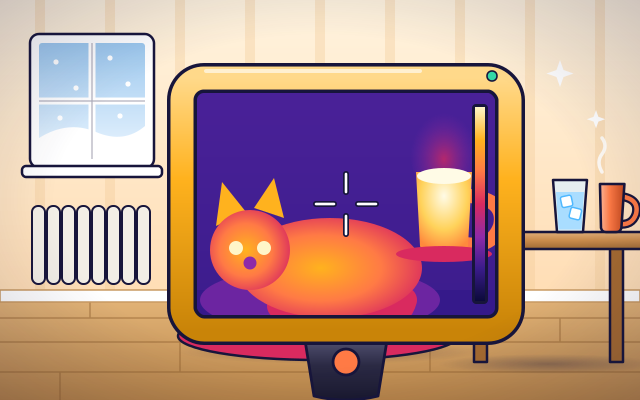
How do thermal cameras show heat patterns?
Compare familiar objects in visible-light and simulated infrared images.
#392
Measuring & instruments
How do thermal cameras show heat patterns?
Compare familiar objects in visible-light and simulated infrared images.
 #393
Measuring & instruments
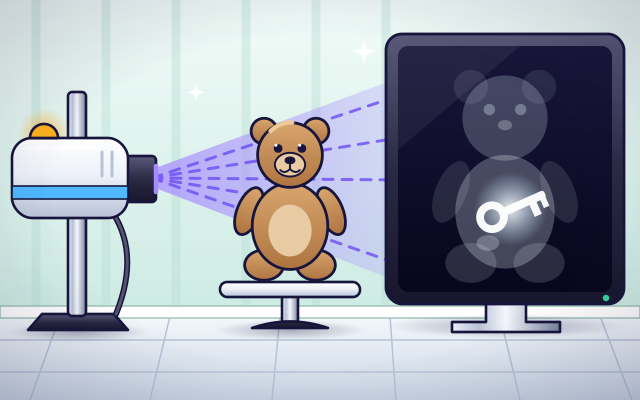
How do X-ray machines look inside objects?
Send simulated X-rays through different materials and compare their resulting images.
#393
Measuring & instruments
How do X-ray machines look inside objects?
Send simulated X-rays through different materials and compare their resulting images.
 #394
Measuring & instruments
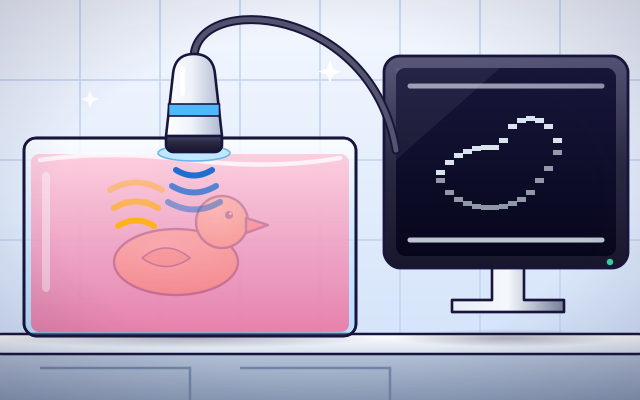
How do ultrasound scanners create pictures?
Send sound pulses into a model and build an image from returning echoes.
#394
Measuring & instruments
How do ultrasound scanners create pictures?
Send sound pulses into a model and build an image from returning echoes.
 #395
Measuring & instruments
How does an MRI scanner see inside the body?
Explore magnets, radio signals, and the assembly of image slices in a simplified scanner.
#395
Measuring & instruments
How does an MRI scanner see inside the body?
Explore magnets, radio signals, and the assembly of image slices in a simplified scanner.
Keep exploring
Games to play next
- Clock TowerKeep the town on time: set the tower clock's hands just right.
- Mapmaker QuestFollow directions to make a map, then read its legend, compass rose and scale.
- Data DetectiveRead the clues hidden in graphs — and build your own.
Guide for grown-ups
- How to start homeschooling: a step-by-step guide for familiesA guide for parents · 7 min read
Science games by grade
Science worksheets by grade
- Preschool Science Worksheets
- Pre-K Science Worksheets
- Kindergarten Science Worksheets
- 1st Grade Science Worksheets
- 2nd Grade Science Worksheets
- 3rd Grade Science Worksheets
- 4th Grade Science Worksheets
- 5th Grade Science Worksheets
- 6th Grade Science Worksheets
- 7th Grade Science Worksheets
- 8th Grade Science Worksheets