How do ultrasound scanners create pictures?
An ultrasound scanner sends very high sounds into something and listens for the echoes. The time each echo takes tells how deep a thing is, so the echoes can draw a picture.
The big idea: Sound bounces off the edges of things, like a ball off a wall. An echo that comes back quickly came from close by. One that takes longer came from deeper down. A computer turns those times into dots on a screen.
It's like dropping a stone into a well and counting until you hear the splash. The longer the wait, the deeper the well.
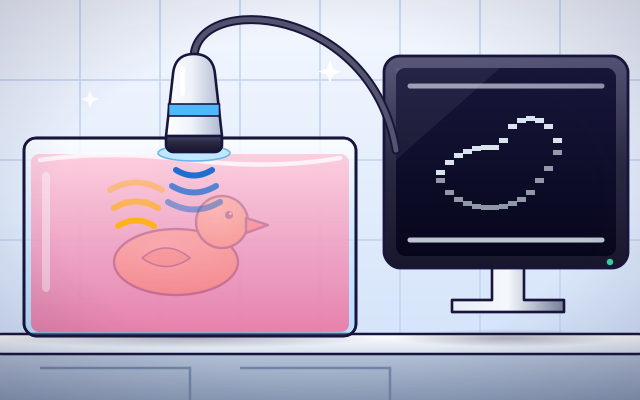
The interactive parts didn't load. The explanations below still work; try reloading the page.
Seeing with sound
- A toy is hidden inside this wobbly block of jelly. You cannot see through the jelly, and nobody wants to cut it open. Is there a way to look inside without touching the toy?
- Think of an echo. Maya shouts at a cliff. The sound travels to the rock, bounces off and comes back to her ears. If the cliff were closer, the echo would come back sooner.
- A scanner uses the same idea. Its probe presses on the jelly and sends out short bursts of sound, much too high to hear. That is ultrasound. A little gel lets the sound slip in without an air gap.
- When the pulse meets the toy, part of it bounces back as an echo. The rest keeps going, through the toy to its far side and on to the bottom of the tank. Every edge sends back its own echo.
- The probe listens for the echoes and a computer times them. An echo that returns quickly gets a dot near the top of the screen. One that takes longer gets a dot lower down. Strong echoes make brighter dots.
- One line of dots is not a picture. But slide the probe along, pinging all the way, and line after line builds an outline. It is a rubber duck! Doctors use the same idea to look at hearts, tummies and muscles. It does not hurt at all.
Inside an ultrasound scanner
Tap each part of the probe and the machine to see what it does.
- Crystals. A row of special crystals sits near the tip. A zap of electricity makes each crystal shake and send out sound. When an echo comes back and shakes the crystal, it makes a tiny bit of electricity. So the same crystal can talk and listen.
- Damping block. Behind the crystals is a block that soaks up their shaking, like a hand on a ringing bell. That keeps each burst of sound very short.
- Rubber lens. The smooth rubber tip touches the surface. It is shaped to squeeze the sound into a narrow beam, so the scanner knows exactly where each echo came from.
- Gel. Sound hates crossing from the probe into air: nearly all of it bounces back. A layer of watery gel fills the gap so the sound can pass in and the echoes can pass out.
- Cable. The cable carries electric zaps down to the crystals and carries the tiny echo signals back up to the machine.
- Computer. The computer measures how long every echo took and how strong it was. From the time it works out the depth.
- Screen. The screen shows a dot for every echo: higher for near things, lower for deep things, brighter for strong echoes. Together the dots draw the hidden thing.
Build a picture from echoes
Send one slow ping and watch the echoes come back. Then slide the probe along the jelly to build the whole picture.
Experiment: One toy is near the top of the jelly and another is deep down. You send a ping above each. Which echo comes back first?
- Put the probe above the toy near the top and send one slow ping.
- Move the probe above the deep toy and send another slow ping.
- Now slide the probe from one end to the other and watch the picture grow.
What we found: The echo from the toy near the top comes back first, because its sound has a shorter trip. The scanner uses that: a short wait means a dot near the top of the screen, a long wait means a dot lower down.
Turn on JavaScript to try it yourself.
Two hidden toys
Two toys are hidden, one near the top and one deep down. Scan the jelly, then say which toy is where.
How echoes become a picture
Sound is a wobble that travels through things: through air, through water, through jelly and through you. When sound reaches the edge of something different, some of it bounces back. That returning sound is an echo. You hear echoes in a tunnel or a big empty hall.
Ultrasound is sound that is too high for people to hear. A scanner's probe has tiny crystals that shake millions of times a second to send a very short burst of ultrasound. Then the probe goes quiet and listens. Each edge the burst meets, such as the top of a toy, the bottom of a toy and the bottom of the tank, sends back its own echo.
The scanner knows how fast sound travels, so it can turn waiting time into distance. A quick echo came from near the surface. A slow echo came from deep down. It is like our stone in the well, except that the scanner counts in millionths of a second. For each echo the computer puts a dot on the screen at the right depth. Many beams side by side make many lines of dots, and the lines make a picture.
Doctors use ultrasound to look at soft parts inside the body, such as the heart beating or a muscle moving. The person lies still, some cool gel goes on the skin, and the probe glides over it. It does not hurt, and it uses only sound.
Key words
- Ultrasound
- Sound that is too high for people to hear.
- Echo
- Sound that has bounced off something and come back.
- Probe
- The hand-held part of the scanner that sends the sound and listens for the echoes.
- Frequency
- How many times something shakes each second. A high frequency is a high sound.
- Reflect
- To bounce back. Sound reflects where one material meets a different one.
- Acoustic shadow
- The dark strip behind something that reflects nearly all the sound, so nothing deeper sends an echo.
Check your thinking
-
How does an ultrasound scanner know how deep something is?
Show the answer
It times how long the echo takes to come back. A quick echo came from near the surface. A slow one came from deep down.
-
Two echoes come back. One arrives quickly and one arrives later. What made the later one?
Show the answer
Something deeper down. The sound that went deeper had a longer trip there and back, so its echo arrives later.
-
Why is gel put between the probe and the surface?
Show the answer
To get rid of the air gap, so the sound can get in. Sound bounces off air. The gel fills the gap so the sound passes into the jelly and the echoes pass back.
-
A hard marble is in the jelly. Why is there a dark stripe on the screen below it?
Show the answer
The marble bounces back nearly all the sound, so none reaches what is underneath. No sound gets past the marble, so no echoes come from below it. That dark stripe is called a shadow.
-
Why does the damping block make each pulse only two or three cycles long?
Show the answer
Short pulses can separate echoes from boundaries that are close together. If the pulse were long, echoes from two nearby boundaries would overlap and blur into one. Short pulses give sharp depth detail.
-
What does an ultrasound scanner send into the thing it is looking at?
Show the answer
Very high sound. Ultrasound is just sound, too high to hear. The scanner listens to its echoes.
You're a Measuring & instruments expert!
You watched, looked inside, tried it, solved the challenge and went deeper. Pick another question below, or switch the age at the top to see this topic another way.
More about measuring & instruments
 #395
Measuring & instruments
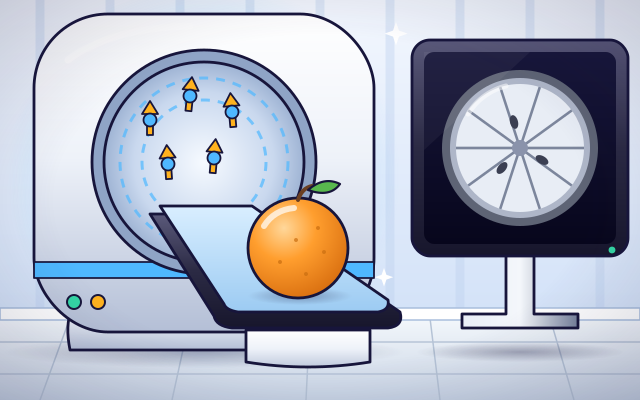
How does an MRI scanner see inside the body?
Explore magnets, radio signals, and the assembly of image slices in a simplified scanner.
#395
Measuring & instruments
How does an MRI scanner see inside the body?
Explore magnets, radio signals, and the assembly of image slices in a simplified scanner.
 #396
Measuring & instruments
How do centrifuges separate samples?
Spin balanced virtual samples and watch components separate according to physical properties.
#396
Measuring & instruments
How do centrifuges separate samples?
Spin balanced virtual samples and watch components separate according to physical properties.
 #397
Measuring & instruments
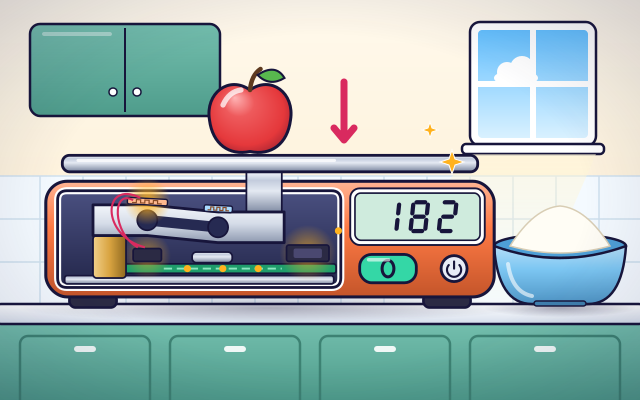
How do digital scales measure weight?
Place objects on a scale and follow sensor changes into a displayed measurement.
#397
Measuring & instruments
How do digital scales measure weight?
Place objects on a scale and follow sensor changes into a displayed measurement.
 #400
Measuring & instruments
How does radar locate distant objects?
Send radio pulses and use returning signals to estimate object positions.
#400
Measuring & instruments
How does radar locate distant objects?
Send radio pulses and use returning signals to estimate object positions.
Keep exploring
Games to play next
- Body ExplorerTap, match and label your way around the amazing human body.
- Clock TowerKeep the town on time: set the tower clock's hands just right.
- Mapmaker QuestFollow directions to make a map, then read its legend, compass rose and scale.
Guide for grown-ups
- How to start homeschooling: a step-by-step guide for familiesA guide for parents · 7 min read
Science games by grade
Science worksheets by grade
- Preschool Science Worksheets
- Pre-K Science Worksheets
- Kindergarten Science Worksheets
- 1st Grade Science Worksheets
- 2nd Grade Science Worksheets
- 3rd Grade Science Worksheets
- 4th Grade Science Worksheets
- 5th Grade Science Worksheets
- 6th Grade Science Worksheets
- 7th Grade Science Worksheets
- 8th Grade Science Worksheets