How are rubber tires made?
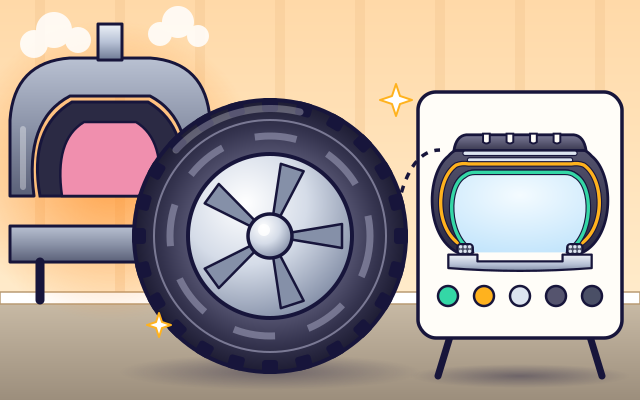
Rubber, fabric cords and steel wires are wrapped in layers on a drum, then pressed and baked in a mold that gives the tire its pattern.
The big idea: A tire is not just rubber. Hidden inside are fabric cords and steel wires that give it strength, and a liner that holds the air. Baking the soft tire in a hot mold, called curing, turns the sticky rubber springy and tough.
It's like a layer cake baked in a patterned tin: stack the layers, bake them into one piece, and the tin presses its pattern into the outside.
The interactive parts didn't load. The explanations below still work; try reloading the page.
How a tire is built and baked
- A tire has to carry a whole car, grip the road in the rain and last for years. Plain rubber could never do that. So what is hiding inside?
- Rubber starts as milky sap from rubber trees, with man-made rubber added. It is mixed with a black powder called carbon black, which makes it tough, and a little sulfur for later.
- On a spinning drum, a builder wraps the layers one by one: an airtight liner, fabric cords, two hoops of steel wire called beads, belts of steel, and last the thick tread.
- The soft tire is called a green tire. It goes into a mold like a giant waffle iron. A rubber bag inside puffs up and presses the tire hard against the patterned walls.
- Heat makes the sulfur tie the long, stringy rubber molecules together, like knots in a net. The sticky, squashy rubber becomes springy and strong. This is called vulcanizing.
- The mold opens, and out comes a finished tire with its tread pattern pressed in. Every tire is checked carefully. Then it is ready to roll.
Look inside a tire
This is a slice cut through a tire. Tap each layer to find out what it does.
- Tread. The tread is the thick outer layer that touches the road. Its rubber is mixed to grip well and wear away slowly.
- Grooves. Grooves are channels cut into the tread. On a wet road they give the water somewhere to go, so the rubber can still touch the road.
- Steel belts. Under the tread lie belts made of thin steel wires. They hold the tread flat against the road and help stop sharp things poking through.
- Body cords. Strong fabric cords run through the tire from one side to the other. They are the tire's skeleton: they hold in the air's push so the rubber does not balloon.
- Inner liner. The inner liner is a thin layer of special rubber that air can hardly pass through. It does the job that inner tubes used to do.
- Sidewall. The sidewall is the side of the tire. It bends every time the wheel turns and soaks up small bumps. The tire's size is printed on it.
- Bead. The bead is a hoop of strong steel wires at each inner edge. It cannot stretch, so it holds the tire tightly on the metal wheel.
What is each layer for?
Tap the layers to build a tire, then pump it up. Next, take one layer off and pump again. What goes wrong without it?
Experiment: What happens when you pump up a tire that has no cords inside?
- Build a tire with every layer and pump it up.
- Tap the body cords to take them off, then pump again.
- Try leaving out other layers, one at a time.
What we found: Without cords, the rubber stretches and the tire swells like a balloon. Every layer has a job: the liner holds the air, the cords hold the shape, the beads grip the wheel, the belts keep the tread flat, and the tread grips the road.
Turn on JavaScript to try it yourself.
Cure it just right
Puff up the bag, pick a heat, and open the mold when the cure pointer is in the green zone. Too soon is sticky, too late is brittle.
Layers, then heat
Rubber is wonderfully stretchy, but that is also its problem. Pump air into a plain rubber ring and it just swells, like a balloon. A tire needs to hold its shape while carrying a heavy car, so it is built from many layers, and each one has its own job.
The inner liner keeps the air in. Fabric cords run through the body like a skeleton and stop the tire from ballooning. Two hoops of steel wire, the beads, hold the tire tight on the wheel. Steel belts keep the tread flat, and the thick tread on the outside grips the road. The layers are wrapped on a spinning drum, one after another.
At this point the tire is soft and sticky, and it has no pattern. It is called a green tire, even though it is black. It goes into a hot mold, and a rubber bag inside puffs up and squeezes it against the mold's patterned walls. This is where the layer cake picture fits best: the layers bake into one piece.
But baking a tire does something baking a cake does not. Rubber is made of long, tangled molecules, like cooked spaghetti. Heat makes sulfur tie those strands together. Now they cannot slide apart, so the rubber springs back every time it is squashed. That change is called vulcanizing, and it is what makes a tire tough and bouncy.
Key words
- Green tire
- A tire that has been built but not yet baked. It is soft, sticky and has no pattern.
- Vulcanizing
- Baking rubber with sulfur so that it becomes springy and strong. Also called curing.
- Cross-link
- A tiny bridge that ties two rubber molecules together.
- Bead
- The hoop of steel wire at the inner edge of a tire that holds it on the wheel.
- Composite
- Something made from two or more materials that work together, like rubber with cords inside.
- Contact patch
- The part of the tire that is touching the road at any moment. It is about the size of your hand.
Check your thinking
-
Why are there fabric cords inside a tire?
Show the answer
To stop the rubber swelling like a balloon. Rubber stretches easily. The cords do not, so they hold the tire's shape against the push of the air.
-
What does baking the tire in the mold do to the rubber?
Show the answer
It ties the rubber molecules together so the rubber is springy. Heat makes sulfur link the long rubber molecules. Linked molecules spring back instead of sliding apart.
-
A tire was taken out of the mold much too early. What is it like?
Show the answer
Soft and sticky, with a weak pattern. Without enough heat and time, too few molecules are tied together, so the rubber is still squashy.
-
A wheel carries 3,000 N. At 300 kPa, the simple model gives a contact patch of 100 square centimeters. What is it at 150 kPa?
Show the answer
200 square centimeters. Area is load divided by pressure. Half the pressure needs twice the area to carry the same load.
-
What are the grooves in the tread for?
Show the answer
They give water somewhere to go on a wet road. Water escapes along the grooves, so the rubber can still press on the road.
-
Which layer keeps the air from leaking out?
Show the answer
The inner liner. The liner is a thin skin of special rubber that air can hardly get through.
You're a Making everyday things expert!
You watched, looked inside, tried it, solved the challenge and went deeper. Pick another question below, or switch the age at the top to see this topic another way.
More about making everyday things
 #304
Making everyday things
How are shoes made?
Assemble upper pieces around a foot-shaped form and attach the sole.
#304
Making everyday things
How are shoes made?
Assemble upper pieces around a foot-shaped form and attach the sole.
 #305
Making everyday things
How is paint made?
Combine pigments and binders and compare how different mixtures cover surfaces.
#305
Making everyday things
How is paint made?
Combine pigments and binders and compare how different mixtures cover surfaces.
 #306
Making everyday things
How is sticky tape made?
Coat a backing with adhesive, roll it onto a core, and cut different widths.
#306
Making everyday things
How is sticky tape made?
Coat a backing with adhesive, roll it onto a core, and cut different widths.
 #307
Making everyday things
How are plastic bottles made?
Watch a heated starter piece expand against a mold using compressed air.
#307
Making everyday things
How are plastic bottles made?
Watch a heated starter piece expand against a mold using compressed air.
Keep exploring
Games to play next
- Machine RepairFix levers, pulleys, gears and ramps so every contraption works.
- Geometry Architect 3DCount, build and fold solids like a real architect.
- Sorting FactoryTurn a work order into if/else rules and watch the conveyor sort every item.
Guide for grown-ups
- How to start homeschooling: a step-by-step guide for familiesA guide for parents · 7 min read
Science games by grade
Science worksheets by grade
- Preschool Science Worksheets
- Pre-K Science Worksheets
- Kindergarten Science Worksheets
- 1st Grade Science Worksheets
- 2nd Grade Science Worksheets
- 3rd Grade Science Worksheets
- 4th Grade Science Worksheets
- 5th Grade Science Worksheets
- 6th Grade Science Worksheets
- 7th Grade Science Worksheets
- 8th Grade Science Worksheets